What Pages Should a Tree Service Website Have?
A tree service website should have focused pages for pruning, removal, emergency storm work, stump grinding, plant health, cabling or bracing when offered, commercial work, service areas, credentials, project proof, pricing context, FAQs, and estimates.
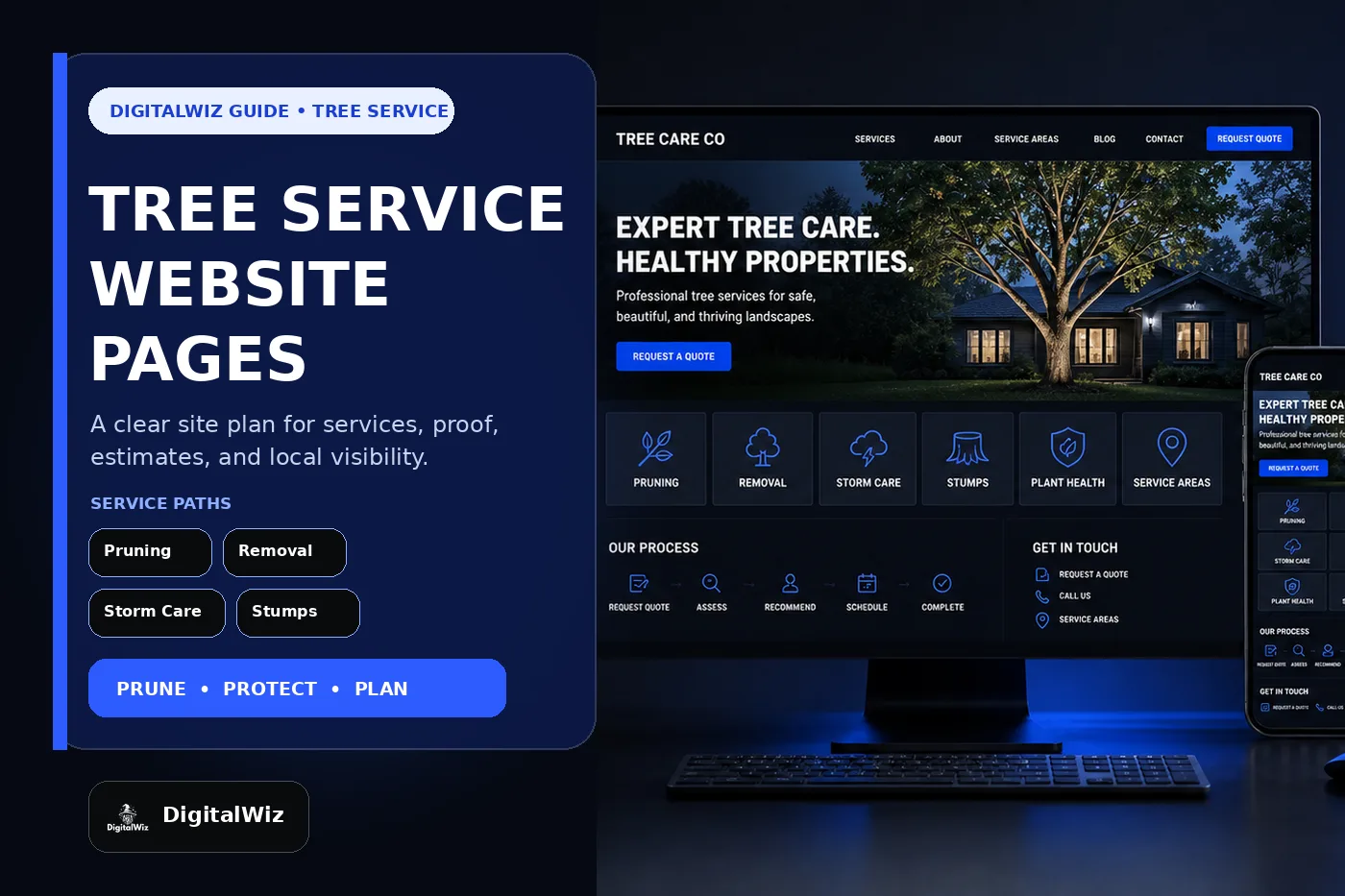
The direct answer
A tree service website should have focused pages for the work customers actually compare: tree pruning, tree removal, emergency or storm response, stump grinding, tree and shrub health care, cabling or bracing when offered, planting, commercial tree care, service areas, credentials, project proof, pricing context, FAQs, and estimates. One catch-all services page makes a homeowner sort out the crew's capabilities while looking at a leaning tree or a blocked driveway.
For a Charlotte or NC tree company, those paths should separate planned care from an urgent hazard. Pruning a mature oak, removing a dead pine, clearing storm damage, grinding a stump, diagnosing decline, and managing trees across a commercial property are different jobs. The equipment, site access, risk, timing, crew, cleanup, and decision process can all change.
Keep the structure useful. Give each real service a strong page, explain how an assessment works, state actual availability and coverage, show legitimate credentials and permission-safe projects, and make requesting an estimate easy from a phone. That gives the website, Search Visibility, and Paid Ads Management clear destinations instead of sending every visitor to the homepage.
- Separate pruning, removal, storm work, stumps, plant health, and commercial care when the customer journey differs.
- Explain assessment, access, equipment, cleanup, safety boundaries, and next steps in plain language.
- Publish accurate credentials, insurance language, hours, emergency availability, and service areas.
- Track calls, forms, site visits, estimates, approved work, job type, and lead quality.
Build pages around the tree work people need
Start with the calls the company is trained, insured, equipped, and staffed to handle. For many residential tree services, that means pruning, removal, storm cleanup, stump grinding, tree risk assessments within the team's qualifications, plant health care, cabling or bracing, and planting. A company that handles crane work, utility-clearance work, land clearing, right-of-way work, municipalities, HOAs, or commercial properties may need separate pages for those buyers and scopes.
Each core page should answer the first questions quickly: do you handle this situation, do you serve this address, what happens during the first visit, what access does the crew need, what may be included in the estimate, how is debris handled, and what should the customer do next? A gallery of huge removals may look impressive, but it does not explain whether the company is a fit for careful structural pruning or a recurring commercial program.
Build these revenue pages before filling the blog with generic tree facts. Service pages and blog posts have different jobs in local SEO. An article can explain when to schedule pruning or what may affect a declining tree. The service page still has to carry the scope, qualification, process, proof, and estimate conversation.
- Pruning page: goals, inspection, pruning types, species and season context, access, debris, and matching projects.
- Removal page: assessment, access, rigging or equipment context, property protection, haul-off, stump options, and limits.
- Storm page: real response hours, triage process, blocked-access priorities, documentation, cleanup, and follow-up.
- Plant health page: visible concerns, diagnostic boundaries, soil or site context, treatment options, monitoring, and qualified staff.
Separate planned care from emergency tree work
Planned tree care gives the customer time to compare. A pruning or removal page can explain the site visit, written scope, tree identification, access, nearby structures, utility concerns, equipment placement, debris handling, stump work, scheduling, and payment process. It should also say what is not included instead of leaving fence removal, permit research, traffic control, firewood, or landscape repair to become a surprise later.
Storm visitors have a different problem. They may be dealing with a tree on a roof, blocked access, hanging limbs, damaged utilities, or several properties affected at once. Put the current phone number, actual emergency availability, service area, and first-call expectations near the top. Do not advertise 24/7 response, immediate arrival, crane availability, or priority service unless the operation can support those claims when a regional storm hits.
Safety language needs clear boundaries. Tell visitors to stay away from fallen or suspended limbs, unstable trees, and any area near damaged utility lines; follow emergency-service and utility instructions; and avoid entering a hazardous work zone. The website should not coach a homeowner through cutting, pulling, climbing, or moving storm-damaged trees. Tree work—especially large-tree pruning and removal—can be dangerous and belongs with trained, properly equipped professionals.
- Use distinct contact paths for routine estimates, active storm hazards, commercial accounts, and plant-health questions.
- State what information and safe-distance photos help the office triage a request.
- Keep emergency hours and response wording accurate across the site, ads, and Google Business Profile.
- Never turn an urgent landing page into do-it-yourself cutting, climbing, rigging, or power-line advice.
Explain estimates and cost drivers honestly
Tree work pricing changes with the tree and the site. Size, species, condition, lean, canopy spread, nearby structures, utility proximity, access, grade, rigging, climbing, lift or crane needs, crew size, traffic control, permits, debris volume, wood handling, stump size, root flare, haul-off, travel, and emergency timing can all move the estimate. A calculator built around trunk diameter alone can set the wrong expectation.
The website can still be useful. Some companies can publish minimum service charges, consultation fees, stump-grinding minimums, or broad planning ranges. Others are better served by explaining what the estimator evaluates, what a written scope includes, which photos help before the visit, and which conditions require an in-person look. Either approach is stronger than hiding every detail behind a form.
Clarify the choices that commonly change a proposal: haul all wood or leave logs, chip brush or remove it, grind the stump or cut flush, remove grindings or leave them, include permit handling, protect turf, repair access damage, or schedule work outside normal hours. Use the framework in Should I Put Prices on My Business Website? to add context without pretending every tree has one price.
- Explain the largest labor, equipment, access, disposal, stump, permit, and emergency cost drivers.
- Use ranges, fees, or minimums only when the company can support and update them.
- Define what the estimate includes, what is optional, and how hidden or changed conditions are handled.
- Do not diagnose tree stability, decay, root failure, utility clearance, or equipment needs from one photo.
Use service-area pages that reflect real crew coverage
Tree companies have real geographic limits. Crew travel, dump sites, equipment transport, emergency demand, repeat plant-health visits, permits, commercial schedules, and project size all affect coverage. State the core service area clearly. If routine pruning, storm response, plant health, and large crane-assisted work have different ranges, spell that out instead of publishing one giant list of towns.
A Charlotte-area tree service may genuinely work in Charlotte, Matthews, Indian Trail, Waxhaw, Monroe, Concord, Huntersville, Gastonia, Fort Mill, or nearby markets. A dedicated location page makes sense when the company can add original information: actual availability, local project examples, common property or tree context, municipal links where useful, commercial capabilities, and the services offered in that market.
Cloning one paragraph across every city does not make the company more local. Google's Business Profile guidance describes local results as mainly shaped by relevance, distance, and prominence. Complete business information and truthful coverage help customers understand the fit; a stack of interchangeable city pages cannot erase crew distance. Read Should I Build City Pages for Every Service Area? before adding another pin.
- State actual routine, emergency, commercial, and recurring-care coverage when those areas differ.
- Create city pages only where the company can add original proof and useful local information.
- Keep name, phone, hours, service area, categories, and website details aligned with Google Business Profile.
- Review local pages when crew coverage, equipment, dump access, permits, or emergency policies change.
Make estimate requests useful, then track lead quality
A tree service form should collect enough information to route the request without asking the homeowner to perform an inspection. Ask for name, phone, email, property address, service needed, number of trees if known, whether the request is routine or storm-related, access notes, obstacles visible from a safe location, desired timing, and optional photos. For commercial work, property type, site contact, access hours, bid documents, recurring-care needs, and invoicing requirements may belong in a separate path.
Test the whole flow on a phone. A customer should be able to call, describe the situation, attach a few safe-distance photos, and understand what happens next without pinching through tiny fields. Confirm that click-to-call works, submissions reach the right inbox or CRM, large photo uploads do not fail silently, and emergency wording matches the real dispatch process.
Then measure the result beyond form count. Record source, campaign, landing page, requested service, coverage fit, routine or urgent status, qualified inquiry, site visit, estimate, approved work, job type, and lead quality when the sales system allows it. That is how the company learns whether pruning pages create planned-care estimates, removal ads reach out-of-area bargain shoppers, or storm traffic overwhelms a general office form.
Want a quick read on whether your tree service website has the right service pages, credentials, local-search foundation, estimate path, project proof, and tracking? Run a free BizScore audit. It will surface the biggest gaps so you can fix the highest-impact issue first.
- Ask for location, service, timing, safe access notes, number of trees if known, and optional photos.
- Route routine, storm, plant-health, stump, commercial, and recurring-care inquiries appropriately.
- Track source and landing page through qualification, site visit, estimate, approved work, and job type.
- Use those findings to improve service pages, ads, forms, coverage, qualification, and follow-up.