Are Service Pages or Blog Posts Better for Local SEO?
For local SEO, service pages usually matter more for high-intent leads. Blog posts support those pages by answering buyer questions, building topical depth, and feeding internal links.
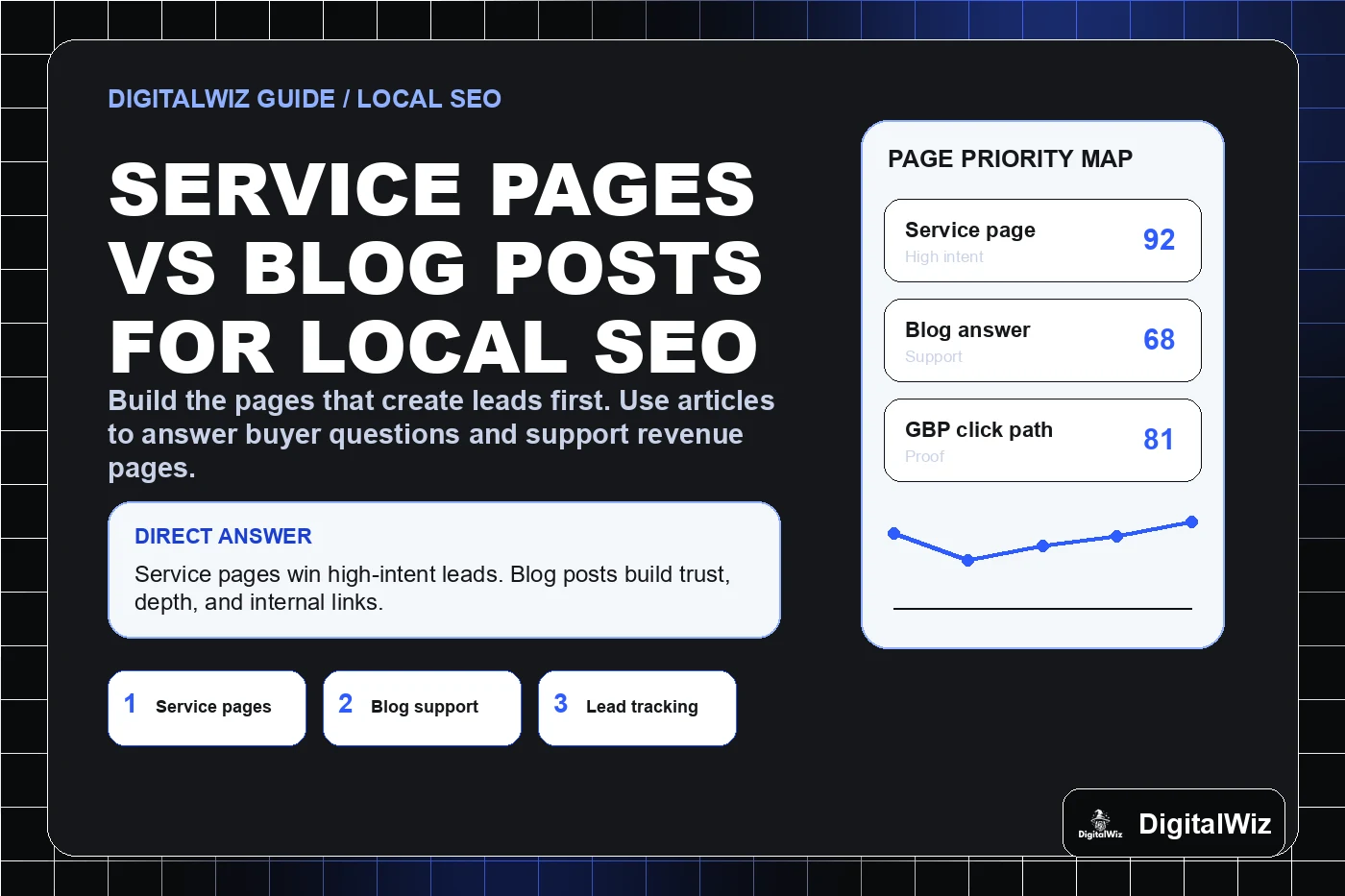
The direct answer
For most Charlotte and NC service businesses, service pages are more important than blog posts for local SEO because they match the searches that turn into calls, forms, bookings, estimates, and consultations. If someone searches for roof repair, dental implants, med spa treatments, emergency plumbing, family law help, or Google Ads management, they usually need a clear service page, not a broad article.
Blog posts still matter. They answer the questions buyers ask before they contact you, support Google and AI-search understanding, and give you natural places to link back to the revenue pages. But a blog cannot make up for weak service pages, vague offers, poor local proof, or missing conversion tracking.
The practical DigitalWiz rule: build the money pages first, then use blog content to support them. Your website, Search Visibility, and Paid Ads Management work better when every article points buyers toward the right next step.
- Use service pages for high-intent searches tied to a specific offer and location.
- Use blog posts for questions, comparisons, cost factors, timelines, checklists, and objections.
- Link blog posts back to the service pages that can actually convert the visitor.
- Measure qualified leads by page type instead of judging everything by traffic.
Why service pages usually win for lead generation
A service page has one job: prove that you solve a specific problem in a specific market and make the next step easy. That is exactly what a local buyer needs when the search has commercial intent. A generic blog post may educate the visitor, but it rarely gives enough proof, process, location detail, and CTA strength to close the gap by itself.
Strong service pages also help Google understand what the business actually offers. They can include service details, local context, FAQs, reviews, project examples, photos, schema, and clear calls to action. For a Charlotte contractor, dentist, med spa, law firm, restaurant, or home service company, those details are often the difference between a visit and a lead.
If your site has ten blog posts but only one thin services page, the structure is backwards. Start with the pages closest to revenue, then build supporting content around real buyer questions.
- Service pages match searches like service + city, emergency + service, and best provider + location.
- They can show proof close to the CTA instead of burying it in a content archive.
- They give paid ads and Google Business Profile clicks a better destination than the homepage.
- They make lead tracking cleaner because each page has a clearer business goal.
Where blog posts still help local SEO
Blog posts are useful when they answer questions that support a buying decision. Think cost factors, timelines, comparisons, mistakes, checklists, local SEO basics, Google Business Profile issues, landing-page questions, and conversion tracking. These topics may not all produce immediate calls, but they build trust and give search systems more context around your expertise.
Google's Search Central guidance focuses on helpful, reliable, people-first content. That means a useful blog post should answer a real question clearly, avoid invented claims, and help someone make a better decision. For AI search and answer engines, clean answer-style content can also make the business easier to understand and cite accurately.
The mistake is publishing random articles with no connection to services. A roofing company does not need a pile of generic home improvement posts. A med spa does not need thin beauty tips that never connect to treatment pages. The blog should support the service strategy.
- Answer questions sales teams hear repeatedly.
- Explain pricing factors without pretending every job costs the same.
- Compare options honestly, including when a service is not the right fit.
- Create internal links to the service, location, and contact pages that matter.
How to choose which page type to create
Start with intent. If the searcher is trying to hire someone, build or improve a service page. If the searcher is trying to understand a problem before choosing, a blog post or FAQ may be the better fit. If the topic supports a paid campaign, a focused landing page may beat both.
For example, "roof repair Charlotte" deserves a service page. "How do I know if storm damage is serious?" may be a blog post that links to roof repair. "emergency roof leak estimate" might need a landing page if you are buying ads. The page type should match the visitor's stage, not the keyword tool's suggestion.
When in doubt, map every topic to a next step before writing. If you cannot identify the service page, audit path, quote request, or contact action the content supports, the topic may not be worth publishing yet.
- Create a service page when the query names a service, provider, city, appointment, quote, or repair need.
- Create a blog post when the query asks how, what, why, when, cost factors, mistakes, or comparison questions.
- Create a landing page when paid clicks need one offer, one audience, and tight message match.
- Refresh an existing page when a new article would compete with something you already have.
The internal linking pattern that makes both work
Service pages and blog posts should not live in separate worlds. The blog should feed the service pages, and the service pages should point to helpful answers when buyers need more detail. This creates a cleaner path for people, Google, and AI systems.
A strong pattern is simple: one core service page, a few supporting articles, relevant city or service-area pages where they are genuinely useful, and a contact or audit path. The supporting articles answer objections and then link naturally to the page that can solve the problem.
This is also better for measurement. If a blog post assists conversions through internal links, you can see whether it helped people reach the service page, BizScore audit, contact form, or call path. Traffic alone is not the scoreboard.
- Link from blog introductions or bottom-line sections to the relevant service page.
- Link from service FAQs to deeper blog answers when the topic needs more explanation.
- Use descriptive anchor text instead of generic "click here" links.
- Keep the path short: article, service page, proof, CTA, tracking.
What to fix first on your site
If you are choosing between service pages and blog posts, audit the current foundation before publishing more. Do you have one strong page for each profitable service? Does each page explain the offer, service area, proof, process, FAQs, and next step? Are calls and forms tracked? If not, fix that before adding more articles.
Once the core pages are useful, build a supporting blog plan around buyer questions. Prioritize topics that help someone choose, understand cost factors, compare options, avoid mistakes, or prepare to contact you. Then link each post back to the right service page or audit path.
Want a quick read on whether your site needs stronger service pages, better blog support, or cleaner tracking? Run a free BizScore audit or contact DigitalWiz. We will show you what to fix first across your website, search visibility, paid ads, and lead path.
- First: improve core service pages and local proof.
- Second: clean up navigation, internal links, CTAs, and tracking.
- Third: publish answer-style blog posts that support the money pages.
- Finally: review which pages create qualified leads, not just visits.