What Pages Should a Pressure Washing Company Website Have?
A pressure washing company website should have focused pages for house washing, roof washing when offered, concrete and flatwork cleaning, commercial work, service areas, project proof, pricing context, FAQs, and estimates.
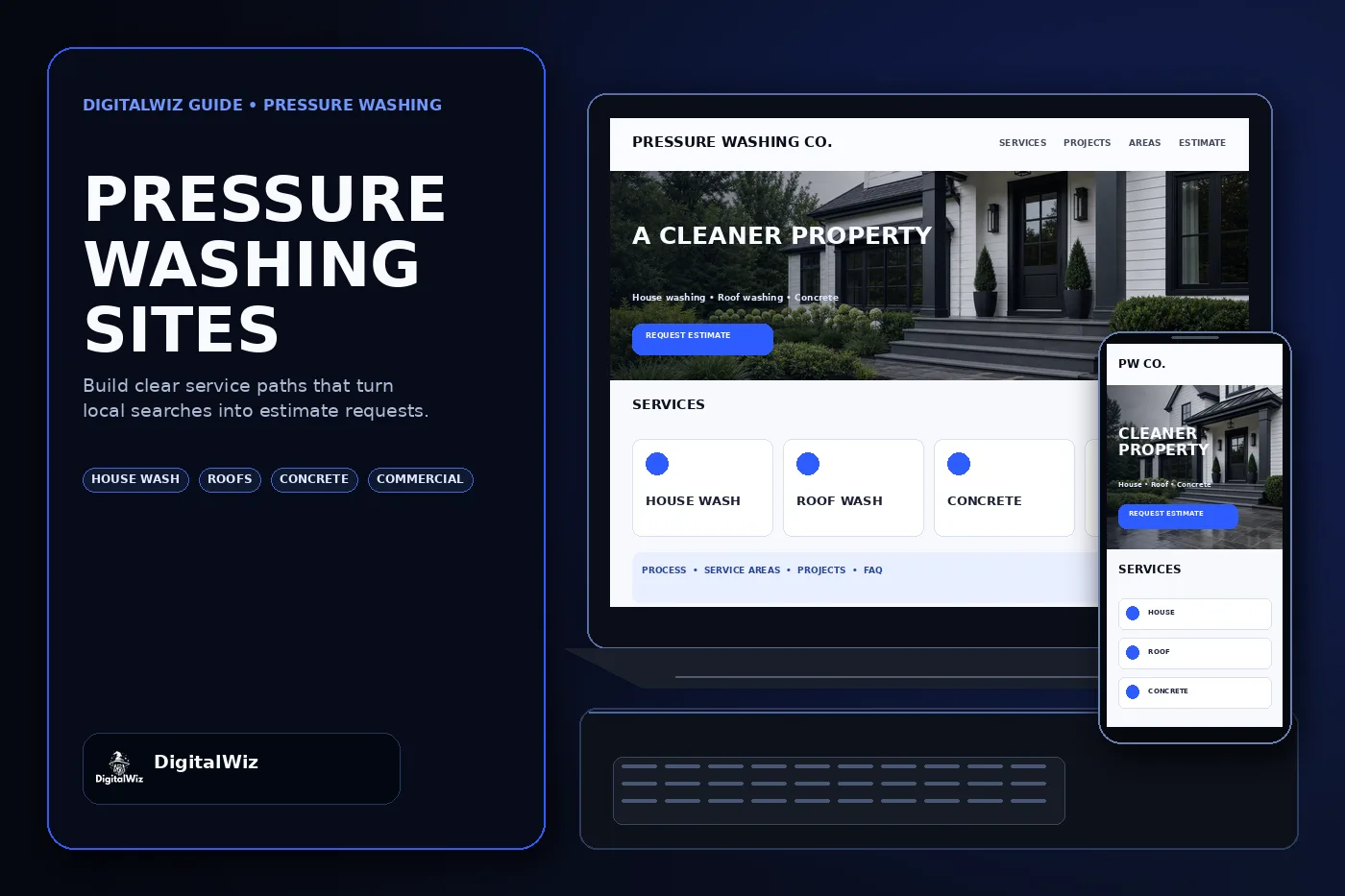
The direct answer
A pressure washing company website should have focused pages for the work customers actually compare: house washing, roof washing when offered, concrete and flatwork cleaning, decks and fences when supported, gutters, commercial or property-management work, service areas, project proof, reviews, pricing context, FAQs, and estimates. One catch-all services page usually leaves the visitor guessing about surfaces, methods, timing, and fit.
For a Charlotte or NC exterior-cleaning company, those paths should separate a routine house wash from a roof treatment, oil-stained concrete, a weathered deck, or recurring commercial work. The surface, buildup, access, runoff, nearby landscaping, preparation, method, crew time, and customer expectations can all change.
Keep the structure useful. Give each real service a strong page, explain how the company evaluates a property, show permission-safe projects, state the actual service area, and make requesting an estimate simple on a phone. That gives the website, Search Visibility, and Paid Ads Management clear destinations instead of sending every click to the homepage.
- Separate house washing, roof work, flatwork, specialty surfaces, and commercial service when the process differs.
- Explain evaluation, preparation, method selection, property protection, and next steps in plain language.
- Publish accurate service areas, availability, insurance language, and surface limitations.
- Track calls, forms, estimate requests, quoted work, sold work, service type, and lead quality.
Build pages around surfaces and customer intent
Start with the work the company is equipped, insured, and trained to handle. For many operators, that means house washing, roof washing, concrete cleaning, patios and walkways, decks, fences, gutters, rust or stain treatment within the team's capabilities, and commercial exterior cleaning. A company that handles apartments, storefronts, restaurants, HOAs, fleets, industrial sites, or multi-property accounts may need separate pages for those buyers and scopes.
Each page should answer the first questions quickly: do you clean this surface, do you serve this address, what happens during an evaluation, what should be moved or protected, how is the method selected, what results are realistic, and how does the customer request an estimate? A gallery of dramatic stripes in concrete may catch the eye, but it does not explain whether the company is a fit for painted siding, older masonry, a delicate roof, or a recurring commercial route.
Build these revenue pages before publishing dozens of generic cleaning tips. Service pages and blog posts have different jobs in local SEO. An article can explain why surfaces weather differently. The service page still has to carry the scope, process, proof, limitations, and estimate conversation.
- House washing page: supported siding and exterior materials, evaluation, preparation, method, property protection, and matching projects.
- Roof washing page: roof types served, inspection boundaries, treatment approach, runoff and landscape protection, limitations, and estimate path.
- Concrete page: driveways, walks, patios, curbs, stains, pretreatment, post-treatment, and realistic outcome language.
- Commercial page: property types, access, scheduling, recurring service, documentation, safety coordination, and account inquiries.
Separate routine washing from specialty work
“Pressure washing” may be the phrase a customer types, but not every surface should be presented as the same high-pressure process. The website should explain that the company chooses equipment, pressure, cleaning solution, dwell time, rinsing, and protection steps based on the material and condition. Keep the explanation plain. Customers need confidence in the process, not a technical performance that turns the page into a do-it-yourself manual.
Roof work deserves its own path when the company genuinely offers it. State which roof materials and property types the team evaluates, what the visit includes, how nearby landscaping and runoff are handled, and which conditions may require another contractor first. Do not diagnose roof life, leaks, structural movement, damaged flashing, or manufacturer-warranty coverage from one photo.
Specialty stains and surfaces need the same honesty. Rust, oil, grease, paint, efflorescence, organic growth, irrigation marks, oxidation, wood coatings, and old repairs do not all respond the same way. Say which services are available, which outcomes depend on a test area or site visit, and when permanent staining or material damage may remain. Clear limits build more trust than a promise that every surface will look new.
- Use service-specific language instead of presenting one pressure setting as the answer for every material.
- Explain when an in-person look, test area, access check, or specialty treatment may be needed.
- Avoid guaranteed restoration, “like new,” zero-damage, or permanent-result claims unless the company can support the exact terms.
- Keep technical instructions focused on the professional process rather than teaching risky chemical or equipment use.
Show the process and property-protection plan
Exterior cleaning touches more than the visible stain. A useful process page can explain the initial walkaround, water access, surface review, fragile items, open windows, electrical fixtures, gates, pets, vehicles, landscaping, drainage, neighboring property, treatment, rinse, final review, and payment. The exact checklist will vary, but the customer should know what the crew checks and what the customer needs to do before arrival.
Property-protection language should be specific without becoming a blanket guarantee. Explain how the team handles nearby plants, outdoor furniture, decorative items, cameras, outlets, doors, screens, aging paint, loose mortar, damaged siding, and pre-existing conditions in its normal workflow. If some items must be moved or some utilities must be available, say so before the appointment.
Also explain scheduling. Commercial buyers may need early-morning work, tenant communication, cones or access control, water recovery, vendor paperwork, or service across several buildings. Residential customers may care more about arrival updates, estimated duration, pets, locked gates, and when they can use the cleaned area again. One vague “we clean everything” paragraph cannot serve both conversations.
- Publish a simple before-service checklist that matches the company's real field process.
- State customer responsibilities, water or access needs, cancellation terms, and weather policies clearly.
- Separate residential scheduling from commercial coordination when the requirements differ.
- Review process copy with the operations team so the website does not promise steps the crew does not follow.
Turn before-and-after photos into useful proof
Before-and-after photos matter in exterior cleaning, but a tight crop of one clean stripe is weak proof by itself. A useful project example identifies the general area, property or surface type, visible condition, agreed scope, preparation, treatment category, access issue when relevant, and finished result. Wide context helps a buyer understand whether the example resembles the work they need.
Match proof to the page. House-washing visitors should see comparable siding and trim. Roof visitors need believable roof context rather than a generic clean home. Concrete customers may care about the age and type of flatwork, stain limitations, edging, and adjacent landscaping. A property manager may want to understand scheduling, access, documentation, and consistency across a larger site.
Use only real, permission-safe work as company proof. Do not invent projects, customers, reviews, ratings, awards, locations, or cleaning results to fill a layout. Recent contractor projects strengthen a website when they help the buyer judge fit and show what the company actually did.
- Label the service, general area, surface, starting condition, scope, and completed work.
- Use consistent angles and lighting when practical, but do not manipulate the result.
- Remove exact addresses, faces, license plates, security details, access codes, and private customer information.
- Never present stock or conceptual imagery as a completed customer project.
Explain estimates and pricing without a bait price
Exterior-cleaning prices can change with square footage, stories, roof pitch, surface material, buildup, stain type, access, water availability, obstacles, landscaping, treatment needs, setup, travel, commercial scheduling, and bundled services. A tiny starting price can create the wrong expectation when it excludes the property the customer actually owns.
The website can still be useful. Some companies can publish minimum service charges, typical package ranges, per-unit commercial pricing, or clear add-ons. Others are better served by explaining the main cost drivers, what photos help, when a site visit is needed, and what a written estimate includes. Either approach gives the customer more context than “call for pricing” on every page.
Spell out common boundaries: windows, gutters, stain removal, oxidation, screen enclosures, moving furniture, water access, sealing, post-treatment, and areas behind locked gates may or may not be included. Use the framework in Should I Put Prices on My Business Website? to add real context without pretending every house or commercial property has one price.
- Explain the largest size, height, surface, access, stain, setup, and scheduling cost drivers.
- Publish ranges, packages, minimums, or fees only when the company can support and update them.
- Define what the estimate includes, what is optional, and how changed conditions are handled.
- Keep promotions, recurring-plan terms, deposits, cancellations, and weather policies current.
Use real service areas and track lead quality
Pressure washing routes have practical limits. Crew travel, setup time, minimum charges, water access, weather, property size, recurring commercial schedules, and follow-up all affect coverage. State the core service area clearly. If routine residential work, roof work, and commercial accounts have different ranges, explain that instead of publishing one oversized map.
A Charlotte-area company may genuinely serve Charlotte, Matthews, Indian Trail, Waxhaw, Monroe, Concord, Huntersville, Gastonia, Fort Mill, or nearby markets. A dedicated city page makes sense when the company can add original information: actual availability, local project examples, property context, service mix, route notes, and useful proof. Cloning one paragraph across every town does not make the business more local. Read Should I Build City Pages for Every Service Area? before adding another location page.
Then make the estimate path useful on a phone. Ask for name, phone, email, service address, surface or service needed, approximate scope if known, stories or access notes, desired timing, and optional photos. Track source, campaign, landing page, call or form, service requested, coverage fit, estimate, sold work, job type, and lead quality when the sales system allows it.
Want a quick read on whether your pressure washing website has the right service pages, local-search foundation, project proof, estimate path, and tracking? Run a free BizScore audit. It will surface the biggest gaps so you can fix the highest-impact issue first.
- State real residential, roof, specialty, commercial, and recurring-service coverage when those areas differ.
- Create local pages only where the company can add original proof and useful market information.
- Route house, roof, concrete, specialty, and commercial inquiries to the right workflow.
- Measure lead quality through estimate, sold work, service type, route fit, and repeat work when possible.