What Pages Should a Masonry Company Website Have?
A masonry company website should have focused pages for brick, block, stone, repair, repointing, chimneys, outdoor masonry, commercial work, service areas, project proof, pricing context, FAQs, and estimates so local buyers can quickly judge the fit.
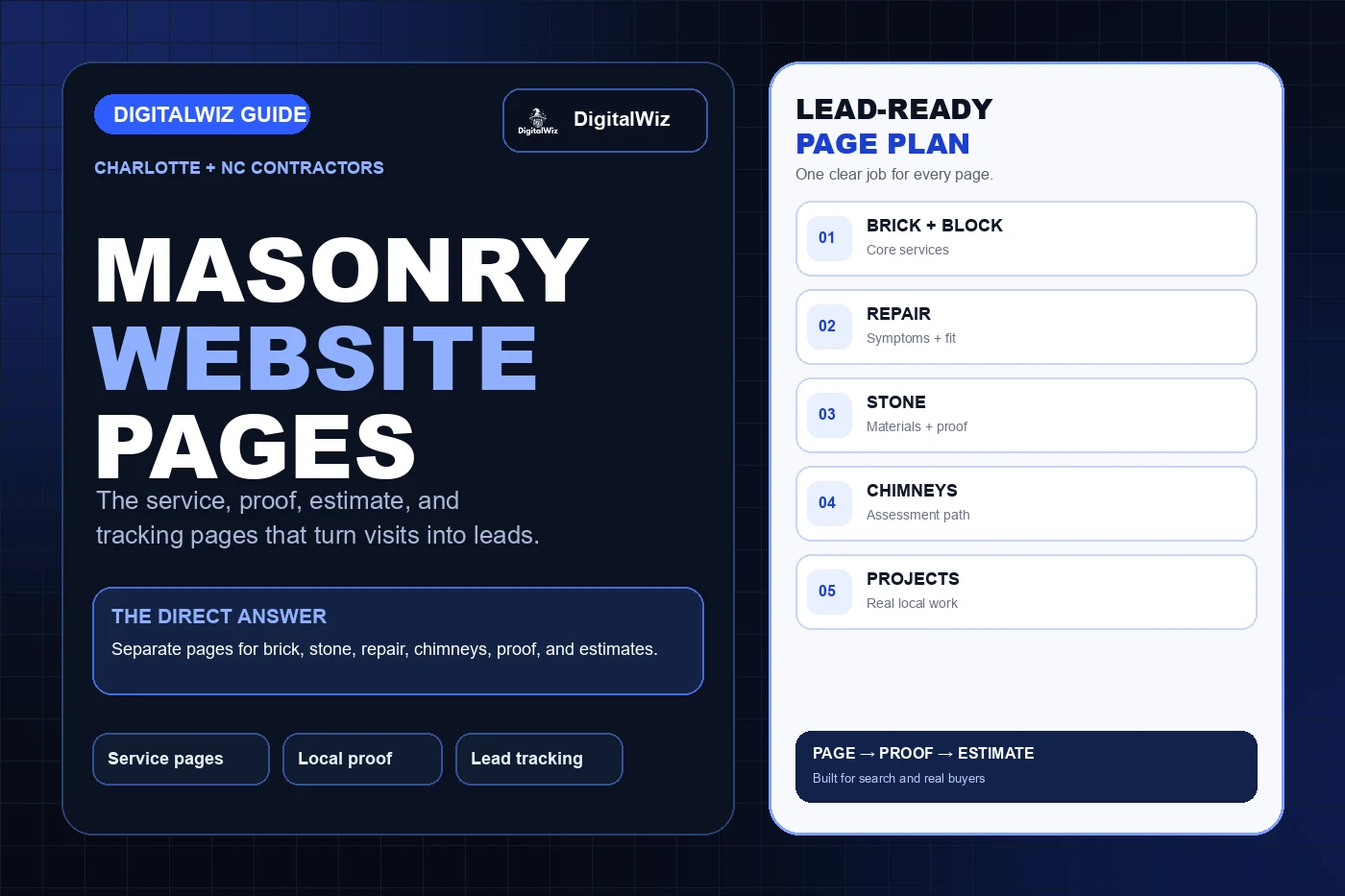
The direct answer
A masonry company website should have focused pages for the work customers actually compare: brickwork, blockwork, natural or manufactured stone, masonry repair, repointing or tuckpointing, chimney masonry, patios and walkways, retaining walls, foundations when offered, commercial masonry, service areas, project proof, reviews, pricing context, FAQs, and estimates. One broad services page usually leaves too many questions unanswered.
For a Charlotte or NC masonry contractor, those pages should separate new construction from repair and restoration. A new brick veneer, failing mortar joint, leaning garden wall, cracked chimney crown, stone entry, commercial block wall, and historic repair are not the same job. The materials, access, diagnosis, crew, permitting, and buyer concerns can all change.
Keep the structure practical: create a useful page for each profitable service, show real matching work, explain what an assessment or estimate involves, state the actual service area, and make the next step easy on a phone. That gives the website, Search Visibility, and Paid Ads Management something specific to work with instead of sending every visitor to the homepage.
- Build separate pages for the masonry services the company wants more of.
- Match project proof, repair context, process details, and FAQs to the service being sold.
- Explain service area, site access, estimate steps, and cost factors in plain language.
- Track calls, forms, estimate requests, landing pages, project type, and lead quality.
Start with the masonry work people are ready to buy
Start with the work that drives the business. For many residential masons, that means brick repair, mortar-joint repair, chimney masonry, stone veneer, steps and stoops, patios, walkways, retaining walls, mailboxes, fireplaces, and small structural repairs within the company's actual scope. A team that handles foundations, commercial block, restoration, or new construction may need a separate section for builders, property managers, architects, or general contractors.
Each page should answer the buyer's first questions fast: do you handle this material and problem, do you work in my area, can I see similar projects, what does the first visit cover, what affects the estimate, and what happens after I reach out? A list of thirty masonry services confirms very little about the company's fit for a weathered chimney or a new stone entrance.
Build these revenue pages before publishing a large library of loosely related advice. Service pages and blog posts have different jobs in local SEO. Articles can answer early research questions, but the service page needs to carry the actual project conversation.
- Brick page: new brickwork, veneer, matching considerations, openings, steps, walls, and project proof.
- Repair and repointing page: symptoms, assessment, mortar compatibility, access, limits, and repair examples.
- Stone page: natural versus manufactured materials, veneer, walls, entries, fireplaces, and finished work.
- Commercial page: block, brick, restoration, scheduling, plans, safety expectations, and coordination when offered.
Separate repair, repointing, and new masonry
Repair visitors often arrive with a symptom rather than a scope. They may see cracked mortar, loose brick, spalling, staining, movement, a deteriorated chimney, water near a wall, or steps pulling away from the house. The website should explain what the company evaluates without diagnosing every condition from a photo or promising one universal fix.
Repointing deserves clear language too. Buyers often use repointing and tuckpointing interchangeably, while contractors may use the terms more precisely. Explain the terminology the company uses, how damaged joints are removed and replaced, why mortar type and joint profile matter, and when wider masonry or moisture problems need attention before cosmetic work begins.
New work needs a different page. A customer planning a patio, stone wall, brick mailbox, outdoor fireplace, veneer, addition, or commercial wall wants design options, materials, samples, layout, drainage, foundations, schedule, and coordination. Keeping new construction and repair separate makes both pages easier to trust.
- Describe visible warning signs without making a remote structural diagnosis.
- Explain the assessment process and when engineering or another specialist may be needed.
- Clarify material matching, mortar color, joint profile, cleaning, curing, and realistic appearance limits.
- Use different calls to action for repair assessments, project estimates, and plan-based commercial inquiries.
Show proof that reveals more than the finished wall
Masonry is visual, but a polished after photo is only part of the proof. Buyers also care about the original condition, demolition or preparation, substrate, flashing or drainage details when relevant, material matching, joint consistency, protection of the property, cleanup, and how the new work meets the existing structure.
Put the right proof on the right page. A repointing visitor should see close, well-lit examples of joints before and after the work. A stone-veneer prospect should see corners, transitions, caps, openings, and a wider view of the finished elevation. A commercial buyer may care more about crew capacity, phasing, plans, documentation, access, and completed scopes at a similar scale.
A central gallery can still work as a browsing hub. Organize it by material and project type, then connect each example to the relevant service and estimate path. Recent contractor projects strengthen a website when the work is real, permission-safe, labeled clearly, and tied to a buying decision.
- Use only real, permission-safe work as company portfolio proof.
- Add concise context: project type, general area, original condition, material, scope, and result.
- Show useful details such as joints, corners, transitions, caps, and repairs instead of distant beauty shots only.
- Keep exact addresses, customer details, plans, access information, and other sensitive material private.
Explain cost factors without guessing from one photo
Masonry prices change with the job. Square footage and material matter, but so do demolition, disposal, access, scaffolding, height, substrate condition, mortar removal, matching, custom cuts, curves, corners, caps, footings, reinforcement, drainage, flashing, cleaning, permits, engineering, protection, mobilization, and the amount of hand work. A website calculator that ignores those details can create the wrong expectation.
The site can still be helpful. Some companies can publish typical ranges or project minimums. Others are better served by explaining what the estimator needs to see, which photos are useful, and which choices move the number. Either approach is stronger than saying every job is different and offering no context at all.
Be careful with repair pricing. A small isolated mortar repair, broad repointing project, rebuilt wall section, chimney restoration, drainage correction, and structural stabilization solve different problems. If the company publishes prices or ranges, review them regularly and explain what is included. The framework in Should I Put Prices on My Business Website? can help.
- Explain the major cost drivers instead of avoiding every price question.
- Use ranges or minimums only when the company can support and update them.
- Separate access, scaffolding, demolition, matching, foundations, permits, or engineering when needed.
- Never imply that every crack, leak, stain, loose unit, or failed joint has the same cause or repair.
Use service-area pages only when they add local value
Masonry contractors have real geographic limits. Crew travel, material delivery, scaffolding, equipment, project size, supplier distance, and repeat visits can all change whether a job makes sense. State the core service area clearly instead of making buyers hunt for it.
A Charlotte-area mason might genuinely work in Charlotte, Matthews, Indian Trail, Waxhaw, Monroe, Concord, Huntersville, Gastonia, Fort Mill, or nearby markets. A dedicated location page makes sense when the company can add real information: completed work, reviews, common materials, property types, permitting experience, travel minimums, or service details for that market.
Google's current Business Profile guidance says complete and accurate information helps businesses appear for relevant local searches, and that local results are mainly based on relevance, distance, and prominence. Clear services and truthful coverage help describe the business. Cloned city pages cannot remove distance. Read Should I Build City Pages for Every Service Area? before multiplying one template across the map.
- State the actual service area on the homepage, service pages, and estimate path.
- Explain real project minimums or travel limits when they affect fit.
- Create a city page only when it contains original local proof and useful information.
- Keep business name, service area, phone, hours, and website details aligned with Google Business Profile.
Make the estimate request useful on a phone
A masonry estimate form should collect enough detail to start a useful conversation without asking the customer to diagnose the wall. Ask for contact information, property location, project type, material if known, visible symptoms or desired work, approximate dimensions, height and access notes, desired timing, and optional photos. For commercial or plan-based work, drawings, bid dates, project contacts, and scope documents may belong in a separate path.
Test the form on a phone. Someone standing beside a chimney, step, wall, or patio should be able to describe the issue, attach a few photos, and understand what happens next without pinching or fighting a huge upload. Keep a tappable phone option for people who prefer to call.
Then track quality, not just form count. Record traffic source, landing page, calls, completed forms, requested service, service area, estimate status, quoted work, sold work, and lead quality when the sales process allows it. If chimney pages create strong assessments while repair ads bring tiny out-of-area requests, page-level data shows where targeting, minimums, proof, copy, or follow-up needs work.
Want a fast read on whether your masonry website has the right service pages, local proof, estimate path, search foundation, and tracking? Run a free BizScore audit. It will show the biggest gaps so you can fix the highest-impact issue first.
- Ask for property area, project type, material, symptoms or desired work, rough dimensions, access, timing, and photos.
- Route repair, chimney, outdoor masonry, new construction, and commercial requests appropriately.
- Track source and landing page through estimate, proposal, sold work, and lead quality when possible.
- Use the findings to improve service pages, ads, proof, forms, qualification, and follow-up.