What Pages Should a Landscaping Company Website Have?
A landscaping company website should have focused pages for landscape design, installation, maintenance, hardscapes, drainage, irrigation, service areas, project proof, reviews, FAQs, pricing context, and contact so local buyers can quickly understand the work and request an estimate.
The direct answer
A landscaping company website should have pages that match the work customers actually buy: landscape design, installation, recurring maintenance, lawn care when offered, hardscapes, drainage, irrigation, outdoor lighting, service areas, recent projects, reviews, FAQs, pricing context, and contact. One generic services page usually cannot explain all of that without turning into a long, vague list.
For a Charlotte or NC landscaper, the structure should separate one-time projects from recurring work. Someone planning a patio, retaining wall, drainage fix, or full yard redesign is making a different decision than a property owner comparing weekly maintenance. The photos, questions, budget context, and next step are different too.
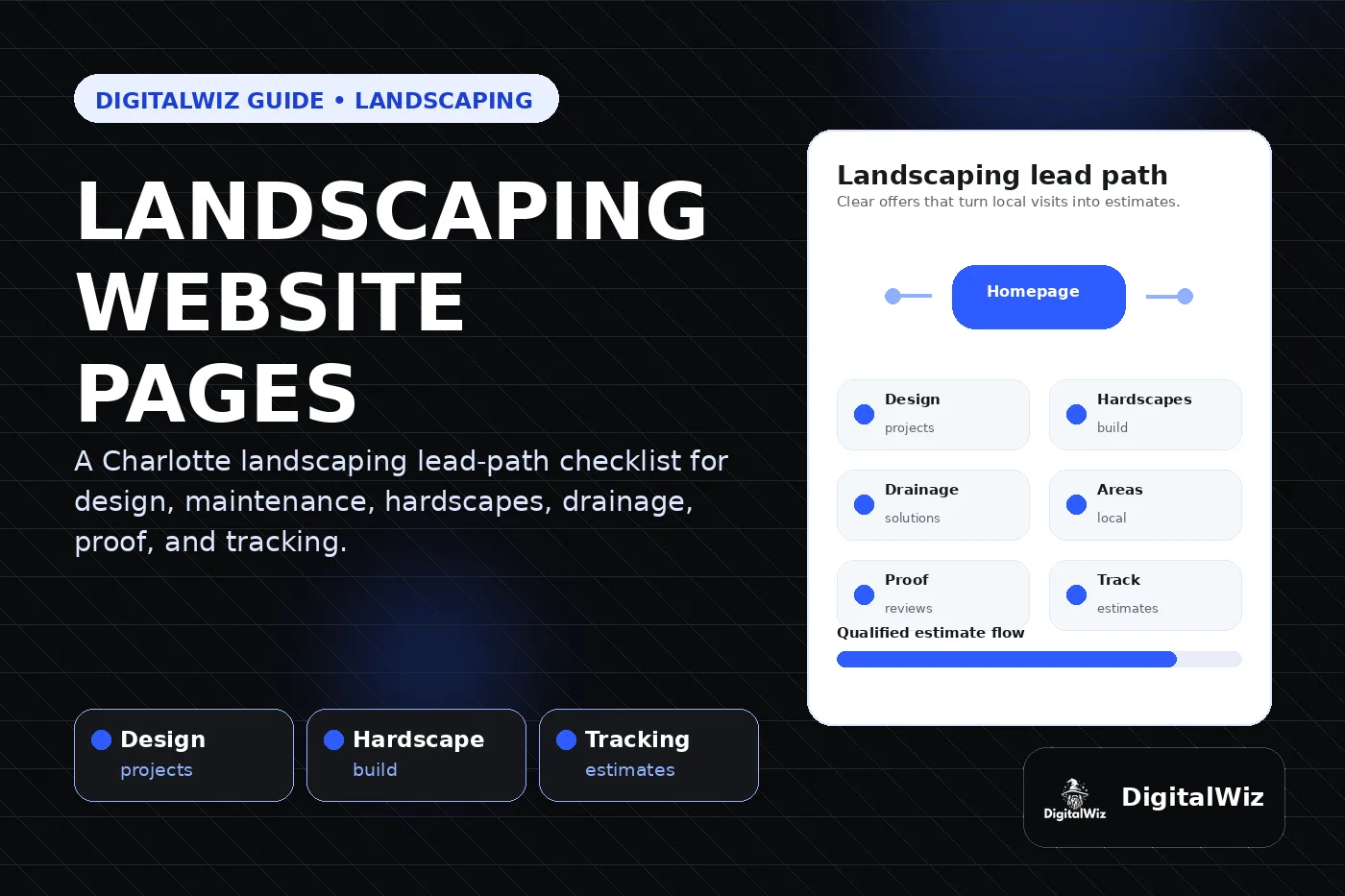
Keep it simple: each important service gets a clear page, relevant proof, the real service area, and an obvious estimate path. That structure gives the website, Search Visibility, and Paid Ads Management a much stronger foundation.
- Create focused pages for the landscaping services that produce meaningful revenue.
- Separate recurring maintenance from design-and-build projects.
- Use real local proof: project photos, reviews, materials, process notes, and service-area details.
- Track calls, forms, estimate requests, landing pages, source, and lead quality.
Start with the services people are ready to buy
The best page plan starts with the jobs the company wants more of. For a design-build landscaper, that may be landscape design, patios, walkways, retaining walls, grading, drainage, irrigation, planting, sod, and outdoor lighting. A maintenance company may need separate pages for mowing, seasonal cleanups, pruning, mulch, fertilization, and commercial property maintenance.
Each page should quickly answer five questions: do you handle this project, do you serve my property, can I see similar work, what affects the price, and how do I request an estimate? A page titled Services with twenty bullets makes the visitor piece the answer together. Focused pages do the sorting for them.
Build the money pages before chasing a huge blog calendar. We covered the tradeoff in Are Service Pages or Blog Posts Better for Local SEO?. Helpful articles can support discovery, but service pages need to carry the sales conversation.
- Landscape design page: goals, consultation, plans, materials, revisions, and installation handoff.
- Hardscape page: patios, walkways, walls, steps, materials, drainage details, and project proof.
- Drainage page: standing water, erosion, grading, downspout routing, assessment, and solution fit.
- Maintenance page: included tasks, property types, cadence, seasonal work, and quote process.
Show project proof where the decision happens
Landscaping is visual, so buyers expect more than polished claims. They want to see whether the company has completed work that resembles their property, style, and budget level. Put relevant project photos on the service page instead of hiding every image in one gallery.
A patio page should show patios. A drainage page should explain the problem and solution, not borrow a glamour shot from a planting project. Short project notes help: the service, general area, challenge, material choice, and result. Real context makes the image useful rather than decorative.
A dedicated gallery can still work as a proof hub, especially when visitors can filter by project type. Just do not make it a dead end. Link projects back to the matching service and estimate path. For a practical system, see Should Contractors Show Recent Projects on Their Website?.
- Use real, permission-safe project photos rather than stock or AI-generated work presented as a portfolio.
- Add concise captions with service, materials, challenge, and result.
- Place reviews beside the service or project they support when possible.
- Protect customer privacy and remove sensitive addresses, plates, or personal details.
Handle service areas without cloning city pages
Landscaping businesses often have a practical travel radius. Crew time, equipment, project size, and recurring routes all affect where a job makes sense. The website should say where the company works, but it does not need fifty near-identical city pages.
A Charlotte-area company might genuinely serve Charlotte, Matthews, Indian Trail, Waxhaw, Monroe, Concord, Huntersville, Gastonia, or nearby markets. Build a city page when there is real local value to add: completed projects, neighborhood or property context, route availability, reviews, service differences, or photos from that market.
Google says local results are mainly shaped by relevance, distance, and prominence, and it recommends complete, detailed business information. A clear service area helps relevance. It does not erase distance, and repeating city names cannot force a better position. Read Should I Build City Pages for Every Service Area? before multiplying location pages.
- State the core service area clearly on the homepage and contact path.
- Explain any project minimums, route limits, or commercial-only areas when accurate.
- Create location pages only when each one contains useful local proof.
- Keep business details aligned across the website, Google Business Profile, and citations.
Answer price, process, and timeline questions
Landscaping prices vary because scope varies. Square footage, access, demolition, grading, drainage, material, plant size, irrigation, permits, equipment, soil conditions, haul-off, and ongoing care can all change the quote. The site does not need to invent one universal number, but it should explain what drives cost.
Process matters just as much. Tell people whether the first step is a phone call, site visit, design consultation, measurement, maintenance quote, or paid planning phase. For projects, explain how proposals, material selections, scheduling, deposits, change orders, installation, cleanup, and final walkthroughs generally work when those steps are accurate for the company.
This kind of clarity saves both sides time. A buyer can decide whether the service fits before submitting a form, and the team gets a better first conversation. If pricing copy feels risky, use the framework in Should I Put Prices on My Business Website?.
- Explain cost factors instead of dodging every price question.
- Use ranges or project minimums only when the company can support them.
- Describe the estimate, design, proposal, schedule, and installation path in plain language.
- Put focused FAQs on the service pages where buyers need the answers.
Make the estimate form qualify without becoming homework
A landscaping estimate form needs enough detail to route the lead, not a twenty-minute application. Ask for the basics: contact information, property location, service or project type, rough timing, a short description, and optional photos. Budget range can help for larger design-build work if the choices are honest and the field is handled tactfully.
Mobile is the test. A homeowner standing in the yard should be able to describe the job and send a few photos without fighting tiny controls. Keep the phone number tappable for people who prefer to call, and set reasonable expectations about what happens after submission without promising a response time the office cannot meet.
Avoid sending every lead into the same bucket. A weekly maintenance request, commercial property inquiry, drainage problem, and six-figure outdoor project need different follow-up. The form can stay short while still capturing the service category that routes the conversation.
- Ask for service type, property area, timing, brief scope, and optional photos.
- Use budget questions selectively for larger projects, not as a blunt gate for every visitor.
- Confirm what happens next and who will contact the prospect.
- Keep consent language clear and separate if marketing texts or emails are optional.
Track which landscaping pages create good estimates
A landscaping site can generate plenty of inquiries and still miss the business goal. Track phone clicks, completed calls, forms, estimate requests, traffic source, landing page, device, requested service, and lead quality. Design-build projects and recurring maintenance should not disappear into one total labeled conversions.
The split matters for SEO and ads. If a drainage page produces strong local leads while a patio campaign produces tire-kickers, the answer may be targeting, page proof, budget context, service area, offer, or follow-up. Page-level data shows where to look. Traffic alone does not.
Want a fast read on whether your landscaping website has the right pages, proof, and tracking? Run a free BizScore audit. It will show the biggest gaps across the website, search visibility, lead path, and measurement so you know what to fix first.
- Track calls and forms by landing page, campaign, and service requested.
- Review lead quality so spam, vendors, job seekers, and out-of-area requests do not distort results.
- Compare estimate requests with booked work and revenue when the sales system allows it.
- Use the findings to improve service pages, proof, ads, FAQs, and follow-up.