What Pages Should a Gutter Company Website Have?
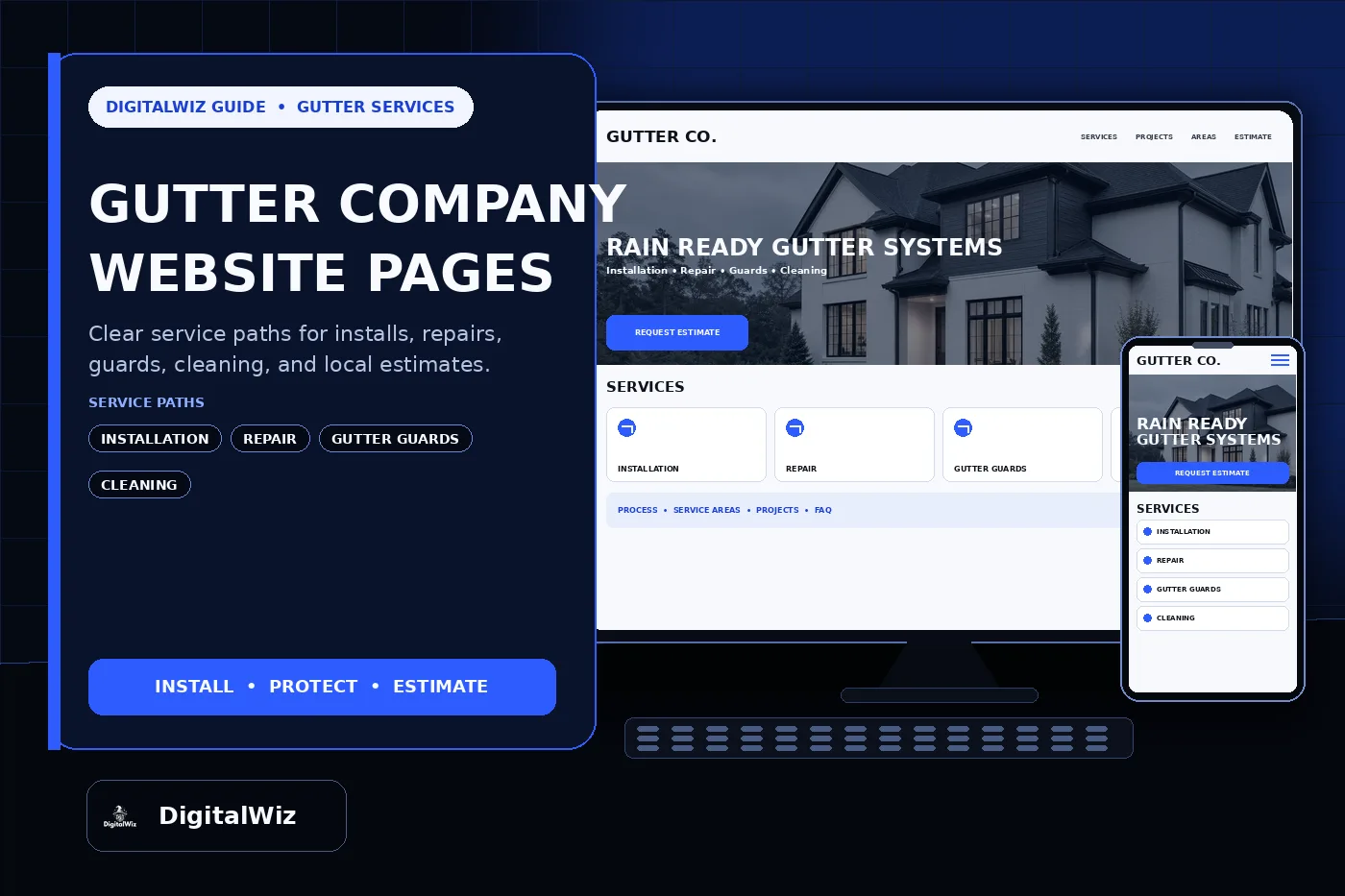
A gutter company website should have focused pages for installation, replacement, repair, gutter guards, cleaning, commercial work, service areas, project proof, pricing context, FAQs, and estimates.
The direct answer
A gutter company website should have focused pages for the work customers actually compare: seamless gutter installation, full replacement, gutter repair, gutter guards, cleaning, downspouts and drainage, commercial work when offered, service areas, project proof, reviews, pricing context, FAQs, and estimates. One catch-all page usually leaves the homeowner wondering whether the company installs new systems, only cleans existing ones, or handles the drainage problem they can see from the yard.
For a Charlotte or NC gutter company, those paths should separate planned installation from an active leak, sagging section, overflowing corner, damaged downspout, recurring clog, or commercial maintenance request. Roofline, fascia condition, home height, tree cover, access, water flow, discharge location, material, color, and the rest of the exterior can change the scope.
Keep the structure practical. Give each real service a useful page, explain how the company evaluates the roof edge and drainage path, show permission-safe projects, state the actual service area, and make requesting an estimate easy on a phone. That gives the website, Search Visibility, and Paid Ads Management clear destinations instead of sending every visitor to the homepage.
- Separate installation, replacement, repair, guards, cleaning, and commercial work when the buyer and process differ.
- Explain evaluation, materials, sizing, attachment, drainage, cleanup, and next steps in plain language.
- Publish accurate service areas, scheduling expectations, warranty terms, and estimate boundaries.
- Track calls, forms, site visits, proposals, sold work, service type, and lead quality.
Build pages around the gutter work people need
Start with the jobs the company is equipped, insured, and staffed to handle. For many residential gutter contractors, that means seamless aluminum gutters, replacement, repairs, downspouts, gutter guards, cleaning, fascia or soffit work within the team's scope, and drainage extensions. A company that serves multifamily properties, HOAs, retail buildings, warehouses, or property managers may need a separate commercial section built around access, scheduling, documentation, and recurring maintenance.
Each core page should answer the first questions fast: do you handle this type of system or problem, do you serve this address, what happens during the site visit, what materials and colors are available, how is water routed away from the structure, what may affect the estimate, and what should the customer do next? A gallery of shiny gutters does not explain whether the team repairs one leaking corner, replaces damaged fascia, works on steep or tall homes, or maintains a commercial property.
Build these revenue pages before filling the blog with generic rainwater tips. Service pages and blog posts have different jobs in local SEO. An article can explain common overflow causes. The installation or repair page still has to carry the scope, process, proof, limitations, and estimate conversation.
- Installation page: materials, profiles, colors, sizing approach, hangers, outlets, downspouts, removal, cleanup, and matching projects.
- Repair page: leaks, loose sections, pitch or flow concerns, damaged outlets, downspouts, inspection process, and repair limits.
- Gutter guard page: compatible systems, inspection, debris and roof context, maintenance expectations, warranties, and estimate path.
- Cleaning or commercial page: access, scheduling, debris handling, documentation, recurring service, and account inquiries.
Explain the whole water path, not just the gutter
A gutter is one part of a drainage path. Water moves from the roof surface to the eave, into the gutter, through outlets and downspouts, and then toward a safe discharge point. A useful website explains that the company looks at the connected system instead of promising that a larger trough or another downspout will solve every wet-basement, erosion, grading, roof, or foundation concern.
Show what the normal evaluation includes: roof-edge condition visible from a safe position, existing gutter profile, seams and corners, hangers, pitch, outlets, downspout placement, discharge, landscaping conflicts, access, and signs of overflow or staining. If fascia, roofing, drainage, masonry, or structural conditions may require another contractor, say that clearly. Good boundaries build trust.
Safety copy matters too. Homeowners should not be coached into climbing ladders, walking roofs, opening guards, or reaching into damaged systems. Ask for ground-level photos when they help, then explain when an on-site assessment is needed. The sales page should make professional evaluation feel straightforward—not turn gutter work into a risky weekend tutorial.
- Describe the route from roof edge to discharge point and the conditions the company actually evaluates.
- State whether fascia, soffit, roof-edge, underground drainage, or landscape work is included or referred out.
- Avoid diagnosing hidden water intrusion, foundation movement, roof leaks, or drainage failures from one photo.
- Keep do-it-yourself ladder, roof, and storm-work instructions off conversion pages.
Turn project photos into useful proof
Gutter work can disappear into the roofline when it is done well, so project proof needs context. A useful example identifies the general area, property type, original concern, gutter profile and material, color choice, downspout plan, guard system when included, fascia work within scope, access issue, and completed result. Wide elevations show how the system fits the house; detail photos can show corners, outlets, end caps, hangers, and clean transitions.
Match proof to the page. Installation visitors should see coherent full systems on similar homes. Repair visitors need an honest explanation of the inspected condition and completed scope. Guard buyers want to know what was installed, which existing gutter it fit, and what maintenance still applies. Commercial buyers may care more about access planning, phased work, documentation, recurring visits, and communication across a larger property.
Use only real, permission-safe work as company proof. Never invent projects, customers, reviews, ratings, awards, locations, warranties, or before-and-after results to fill a template. Recent contractor projects strengthen a website when they help the buyer judge fit and show what the company actually did.
- Label the service, general area, property type, original concern, installed or repaired system, and completed scope.
- Use wide elevations plus clear details of corners, outlets, downspouts, guards, and discharge when useful.
- Remove exact addresses, faces, license plates, access details, security features, and private customer information.
- Never present stock or conceptual imagery as a completed customer project.
Explain estimates and cost drivers honestly
Gutter pricing changes with more than linear footage. Home height, roofline complexity, corners, gutter size and profile, material, finish, removal, fascia condition, hanger spacing, outlets, downspout count and length, guards, access, landscaping, disposal, specialty equipment, commercial scheduling, and drainage work can all move the proposal. A tiny starting price can set the wrong expectation when it excludes the home the customer actually owns.
The website can still be useful. Some companies can publish minimum service charges, cleaning ranges, common repair fees, or planning ranges for straightforward installations. Others are better served by explaining the main cost drivers, what measurements and photos help, when a site visit is required, and what a written estimate includes. Either approach gives the customer more context than a blank form with no process.
Spell out common boundaries: gutter removal, disposal, fascia or soffit repair, roof-edge work, guards, underground drains, splash blocks, extensions, painting, permits when applicable, and landscape restoration may or may not be included. Use the framework in Should I Put Prices on My Business Website? to add context without pretending every roofline has one price.
- Explain the biggest height, access, material, roofline, downspout, guard, repair, and scheduling cost drivers.
- Publish ranges, fees, minimums, or packages only when the company can support and update them.
- Define what the estimate includes, what is optional, and how changed or hidden conditions are handled.
- Keep warranty, cleaning-plan, deposit, cancellation, and financing language current.
Use real service areas and track lead quality
Gutter contractors have practical geographic limits. Crew travel, fabrication, material delivery, ladders or lifts, cleanup, repair minimums, commercial scheduling, and follow-up all affect coverage. State the core service area clearly. If installation, small repairs, cleaning, and commercial accounts have different ranges, explain that rather than publishing one oversized map.
A Charlotte-area company may genuinely serve Charlotte, Matthews, Indian Trail, Waxhaw, Monroe, Concord, Huntersville, Gastonia, Fort Mill, or nearby markets. A dedicated city page makes sense when the company can add original information: actual availability, local project examples, common home or roofline context, service mix, route notes, and useful proof. Cloning one paragraph across every town does not make the business more local. Google's Business Profile guidance says local results are mainly shaped by relevance, distance, and prominence; complete, detailed business information helps Google understand the match. Read Should I Build City Pages for Every Service Area? before adding another location page.
Then make the estimate path useful on a phone. Ask for name, phone, email, service address, installation or existing-system concern, building height if known, desired timing, access notes, and optional ground-level photos. Track source, campaign, landing page, call or form, requested service, coverage fit, site visit, proposal, sold work, job type, and lead quality when the sales system allows it.
Want a quick read on whether your gutter company website has the right service pages, local-search foundation, project proof, estimate path, and tracking? Run a free BizScore audit. It will surface the biggest gaps so you can fix the highest-impact issue first.
- State real installation, repair, cleaning, commercial, and recurring-service coverage when those areas differ.
- Create local pages only where the company can add original proof and useful market information.
- Route installation, repair, guard, cleaning, drainage, and commercial inquiries to the right workflow.
- Measure lead quality through site visit, proposal, sold work, service type, route fit, and repeat service when possible.