What Pages Should a Flooring Company Website Have?
A flooring company website should have focused pages for hardwood, luxury vinyl plank, tile, carpet, refinishing, repairs, commercial work, service areas, project proof, pricing context, FAQs, and estimates so local buyers can quickly judge the fit.
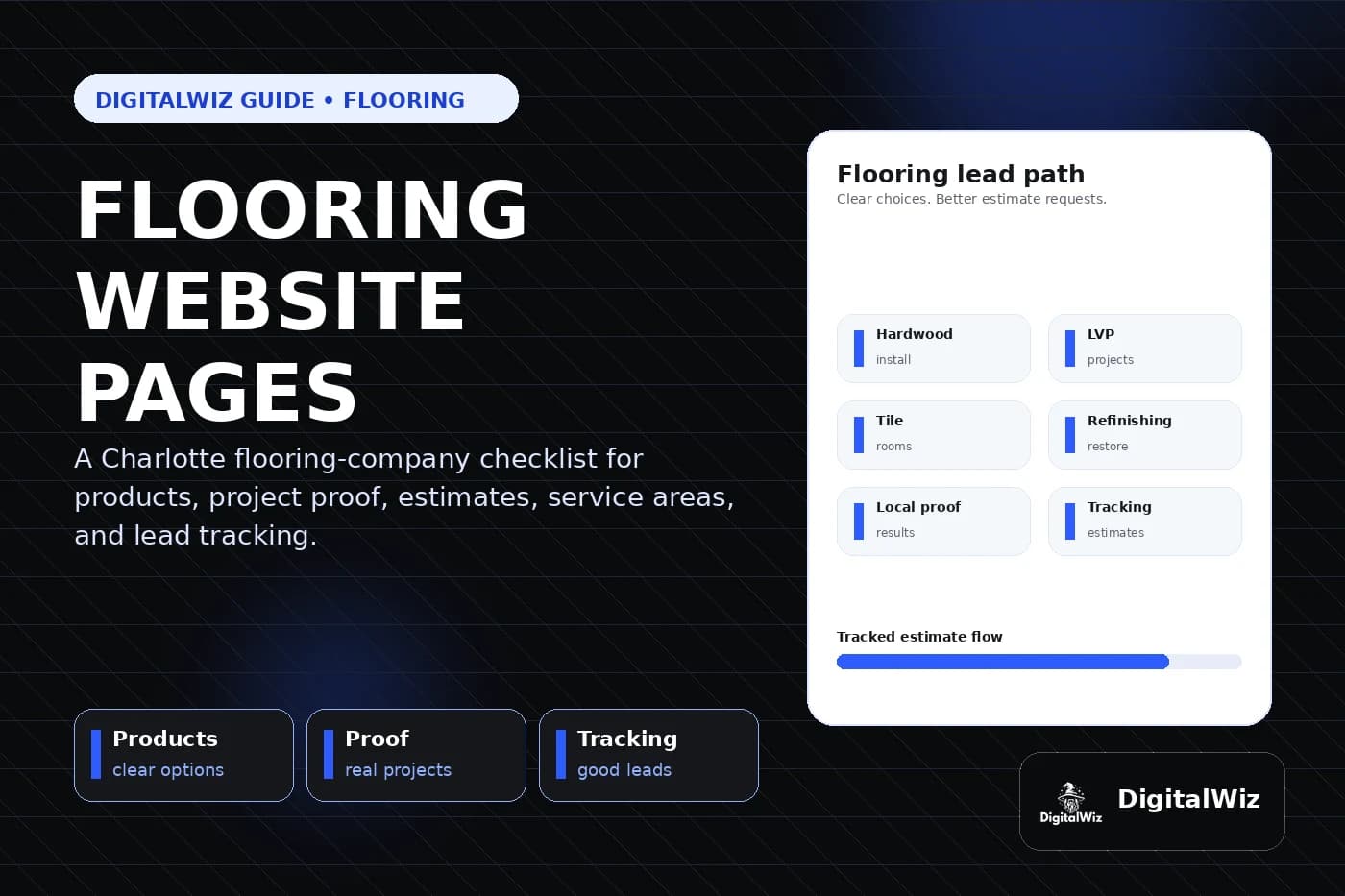
The direct answer
A flooring company website should have focused pages for the work and materials customers actually compare: hardwood installation, hardwood refinishing, luxury vinyl plank, tile, carpet when offered, laminate, flooring repair, stairs, commercial flooring, service areas, project proof, reviews, pricing context, FAQs, and estimates. One broad flooring page usually forces buyers to sort through too many unrelated options.
For a Charlotte or NC flooring contractor, those pages should separate installation from restoration and repair. Replacing carpet with LVP is not the same decision as refinishing original hardwood, repairing water-damaged boards, tiling a bathroom, installing commercial carpet tile, or matching an existing floor. The preparation, moisture concerns, product choices, schedule, access, and buyer questions can all change.
Keep the structure practical: create a useful page for every profitable flooring service, show real matching work, explain what an estimate covers, state the actual service area, and make the next step easy on a phone. That gives the website, Search Visibility, and Paid Ads Management specific pages to work with instead of sending every visitor to the homepage.
- Build separate pages for the flooring materials and services the company wants more of.
- Match project photos, preparation details, care guidance, and FAQs to each service.
- Explain service area, site conditions, estimate steps, and cost factors in plain language.
- Track calls, forms, showroom visits, sample requests, estimates, and lead quality.
Start with the flooring work people are ready to buy
Start with the jobs that drive the business. For many residential flooring companies, that means hardwood installation, sanding and refinishing, engineered wood, LVP or luxury vinyl tile, tile, carpet, laminate, stairs, and repairs. A team that handles builders, property managers, offices, retail, multifamily turns, gyms, healthcare spaces, or other commercial projects may need a separate section built around those buyers.
Each page should answer the first questions quickly: do you install or repair this floor, do you work in my area, can I see similar projects, what product choices do you carry or install, what preparation may be needed, and what happens after I request an estimate? A page with a logo wall of flooring brands and a short list of materials leaves most of that unanswered.
Build these revenue pages before publishing a huge library of design inspiration. Service pages and blog posts have different jobs in local SEO. Articles can answer early research questions, but the service page needs to carry the product, project, proof, and estimate conversation.
- Hardwood page: solid versus engineered options, species, finish, installation methods, acclimation, care, and project proof.
- Refinishing page: floor condition, color and sheen choices, dust control, repairs, schedule, cure time, and realistic limits.
- LVP page: wear layer and construction context, subfloor preparation, transitions, stairs, water exposure, and examples.
- Tile or commercial page: suitable spaces, substrate, layout, transitions, access, phasing, maintenance, and matching work.
Separate installation, refinishing, and repair
Installation visitors usually begin with a room, product, and desired result. They need help understanding material fit, samples, removal, subfloor preparation, moisture testing when appropriate, transitions, baseboards, furniture, disposal, schedule, and care. The page should explain the company's real process without presenting one product as perfect for every home.
Refinishing deserves its own page because the decision is different. Buyers want to know whether their floor can be sanded, how stains and natural finishes may look, what happens to gaps or damaged boards, how dust is managed, when they can walk on the floor, and when furniture or rugs can return. Avoid promising an exact color match or a flawless result before seeing the wood and its condition.
Repairs need honest boundaries too. Squeaks, pet stains, cupping, gaps, loose tile, cracked grout, water damage, worn finish, and damaged planks can have different causes. Explain what the company inspects, when a localized repair may work, when matching can be difficult, and when broader replacement or another specialist may be the better recommendation.
- Describe evaluation and preparation without diagnosing hidden conditions from a photo.
- Explain moisture, subfloor, leveling, transition, and matching considerations when relevant.
- Set realistic expectations for stain variation, patch visibility, replacement boards, grout, and existing wear.
- Use distinct calls to action internally for installation estimates, refinishing consultations, and repair assessments.
Show proof that helps buyers compare the finish
Flooring is visual, but one wide after photo does not tell the full story. Buyers also care about the original surface, demolition, floor preparation, layout, board direction, pattern alignment, cuts, transitions, stairs, trim, seams, edges, finish consistency, cleanup, and how the floor meets nearby rooms.
Put the right proof on the right page. A refinishing prospect should see comparable wood species, before-and-after condition, stain or natural-finish context, and clean edges. An LVP buyer should see transitions, stairs, doorways, and larger room views. A tile visitor should see layout, grout joints, corners, niches, and changes of plane rather than one distant beauty shot.
A central gallery can still work as a browsing hub. Organize it by material, service, room, and project type, then connect each example to the relevant estimate path. Recent contractor projects strengthen a website when the work is real, permission-safe, labeled clearly, and tied to a buying decision.
- Use only real, permission-safe work as company portfolio proof.
- Add concise context: general area, room or property type, original condition, material, scope, and result.
- Show transitions, edges, stairs, patterns, repairs, and preparation details where they help the buyer.
- Keep exact addresses, customer details, access information, security features, and personal belongings private.
Explain cost factors without turning the site into a product catalog
Flooring prices change with far more than the material's square-foot price. Removal, disposal, room shape, stairs, subfloor condition, leveling, moisture mitigation, adhesive, underlayment, transitions, trim, furniture, occupied-space protection, pattern, board width, finish system, repairs, delivery, access, commercial phasing, and product availability can all move the estimate.
The website can still be useful. Some companies can publish typical ranges or project minimums. Others are better served by explaining what the estimator measures, which site conditions matter, whether samples or showroom visits are part of the process, and which choices change the proposal. Either approach beats a page that says call for price and offers no context.
Do not let a huge manufacturer catalog become the whole website. Product filters can help shoppers explore, but local proof, preparation, installation standards, service area, estimate steps, and follow-up are what explain why this flooring company is the right fit. If pricing copy feels risky, use the framework in Should I Put Prices on My Business Website?.
- Explain labor, preparation, removal, stairs, transitions, trim, repairs, and site-condition cost drivers.
- Use ranges or minimums only when the company can support and update them.
- Clarify what measurements, samples, product allowances, delivery, installation, and cleanup include.
- Never imply that every subfloor, moisture issue, damaged board, stain, or cracked tile has the same fix.
Use service-area pages only when they add local value
Flooring companies have real geographic limits. Travel time, material delivery, crew scheduling, equipment, multiple finish visits, commercial phasing, and project size can all change whether a job makes sense. State the core service area clearly instead of making buyers hunt for it.
A Charlotte-area flooring company might genuinely work in Charlotte, Matthews, Indian Trail, Waxhaw, Monroe, Concord, Huntersville, Gastonia, Fort Mill, or nearby markets. A dedicated location page makes sense when the company can add real information: completed projects, reviews, common property types, delivery or showroom context, project minimums, or service details for that market.
Google's Business Profile guidance says complete and accurate information helps businesses appear for relevant local searches, and it describes local results as mainly based on relevance, distance, and prominence. Clear services and truthful coverage help describe the business. Cloned city pages cannot remove distance. Read Should I Build City Pages for Every Service Area? before multiplying one template across the map.
- State the actual service area on the homepage, service pages, and estimate path.
- Explain real project minimums, showroom coverage, or travel limits when they affect fit.
- Create a city page only when it contains original local proof and useful information.
- Keep business name, service area, phone, hours, and website details aligned with Google Business Profile.
Make the estimate request useful on a phone
A flooring estimate form should collect enough detail to start a useful conversation without asking the customer to measure like an installer. Ask for contact information, property location, flooring type or service, rooms involved, current surface, rough square footage if known, stairs, occupied or vacant status, desired timing, and optional photos. For commercial work, property type, plans, bid dates, work hours, phasing, and product specifications may belong in a separate path.
Test the form on a phone. Someone standing in a room should be able to describe the project, attach a few useful photos, and understand what happens next without pinching or fighting a huge upload. If the company has a showroom, make the address, hours, appointment expectations, and sample process easy to find.
Then track quality, not just form count. Record traffic source, landing page, calls, forms, showroom or sample requests, service, material interest, area, estimate status, quoted work, sold work, and lead quality when the sales process allows it. If refinishing pages create strong estimates while generic flooring ads attract product-only shoppers outside the service area, page-level data shows where targeting, proof, copy, qualification, or follow-up needs work.
Want a fast read on whether your flooring website has the right service pages, project proof, estimate path, search foundation, and tracking? Run a free BizScore audit. It will show the biggest gaps so you can fix the highest-impact issue first.
- Ask for property area, service or material, rooms, current floor, stairs, timing, and optional photos.
- Route installation, refinishing, repair, builder, property-management, and commercial requests appropriately.
- Track source and landing page through estimate, proposal, sold work, and lead quality when possible.
- Use the findings to improve service pages, project proof, ads, forms, qualification, and follow-up.