What Pages Should a Fence Company Website Have?
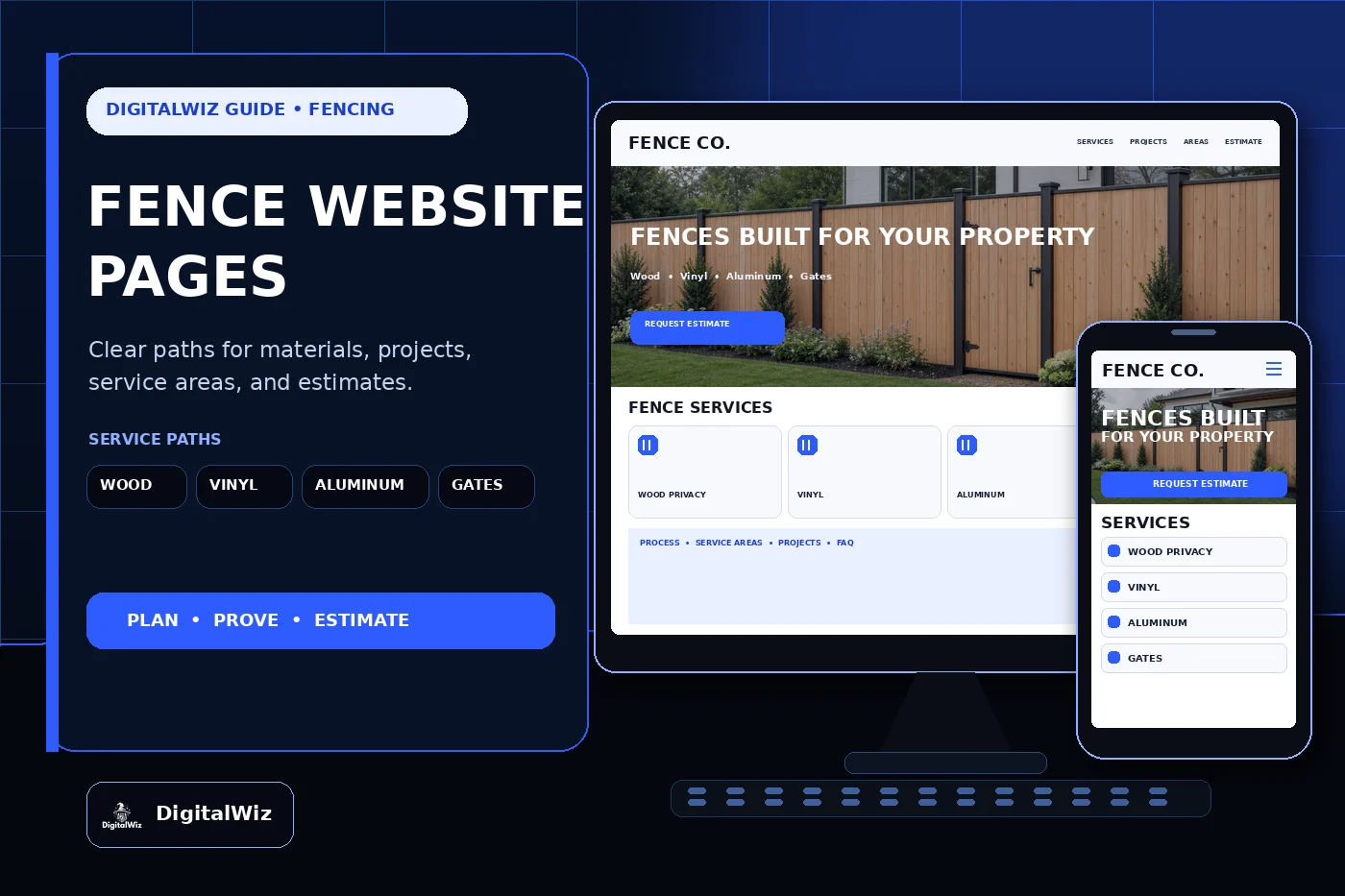
A fence company website should have focused pages for wood, vinyl, aluminum or ornamental fencing, chain-link when offered, gates, repairs, commercial work, service areas, project proof, pricing context, FAQs, and estimates.
The direct answer
A fence company website should have focused pages for the work customers actually compare: wood privacy fencing, vinyl, aluminum or ornamental metal, chain-link when offered, pool fencing within the company's scope, gates, repairs, commercial work, service areas, project proof, reviews, pricing context, FAQs, and estimates. One generic services page makes the buyer sort through materials, property types, and project limits alone.
For a Charlotte or NC fence contractor, those paths should separate a new backyard privacy fence from a pool enclosure, decorative front-yard fence, damaged gate, commercial perimeter, or repair request. Material, height, grade, soil, access, demolition, gates, local rules, utility coordination, and the property's actual boundary can all change the job.
Keep the structure useful. Give every real material and project type a clear page, explain how the site visit and proposal work, show permission-safe installations, state the actual service area, and make requesting an estimate easy on a phone. That gives the website, Search Visibility, and Paid Ads Management clear destinations instead of sending every visitor to the homepage.
- Separate wood, vinyl, aluminum or ornamental, chain-link, gates, repairs, and commercial work when the buyer or process differs.
- Explain the site visit, measurements, material choices, layout, approvals, installation, cleanup, and next steps.
- Publish accurate service areas, project minimums, lead times, warranties, and estimate boundaries.
- Track calls, forms, site visits, proposals, sold projects, fence type, and lead quality.
Build pages around materials and project types
Start with the fences the company is equipped, insured, and staffed to install. For many residential contractors, that means wood privacy, vinyl privacy or picket, aluminum ornamental, chain-link, pool fencing, farm or split-rail work when offered, custom gates, and repairs. A team serving HOAs, apartments, schools, warehouses, athletic facilities, or industrial properties may need a separate commercial section built around access, security, scheduling, documentation, and larger scopes.
Each material page should answer the first questions fast: where does this system fit, which styles and heights are available, how does the site affect installation, what maintenance is typical, how are gates handled, what may change the proposal, and how does the customer request an estimate? A gallery of beautiful fences does not explain whether the company installs on slopes, removes an old fence, handles powered gates, repairs storm damage, or works around a pool.
Build these revenue pages before filling the blog with generic backyard ideas. Service pages and blog posts have different jobs in local SEO. An article can compare wood and vinyl. The material page still has to carry the scope, options, process, proof, limitations, and estimate conversation.
- Wood page: privacy and decorative styles, species or board options, posts, gates, finish or staining boundaries, maintenance, and matching projects.
- Vinyl page: profiles, colors actually available, reinforcement, gates, grade changes, cleaning, warranties, and estimate path.
- Aluminum or ornamental page: styles, heights, rails, gates, pool-use boundaries, finish, grade transitions, and project examples.
- Chain-link or commercial page: fabric, coating, height, privacy options, gates, access control boundaries, scheduling, and account inquiries.
Explain layout, boundaries, and approvals clearly
Fence projects touch decisions the website should not blur together. The contractor can explain its measuring, layout, proposal, utility-coordination, permit, HOA, and installation process. It should not imply that a quick walkaround establishes a legal property line or that every project can use the customer's preferred height and placement without review.
State what the company needs before work begins. That may include an existing survey or other boundary information, HOA approval, permit information, access through a gate or neighboring area, utility-locate coordination, pool-barrier requirements, or confirmation of who removes landscaping and the old fence. The exact responsibilities vary by company and location, so the page should match the real contract instead of offering one universal checklist.
A good process page also explains what happens on difficult sites: slopes, retaining walls, tree roots, drainage paths, rock, narrow access, shared fence lines, easements, septic areas, irrigation, and nearby structures may require a different layout, equipment plan, or additional review. Clear limits prevent the sales page from promising a design the field team cannot install.
- Explain how the proposed fence line is marked and which boundary information the customer must provide.
- State who handles permit research, HOA submissions, utility locating, neighbor access, and pool-barrier coordination.
- Describe how slopes, retaining walls, drainage, trees, rock, utilities, easements, and tight access affect planning.
- Keep legal-boundary, code, engineering, and approval claims precise; refer customers to the appropriate authority or professional when needed.
Turn fence projects into useful proof
Fence buyers need more than a tight photo of perfect boards. A useful project example identifies the general area, property type, purpose, material, style, height when appropriate, gate plan, grade or access challenge, old-fence removal when included, and completed result. Wide views show whether the fence line, gates, posts, transitions, and relationship to the property make sense.
Match proof to the page. Wood visitors should see comparable styles, corners, gates, and grade changes. Vinyl buyers need believable profiles and clean transitions. Aluminum and pool-fence visitors need clear views of spacing, gates, latches, terrain, and the surrounding context without implying that one photo proves compliance for every property. Commercial buyers may care more about perimeter length, access points, scheduling, security needs, documentation, and communication.
Use only real, permission-safe work as company proof. Never invent projects, customers, reviews, ratings, awards, material warranties, locations, or before-and-after results to fill a template. Recent contractor projects strengthen a website when they show what the company actually installed and help the buyer judge fit.
- Label the general area, fence material and style, property type, project goal, gates, site challenge, and completed scope.
- Use wide elevations plus clear details of posts, corners, transitions, gates, and hardware when useful.
- Remove exact addresses, faces, license plates, security details, access codes, and private property information.
- Never present stock, supplier, or conceptual imagery as a completed customer installation.
Explain estimates and cost drivers without a bait price
Fence pricing changes with more than linear footage. Material and style, fence height, post system, grade, soil and rock, corners, gates, hardware, demolition, haul-off, clearing, access, equipment, retaining conditions, custom fabrication, permits, commercial scheduling, and travel can all move the proposal. A tiny starting price can set the wrong expectation when it excludes the property the customer actually owns.
The website can still be useful. Some companies can publish project minimums, repair-call fees, planning ranges, or examples for straightforward installations. Others are better served by explaining the main cost drivers, what photos and documents help, when a site visit is required, and what a written estimate includes. Either approach gives the customer more context than a blank form with no process.
Spell out the common boundaries: survey or boundary work, permits, HOA fees, utility relocation, vegetation removal, grading, retaining walls, old-fence disposal, staining or sealing, electrical work, access-control equipment, landscape repair, and gate automation may or may not be included. Use the framework in Should I Put Prices on My Business Website? to add context without pretending every fence line has one price.
- Explain the biggest material, height, grade, soil, demolition, gate, access, approval, and scheduling cost drivers.
- Publish ranges, minimums, fees, or packages only when the company can support and update them.
- Define what the estimate includes, what is optional, and how changed or hidden conditions are handled.
- Keep deposits, change orders, cancellation terms, lead times, material warranties, and workmanship warranties current.
Use real service areas and track lead quality
Fence contractors have practical geographic limits. Crew travel, material delivery, equipment transport, project minimums, repair calls, permitting familiarity, commercial scheduling, and follow-up all affect coverage. State the core service area clearly. If full installations, small repairs, automated gates, and commercial projects have different ranges, explain that rather than publishing one oversized map.
A Charlotte-area fence company may genuinely serve Charlotte, Matthews, Indian Trail, Waxhaw, Monroe, Concord, Huntersville, Gastonia, Fort Mill, or nearby markets. A dedicated city page makes sense when the company can add original information: actual availability, local project examples, property or terrain context, materials installed there, approval resources, and useful proof. Cloning one paragraph across every town does not make the business more local. Read Should I Build City Pages for Every Service Area? before adding another location page.
Then make the estimate path useful on a phone. Ask for name, phone, email, property address, fence material or goal, approximate footage if known, preferred height, number of gates, old-fence removal, grade or access notes, desired timing, and optional ground-level photos or survey information. Track source, campaign, landing page, call or form, requested fence type, coverage fit, site visit, proposal, sold work, project value, and lead quality when the sales system allows it.
Want a quick read on whether your fence company website has the right material pages, local-search foundation, project proof, estimate path, and tracking? Run a free BizScore audit. It will surface the biggest gaps so you can fix the highest-impact issue first.
- State real installation, repair, gate, commercial, and specialty-project coverage when those areas differ.
- Create local pages only where the company can add original proof and useful market information.
- Route material, repair, pool, gate, commercial, and access-control inquiries to the right workflow.
- Measure lead quality through site visit, proposal, sold project, fence type, route fit, and project value when possible.