What Pages Should a Pool Contractor Website Have?
A pool contractor website should have focused pages for new pool construction, renovations, service or maintenance when offered, pool types, design process, service areas, project proof, pricing context, financing, FAQs, and estimates.
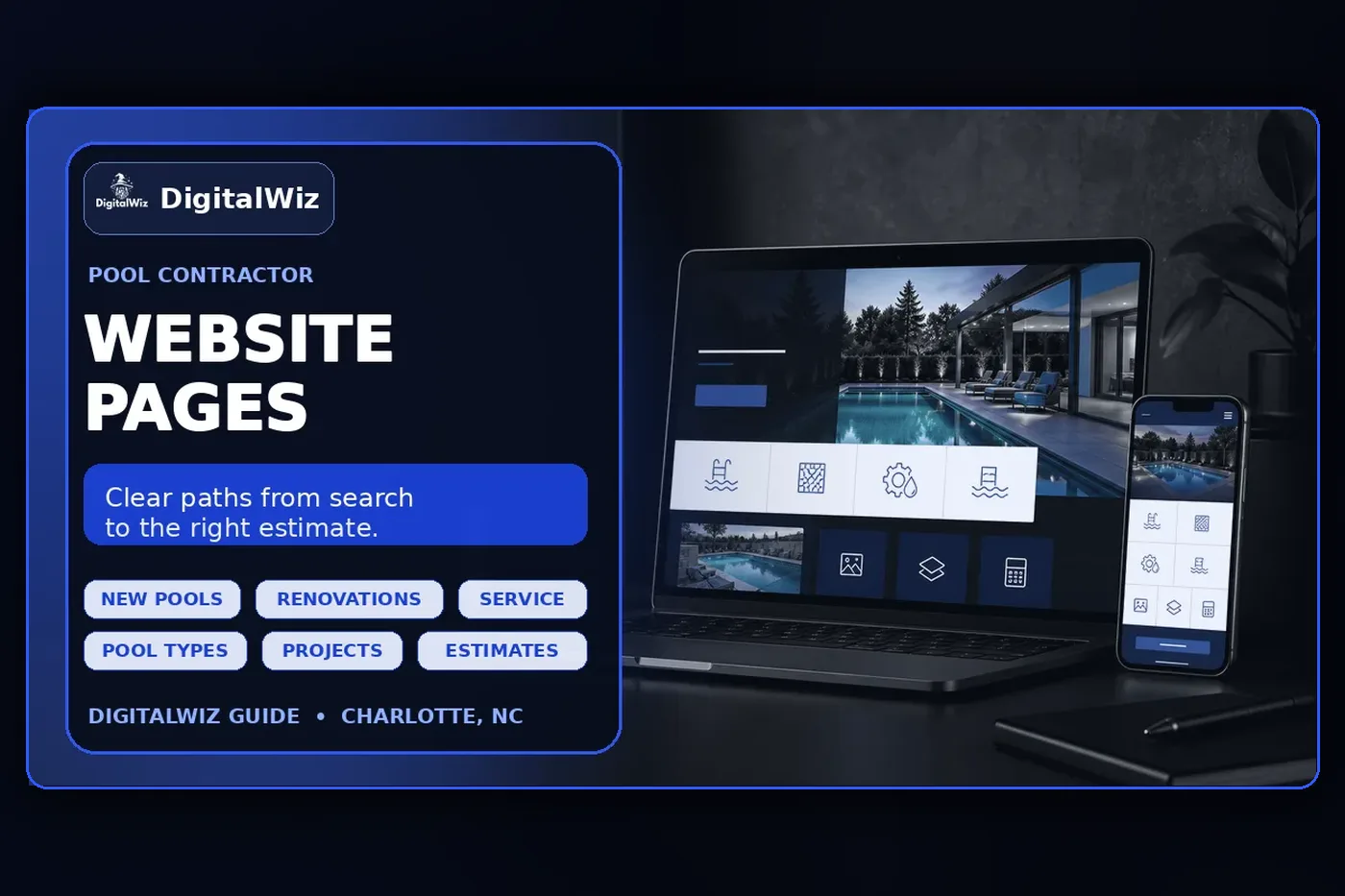
The direct answer
A pool contractor website should have focused pages for the work customers actually compare: new pool design and construction, renovations or resurfacing, fiberglass, concrete or vinyl-liner pools when offered, spas and water features, decks or outdoor-living work within the company's scope, equipment upgrades, service or maintenance, service areas, project proof, reviews, pricing context, financing, FAQs, and estimates. One broad pool services page makes a high-consideration buyer piece the company together on their own.
For a Charlotte or NC pool company, the site should separate a new backyard project from an existing-pool problem. A homeowner planning a custom pool has different questions than someone comparing resurfacing, replacing a liner, upgrading equipment, repairing a leak, adding automation, or hiring weekly maintenance. The design process, site visit, budget, timeline, permits, access, and next step can all change.
Keep the structure practical: give each profitable line of work a useful page, show real matching projects, explain how design and estimating begin, state the actual service area, and make it easy to inquire on a phone. That gives the website, Search Visibility, and Paid Ads Management specific destinations instead of sending every click to the homepage.
- Separate new pools, renovations, repair, and maintenance when the customer and sales process differ.
- Create pool-type or feature pages only for systems the company genuinely designs, builds, or services.
- Show real projects with useful scope, material, access, and process context.
- Track calls, forms, design consultations, site visits, proposals, sold work, and lead quality.
Build pages around the pool work the company wants
Start with the calls the business is equipped to handle. A design-build pool contractor may need pages for custom pool construction, fiberglass pools, concrete or gunite pools, vinyl-liner pools, spas, tanning ledges, water features, pool decks, outdoor kitchens, and complete backyard projects. A renovation team may focus on resurfacing, tile and coping, liner replacement, deck renovation, equipment changes, and structural or cosmetic updates within its actual capabilities.
Service companies have a different menu. Weekly maintenance, openings and closings, inspections, leak detection, pumps, filters, heaters, salt systems, automation, cleaning, and repairs may deserve focused pages when the company offers them. Do not publish a page for every possible component just to collect keywords. A page should exist because the team can explain, sell, schedule, and support that work.
Each page should answer the buyer's first questions quickly: do you handle this type of pool or project, do you serve my area, can I see comparable work, what happens during the first visit, what choices matter, and how do I get a proposal? Build these revenue pages before filling the blog with generic backyard inspiration. Service pages and blog posts have different jobs in local SEO.
- New pool page: design options, pool types, site evaluation, access, selections, construction stages, and consultation path.
- Renovation page: existing condition, resurfacing, tile, coping, decks, equipment, limitations, and matching projects.
- Service page: covered systems, scheduling, diagnostic process, maintenance options, service limits, and contact path.
- Commercial page: property types, documentation, access, scheduling, service capacity, and account inquiries when offered.
Separate new construction, renovation, and service
A new pool buyer is planning a property project, not ordering one product from a shelf. The page should explain how the company evaluates the yard, access, grade, drainage, utilities, desired use, pool type, features, deck relationship, equipment, selections, permits, and construction sequence. It should also say what the first consultation covers and what information helps the team decide whether the project is a fit.
Renovation visitors already have a pool and may not know what is cosmetic, mechanical, or structural. Explain what the company inspects before recommending resurfacing, tile, coping, deck work, liner replacement, equipment upgrades, or a broader rebuild. Avoid diagnosing a leak, crack, stain, movement, plumbing issue, or equipment failure from one photo. Existing conditions can change the appropriate scope.
Maintenance and repair need a faster route. Show the real coverage area, supported pool and equipment types, current scheduling expectations, and whether the company serves pools it did not build. If emergency or same-day language appears, it should match actual staffing. Keeping these paths separate prevents a weekly-service request from landing in a design form and a major renovation lead from getting buried in a repair queue.
- Use different inquiry paths for new construction, renovations, one-time repair, and recurring service.
- Explain the first evaluation without promising a scope before the property or pool is inspected.
- State which pool types, equipment categories, property types, and geographic areas the company supports.
- Keep availability claims accurate and easy for office or dispatch staff to update.
Turn the project gallery into useful proof
Pool work is visual, but a wall of perfect blue-water photos does not answer many buying questions. Useful project proof identifies the general area, original yard or pool condition, project type, major selections, access considerations, scope, and finished result. For new construction, show how the pool, deck, grade, drainage, equipment area, and home relate to one another instead of relying only on tight waterline crops.
Put proof beside the matching service. Fiberglass examples belong on the fiberglass page. Renovation visitors should see comparable before-and-after conditions with honest labels. An equipment or automation page needs tidy, understandable installation context rather than a luxury backyard that hides the actual work. A commercial buyer may care more about coordination, access, documentation, scheduling, and a similar property type.
Use only real, permission-safe work as company proof. Stock or AI imagery can support a design concept when it is labeled honestly, but it should never be presented as a completed client pool. Recent contractor projects strengthen a website when they help the buyer compare fit instead of manufacturing a portfolio.
- Label project type, general area, pool or renovation category, notable choices, and completed scope.
- Show wide views plus useful details such as coping, tile, transitions, equipment areas, and deck relationships.
- Never invent a customer, review, project location, award, rating, or construction result.
- Keep exact addresses, access details, family information, security features, and identifiable private spaces out of public proof.
Explain process, safety, and project boundaries clearly
Pool projects can involve design, excavation, utilities, structures, barriers, electrical work, plumbing, drainage, inspections, and local approvals. The website should explain who coordinates each part in the company's normal process without pretending every municipality or property follows one checklist. Rules and responsibilities can vary by location and scope, so keep permit and inspection language accurate to the markets the team serves.
The same care applies to safety copy. Explain that barriers, gates, alarms, electrical systems, drains, equipment, water chemistry, and operating instructions need to follow the applicable project requirements and manufacturer guidance. Do not turn the sales page into a do-it-yourself technical manual, and do not make a blanket claim that one feature makes a pool safe.
A clear process page can cover initial fit, site visit, concept or design, selections, preliminary budget, proposal, engineering or permitting when required, scheduling, construction, inspections, startup, orientation, and warranty or service handoff. Keep it aligned with the real company workflow. If design fees, deposits, change orders, owner-supplied work, landscape restoration, fencing, or electrical upgrades sit outside the base scope, say so before the proposal stage.
- Describe who handles design, site evaluation, plans, permits, inspections, trades, startup, and handoff.
- Separate included work from owner responsibilities and common outside scopes.
- Use calm, specific safety language without unsupported guarantees or risky instructions.
- Review process and compliance copy whenever service areas, partners, or project types change.
Give honest pricing and financing context
Pool pricing changes with much more than length and width. Pool type, design, excavation, soil and rock, access, grade, drainage, engineering, utilities, plumbing runs, equipment, heating, automation, interior finish, tile, coping, deck area, retaining needs, water features, lighting, landscaping, fencing, permits, haul-off, and site restoration can all move a new-build proposal. Renovation costs depend on the existing shell, finish, tile, coping, deck, plumbing, equipment, hidden conditions, and access.
The website can still help. Some companies can publish project minimums, planning ranges, design fees, service-call fees, or maintenance plan details. Others are better served by explaining the main cost drivers and what the first consultation or inspection includes. Either approach is stronger than a tiny starting price that excludes most of the finished project.
If financing is available, explain who provides it, which project types may qualify, and where the customer can review current terms. Do not imply guaranteed approval or hide important conditions behind a button. For a broader framework, read Should I Put Prices on My Business Website?.
- Explain the largest new-build, renovation, repair, and maintenance cost drivers in plain language.
- Publish ranges, fees, or minimums only when the company can support and update them.
- Clarify whether design, engineering, permits, utilities, fencing, landscaping, and restoration are included.
- Keep financing language current, qualified, and free of guaranteed-approval claims.
Use local pages and lead tracking with a purpose
Pool contractors have real geographic limits. Design meetings, equipment coverage, excavation logistics, supplier distance, permitting familiarity, service routes, warranty visits, and project size can all affect where the company works. State the core area clearly. A Charlotte-area company may serve different markets for custom construction than it does for weekly maintenance or one-time repairs.
Build a city page only when it adds useful local information: actual coverage, completed projects, property or access context, relevant process details, local reviews, service limitations, or scheduling expectations. Google's Business Profile guidance describes local results as mainly shaped by relevance, distance, and prominence. Complete business information and truthful service coverage help customers understand the fit; cloned city pages cannot erase distance.
Then make the form useful on a phone. Ask for contact details, property location, new pool or existing pool, project or service type, desired timing, rough goals, access notes, and optional photos. Track traffic source, landing page, call or form, consultation or service booking, proposal, sold work, project category, service area, and lead quality when the sales process allows it.
Want a quick read on whether your pool company website has the right service pages, project proof, local-search foundation, inquiry path, and tracking? Run a free BizScore audit. It will surface the biggest gaps so you can fix the highest-impact issue first.
- State the actual construction and service coverage instead of publishing one vague regional claim.
- Create local pages only where the company can add original proof and useful market information.
- Route new construction, renovation, repair, maintenance, and commercial requests to the right workflow.
- Measure lead quality through consultation, site visit, proposal, sold work, and service retention when possible.