Are Google Local Services Ads Worth It for a Service Business?
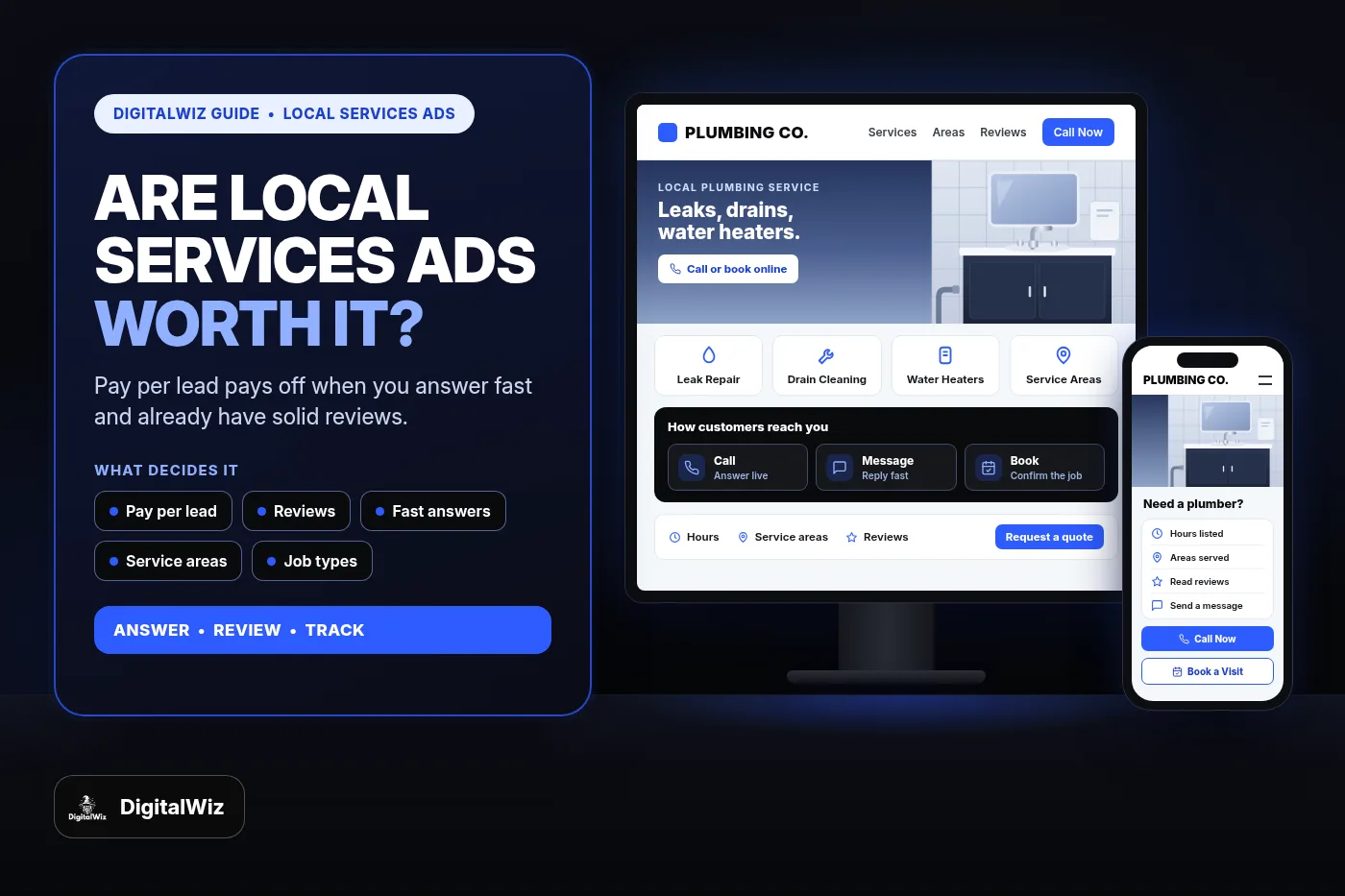
Google Local Services Ads can be worth it for service businesses that answer the phone quickly, have solid Google reviews, and want to pay per lead instead of per click. They are a weaker fit if calls get missed, reviews are thin, or you need full control over keywords and landing pages.
The direct answer
Google Local Services Ads (LSA) are often worth testing for home and local service businesses, but only if your business is set up to win the lead once the phone rings. You pay for leads rather than clicks, your ad can show your Google reviews and a Google Verified badge once you qualify, and the ad can appear prominently on Google Search for the services and areas you choose.
They are not a shortcut around the basics. Google ranks these ads partly on how quickly you respond, how many reviews you have and how good they are, and how complete your profile is. A business that misses calls or has a thin review history usually pays for leads it does not convert, or barely shows at all.
A quick way to decide:
- Good fit: your category is eligible, someone reliably answers calls during business hours, and you already have a healthy base of Google reviews.
- Test carefully: you are newer, have few reviews, or can only answer the phone part of the day.
- Not first: you cannot pass licensing or background requirements yet, or you need traffic to specific landing pages and offers.
How Local Services Ads actually work
LSA is a different product from the regular Google search ads most people picture. Instead of writing ads and paying when someone clicks to your website, you build a profile with your services, service area, hours, photos, and a short business bio. When a customer taps your ad, they see that profile and can call you, send a message, or, in some categories, request a booking.
Google charges for valid leads, not clicks. According to Google's Local Services help center, a valid lead can be an answered call, a missed call during your business hours where the caller stays on the line for more than 20 seconds, a voicemail, a text or email message, or a booking request. Lead prices vary by location, job type, lead type, and bidding mode, so there is no single price to plan around.
You set an average weekly budget. Google can spend more than that in a given week, but not more than the monthly maximum based on that weekly average. Billing runs through Google Ads, and the account has to pass Google's screening and verification checks, which can include business registration, licensing, insurance, and background checks depending on your category and location.
- Your ad shows your business name, rating, review count, hours, and the Google Verified badge once you qualify.
- Calls go through a Google tracking number that forwards to your business phone.
- Reviews come from your Google Business Profile, so the two are connected.
When LSA tends to be a good fit
LSA suits businesses whose customers pick up the phone, compare a few options, and book. Think plumbers, HVAC, electricians, roofers, garage door, pest control, cleaning, and similar trades where the decision is "who can come out and do this job" rather than "which website explains this best."
It also helps when you do not have the time or budget to build and manage a full search campaign yet. The setup is simpler than Google Ads search campaigns: no keyword lists, no ad copy testing, and no landing page to build before you can start, although the verification checks can take time.
- You can answer most calls live during the hours you list, or call back quickly.
- Your Google review count and rating hold up well against competitors in your area.
- You can clearly define the job types you want and the areas you can actually serve.
- Paying per lead fits how you already think about marketing costs.
When LSA is a poor fit, or should not come first
LSA is a weak starting point if calls routinely go to voicemail. Missed calls hurt your responsiveness, and responsiveness affects where you rank. You can also pay for a missed call during business hours if the caller stays on the line long enough, so a busy crew with nobody covering the phone is a costly combination.
It also does little for a business with a handful of reviews, because star rating and review count are part of how Google orders profiles. In that case, a steady review habit and a solid Google Business Profile usually need to come first. Our guide on whether Google reviews help local SEO covers how to build that habit without breaking Google's rules.
Finally, LSA gives you less control. You cannot choose exact keywords, write ad headlines, or send people to a specific page on your site. If you need to promote one service, one offer, or one high-margin job type, a regular search campaign usually gives you more precision.
Local Services Ads vs. regular Google search ads
The two formats solve different problems, and many service businesses can use both. LSA is closer to a pay-per-lead directory listing with Google's verification behind it. Search ads are a pay-per-click channel where you control keywords, messaging, and the landing page.
With search ads, the landing page does a lot of the selling, which is why we recommend a focused page instead of your homepage. See whether you need a separate landing page for Google Ads for how to build one. With LSA, your reviews, hours, and how fast you answer do most of that work instead.
If you are still deciding between paid search and organic growth in general, start with Google Ads or SEO first. LSA is one more paid option inside that decision, not a replacement for it.
- LSA: pay per lead, profile-based, limited control, depends heavily on reviews and responsiveness.
- Search ads: pay per click, keyword and ad control, depends heavily on your landing page and tracking.
- Both: only worth it if you can see which leads turn into booked jobs.
What decides whether you get leads
Google describes the LSA ranking as an auction that weighs your bid and the quality of your profile. The factors it lists include how likely your ad is to produce a lead, how relevant your services are to the search, and your responsiveness. Profile quality includes your rating, number of reviews, response time, photos, and the verification checks you have completed.
In practice, that means operations matter as much as marketing. The same habits we cover in how fast a service business should respond to a website lead apply here: answer quickly, call back missed calls, and reply to messages even when you have to decline the job. Google says regularly failing to answer calls or respond to messages can affect your ad ranking.
- Keep your hours accurate. Google uses your Business Profile hours to decide whether a missed call counts.
- Add real photos of your work. Google asks advertisers not to upload personally identifying photos.
- Turn on message leads if you cannot always answer the phone, and respond to them promptly.
- Keep asking happy customers for reviews.
How to avoid paying for the wrong leads
A lot of wasted LSA spend comes from settings, not from the ads themselves. Google's help pages say it no longer supports lead credits for "job type not serviced" or "geo not serviced" leads. If a lead comes in for work or a location you did not really want, expect to pay for it, so get the settings right up front.
Google does automatically review leads and can credit ones its systems find to be spam, duplicates, or low quality, and you can rate individual leads to give feedback. That is useful, but it is not a substitute for clean settings.
- Select only the job types you actually want, not every option in your category.
- Set service areas to places you can reliably reach, and exclude the rest.
- Keep your ad schedule and Business Profile hours to times when someone can actually answer.
- Review the leads page weekly and rate poor leads so the system learns what you want.
How to tell whether it is working
The LSA dashboard shows leads and charges, but it cannot tell you which leads became paying jobs. That part is on you. Log every LSA lead in the same place as your website calls and forms, mark which ones booked, and compare the cost per booked job against your other channels.
Our guide to tracking where website leads come from walks through a simple weekly report that works for this. Give a new LSA account enough time and enough leads to judge fairly before you raise the budget or shut it off.
Common questions
Do Local Services Ads replace my website?
No. LSA sends people to a Google profile, not your site. Some customers will still look you up before they call, so your website, service pages, and reviews keep doing the convincing in the background.
Do I pay if I miss a call from a Local Services ad?
It can happen. Under Google's current rules, a missed call during your business hours can count as a valid lead if the caller stays on the line for more than 20 seconds. Answered calls are judged by the conversation instead. Rules change, so check Google's Local Services help center before you rely on any detail.
What happened to the Google Guaranteed and Google Screened badges?
Google announced in August 2025 that it would replace Google Guaranteed, Google Screened, License Verified by Google, and the related money-back guarantee with a single Google Verified badge starting that October.
Can I run Local Services Ads and regular Google search ads at the same time?
Yes. They are separate ad formats with separate settings. Running both can make sense, as long as you track the leads from each one separately so you know which is actually producing booked work.
How much does a Local Services Ads lead cost?
There is no fixed price. Google says lead prices vary by location, job type, lead type, and bidding mode. The number that matters for your business is the cost per booked job, which you can only see by tracking outcomes.
The bottom line
Local Services Ads are worth a real test for service businesses that answer the phone, have solid reviews, and keep their job types and service areas tight. If those pieces are not in place yet, fix them first. They will make every other channel work better too.
Want a second opinion on where LSA fits next to your website, search ads, and SEO? Run a free BizScore audit, see how we approach paid ads management and search visibility, or contact DigitalWiz to talk it through.