What Should Be on a Google Ads Landing Page for a Local Business?
A local Google Ads landing page should match the ad, focus on one offer, show local proof, make calling or booking easy, load fast on mobile, and track every call and form before more budget is spent.
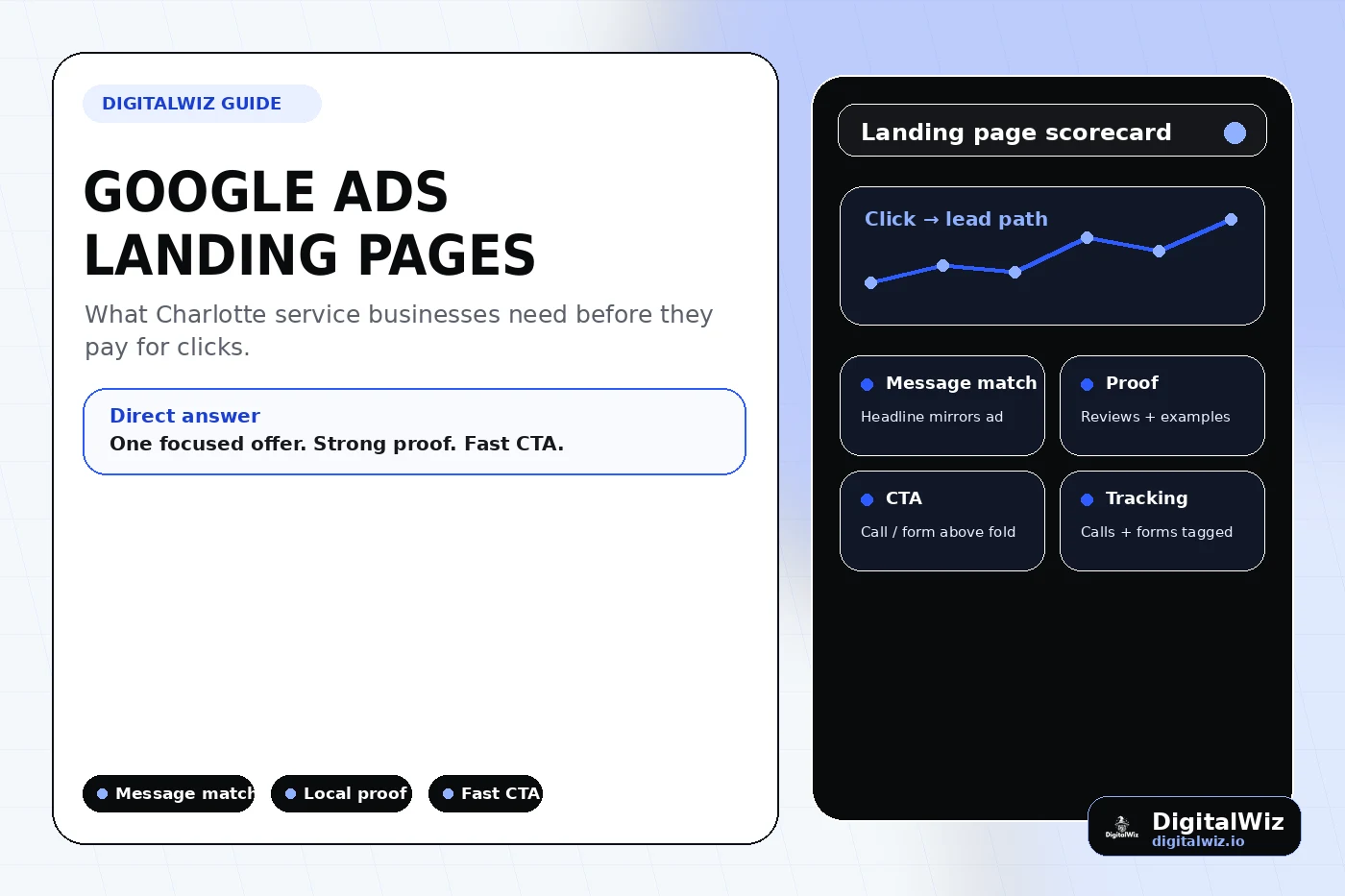
The direct answer
A good Google Ads landing page for a local business should do one job: turn a paid click into a qualified call, form fill, booking, or estimate request. It should not be a generic homepage, a cluttered service menu, or a page that makes people hunt for the next step.
The page needs tight message match with the ad, one clear offer, proof that you serve the local market, a strong call-to-action near the top, fast mobile performance, and tracking for calls and forms. If those pieces are missing, increasing the ad budget usually just buys more unclear traffic.
For a Charlotte service business, the best landing page feels specific: the service is obvious, the area is clear, the proof is relevant, and the visitor can call, book, or request a quote without scrolling through a maze.
- Lead with the exact service or offer from the ad, not a vague headline.
- Use one primary CTA: call, book, request a quote, or start an audit.
- Show local trust signals: reviews, service areas, project examples, credentials, or guarantees you can actually support.
- Track phone calls, form submissions, and lead quality before judging the campaign.
Start with message match
Message match means the landing page confirms what the searcher clicked. If the ad says "emergency plumbing repair in Charlotte," the page should not open with a broad "Welcome to our company" headline. It should immediately confirm the service, location, and next step.
This matters for buyers and for campaign quality. Google Ads documentation describes landing page experience as part of Quality Score, alongside expected clickthrough rate and ad relevance. The practical takeaway is simple: the page should be useful, relevant, transparent, and easy to navigate.
Local businesses often lose money when one ad group sends every click to the same page. A roofing repair ad, roof replacement ad, and commercial roofing ad may all need different headlines, proof, and CTAs even if they live on the same website.
- Repeat the core service from the ad in the H1 or opening section.
- Mention the city or service area when local intent matters.
- Keep the offer consistent from keyword to ad to landing page.
- Remove distractions that do not help someone take the next step.
Make one offer obvious above the fold
A landing page should not ask a cold visitor to understand your entire business in five seconds. It should answer: "Am I in the right place, can this company help me, and what do I do next?"
For most local campaigns, the top section needs a clear headline, a short benefit-driven subhead, a phone number or booking button, and one supporting proof point. If the page is for a free estimate, say that. If it is for a consultation, say that. If you respond quickly, explain what that means without overpromising.
DigitalWiz usually pairs Paid Ads Management with landing page cleanup because clicks are only valuable when the page can convert them. A better page can make the same ad spend work harder.
- Use one main CTA button and repeat it naturally down the page.
- Put click-to-call and form access where mobile users can reach it quickly.
- Keep forms short for first contact. Ask for details after the lead starts the conversation.
- Avoid competing CTAs like newsletter signup, unrelated service cards, and social follow buttons in the main conversion path.
Add proof that lowers risk
Paid traffic is skeptical traffic. The visitor may not know your business, and every competitor is one back button away. Proof helps the page feel safer before someone shares their information or calls your team.
Good proof is specific. Reviews, before-and-after examples, project photos, service-area details, badges, financing notes, response expectations, and simple process steps can all help. The goal is not to stuff the page with logos or claims. The goal is to answer the doubts that stop buyers from reaching out.
For regulated or trust-heavy categories like law firms, dentists, med spas, and home services, avoid exaggerated claims. Clear process, real reviews, helpful FAQs, and transparent next steps usually beat hype.
- Use reviews that mention the service being advertised when possible.
- Show local context: Charlotte, Matthews, Indian Trail, Waxhaw, Concord, Huntersville, Monroe, Rock Hill, or the actual service area.
- Include a short "what happens next" section so people know what to expect after submitting.
- Answer the top objections: cost, timing, service area, credentials, and availability.
Build for mobile speed and clarity
Most local ad clicks happen in impatient moments. Someone needs a quote, appointment, repair, consultation, or answer now. A slow page, tiny phone number, broken form, or buried CTA can waste the click before the visitor reads anything.
Mobile landing pages should be lightweight, readable, and easy to act on. That means short sections, clear buttons, compressed images, no intrusive popups, and a form that works on real phones. If the page looks good on desktop but fights users on mobile, the campaign will feel more expensive than it needs to be.
This is where Website Development and paid ads overlap. The ad creates the visit, but the website experience decides whether the visit becomes a lead.
- Test the page on a phone before launching the campaign.
- Keep the headline, proof, and CTA visible without forcing a long scroll.
- Make the phone number tappable and the form easy to complete.
- Compress images and remove scripts that do not help the landing page convert.
Track the leads, not just the clicks
A campaign can look busy and still be weak if nobody knows which calls and forms became real opportunities. At minimum, track form submissions, click-to-call actions, phone calls from ads, and the landing page source. Better tracking ties the lead back to campaign, keyword theme, service, and close quality.
This does not mean drowning in dashboards. It means knowing whether the campaign is producing useful conversations. A local business should be able to separate spam, job seekers, wrong-service requests, price shoppers, and strong leads before deciding whether to scale spend.
If you are already investing in Search Visibility, the same tracking discipline helps SEO too. Paid ads, SEO, AI visibility, and landing pages all improve when the business understands which pages and messages create real inquiries.
- Track calls and forms separately so phone-heavy campaigns do not get undervalued.
- Use thank-you pages or conversion events that confirm a real submission.
- Review lead quality weekly, not just cost per click.
- Feed winning search terms and objections back into service pages and FAQs.
The bottom line
A local Google Ads landing page should be focused, fast, trustworthy, and trackable. It should match the ad, explain the offer, prove the business is credible in the local market, and make the next step obvious.
If your ads are getting clicks but not leads, do not assume the only fix is a bigger budget. The landing page may need clearer copy, stronger proof, fewer distractions, better mobile UX, and better conversion tracking first.
Want to see where your paid traffic is leaking? Run a free BizScore audit or contact DigitalWiz. We will review the page, search visibility, paid ads path, and tracking so you know what to fix before spending more.