Do Google Reviews Help Local SEO?
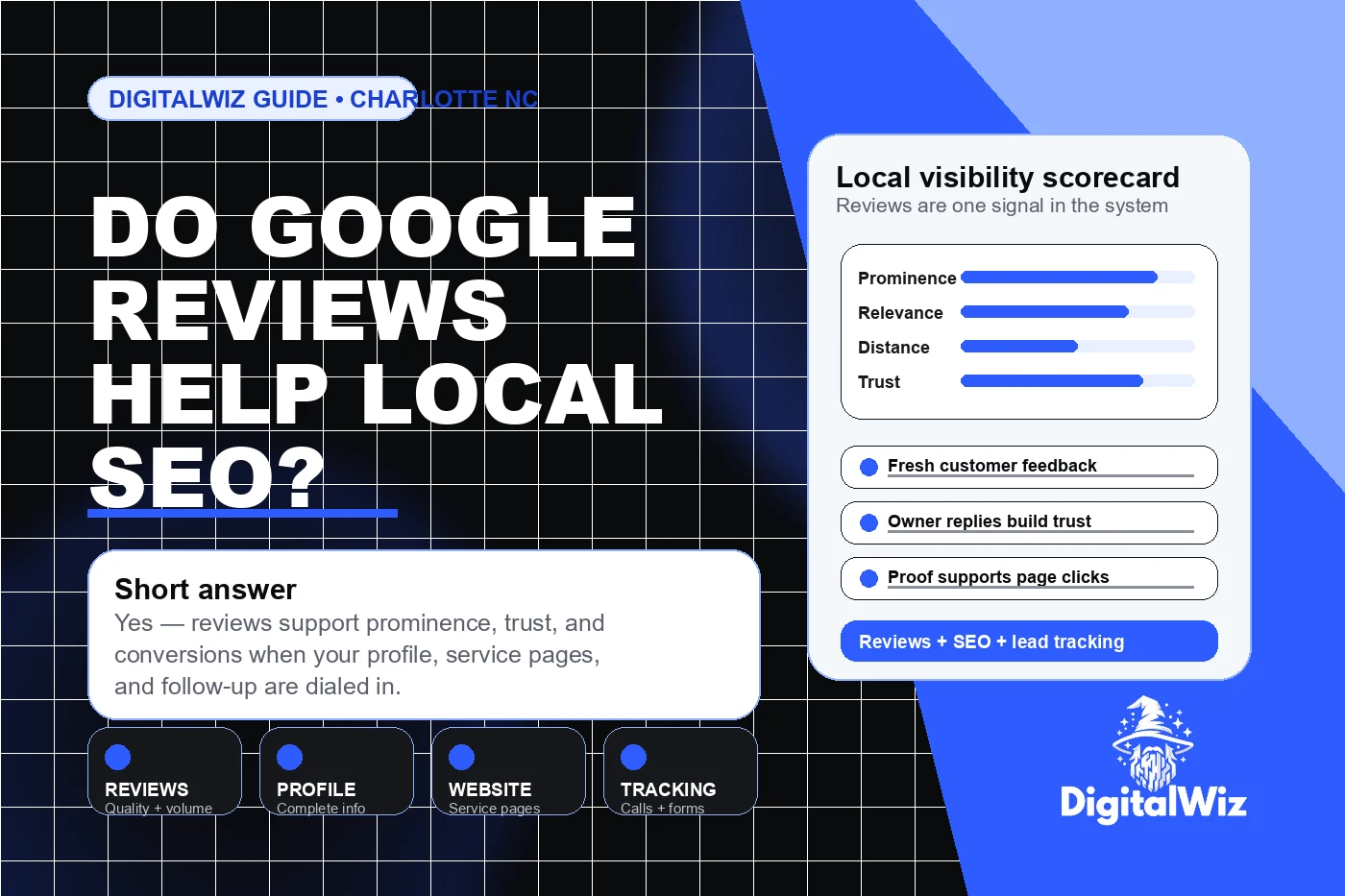
Yes. Google reviews can support local SEO because they feed prominence, trust, and buyer confidence — but they work best when your profile, website, and lead tracking are built correctly.
The direct answer
Yes — Google reviews help local SEO, but not like a magic ranking switch. Reviews can support the prominence and trust signals around your business, and they can make more people choose you when they see you in Google Search or Maps.
For a Charlotte service business, the practical goal is not just “get more stars.” The goal is to build a steady proof engine: real customer reviews, thoughtful owner replies, accurate Google Business Profile details, strong service pages, and tracking that shows which calls and forms came from local search.
Google’s own local ranking guidance says local results are shaped by relevance, distance, and prominence, and that more reviews and positive ratings can help local ranking. Google also recommends replying to reviews because it shows you value customer feedback. That is the playbook: earn real feedback, respond well, and connect it to a website that turns visibility into leads.
- Reviews can support local prominence and buyer trust.
- Review quality, recency, and owner responses matter more than chasing a one-time spike.
- Reviews work better when your Google Business Profile and website service pages are complete.
- Never buy fake reviews, review-gate customers, or stuff keywords into replies.
- Track calls, forms, and booked jobs so you know whether review growth is producing business.
Why reviews matter for local visibility
Local SEO is partly about proving that your business is real, active, relevant, and trusted in the market you serve. Reviews help with that proof. A homeowner comparing roofers, HVAC companies, med spas, dentists, law firms, restaurants, or contractors is usually looking for confidence before they call.
That confidence shows up in two places. First, reviews can influence how strong your business appears in local results. Second, reviews influence conversion. Even if two companies appear near each other on the map, the one with current, believable feedback and helpful responses often earns the click or call.
This is why reviews should sit inside a bigger Search Visibility system. Your profile, service categories, photos, services, website links, city/service pages, and review process all need to tell the same story.
- A complete Google Business Profile gives Google and customers clearer business information.
- Reviews add real-world proof that customers have used the business.
- Owner replies show the business is active and paying attention.
- Current feedback can reduce friction before a prospect calls or fills out a form.
What to do before asking for more reviews
Before you push for more reviews, clean up the basics. Make sure your name, address or service area, phone number, hours, categories, services, appointment links, and website link are accurate. A review push will not fix a messy profile.
Then check the landing experience. If someone clicks from your profile to your website, can they quickly see your services, service area, proof, FAQs, photos, and a simple next step? If the answer is no, review growth may create attention without enough leads.
For many local businesses, the best setup is a strong core website, focused service pages, a clean Google Business Profile, and a simple follow-up process after the job or appointment is complete.
- Confirm your primary and secondary Google Business Profile categories.
- Make sure your top services are listed clearly.
- Use a website page that matches the service people are looking for.
- Add photos that prove real work, location, team, or results when appropriate.
- Set up call and form tracking before judging performance.
How to ask for reviews without creating problems
Ask every satisfied customer in a normal, ethical way. Do it soon after the service while the experience is fresh. Make the request simple, but do not pressure people or offer rewards for positive reviews.
A good review request sounds human: thank them, mention the job or appointment, and send the direct review link. If they had a bad experience, solve the issue instead of trying to filter them away from Google. Review gating is risky and can damage trust.
The best review systems are boring and consistent. A contractor might ask after final walkthrough. A med spa might ask after a follow-up. A dentist might ask after a successful visit. A law firm might ask when the matter is closed and the client is comfortable sharing.
- Ask soon after a successful service or appointment.
- Use one direct review link and one clear request.
- Do not buy reviews or offer incentives for positive ratings.
- Do not ask staff, vendors, or fake accounts to pad the profile.
- Keep the request short enough that your team will actually use it.
How to respond to reviews
Reply to reviews like a real business owner, not a keyword robot. Thank the customer, reference the service naturally when it makes sense, and keep private details private. For negative reviews, stay calm, acknowledge the issue, and invite the person to continue the conversation offline.
Do not write awkward replies packed with city names and service keywords. That looks spammy to customers and does not build trust. The reply should make the next buyer think, “This company pays attention.”
A simple response rhythm can help: reply to new reviews weekly, flag anything that needs a service recovery conversation, and use recurring feedback to improve operations.
- Thank the customer by name when appropriate.
- Mention the service naturally, not repeatedly.
- Avoid sharing private project, medical, legal, or financial details.
- Move sensitive issues to phone or email.
- Use repeated feedback to improve the customer experience.
How reviews fit with SEO, ads, and lead tracking
Reviews help people trust you, but they do not replace your website, SEO, or paid ads. A business with strong reviews and weak pages can still lose leads. A business running paid ads without review proof may pay for clicks that do not convert well.
The stronger system connects everything: review growth, Google Business Profile optimization, service pages, landing pages, call tracking, form tracking, and follow-up. That lets you see whether local search is producing real opportunities instead of just profile views.
If you want help tightening that system, start with a free BizScore audit or book a strategy call through DigitalWiz. We will show you what to fix first: reviews, profile gaps, website pages, tracking, or ads.
- Use reviews to increase trust at the moment someone compares options.
- Use service pages to answer buyer questions and capture organic demand.
- Use landing pages to improve ad conversion and message match.
- Use tracking to see which channels create calls, forms, and booked work.