Google Ads or SEO First for Charlotte Businesses?
Need leads this month? Start with paid ads and a focused landing page. Want lower-cost visibility over time? Build SEO in parallel.
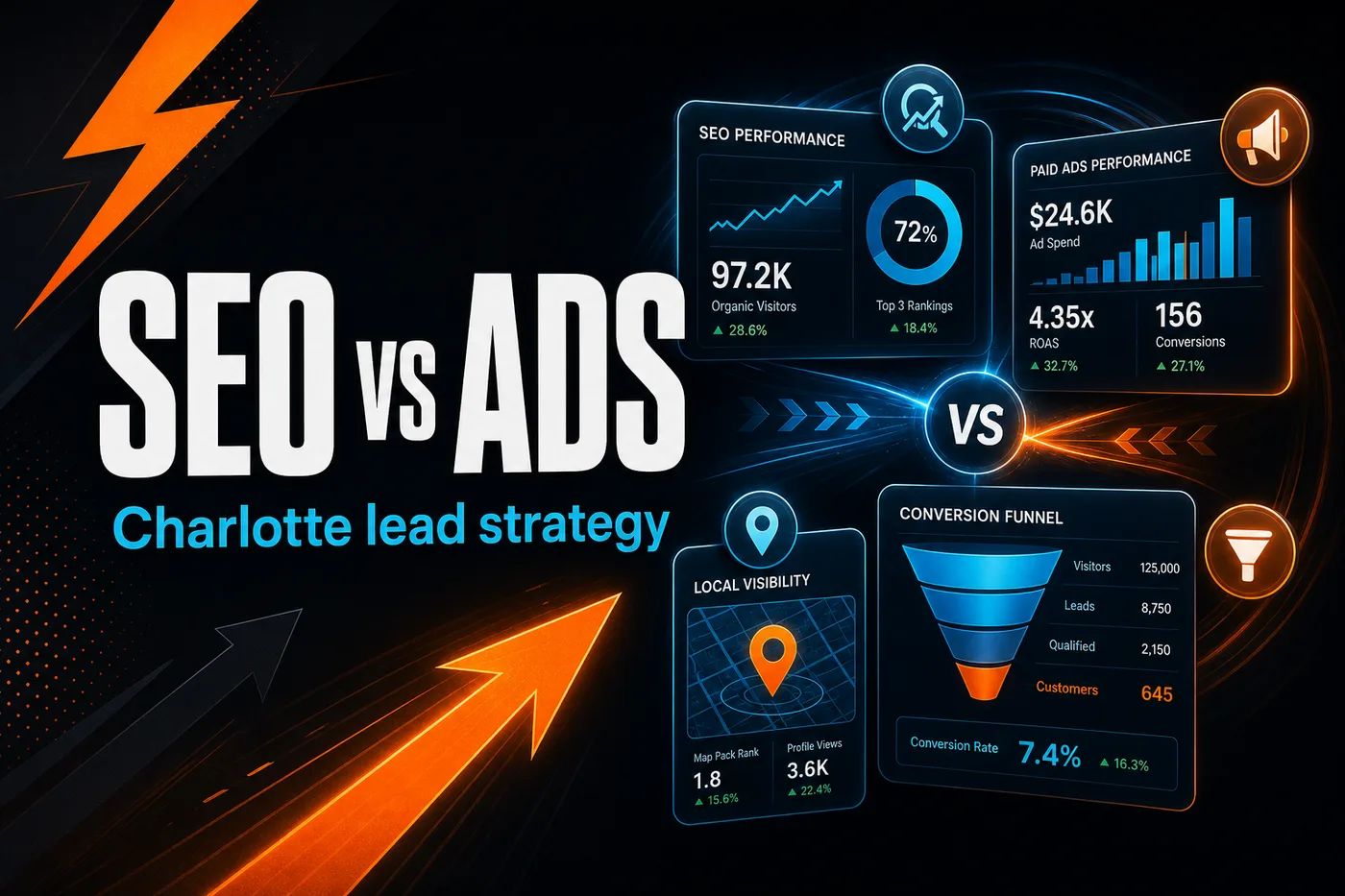
The direct answer
Run Google Ads first if you need qualified leads quickly and already have a page that can convert the click. Build SEO first if you can wait, your budget is tight, and your website needs a stronger long-term foundation.
For most Charlotte service businesses, the smartest move is not ads or SEO. It is ads for speed, SEO for durability, and conversion tracking so you know which channel actually turns into calls, forms, booked jobs, or consultations.
Google's own guidance separates the channels clearly: SEO improves unpaid visibility over time, while PPC ads are paid placements that can show beside relevant searches. They work differently, so they should be measured differently.
- Need leads now? Start with paid search and a dedicated landing page.
- Need a stronger search footprint? Build local SEO, service pages, and Google Business Profile signals.
- Need predictable growth? Use both, then shift budget based on tracked lead quality.
When Google Ads should come first
Paid ads make sense when speed matters. A roofer with storm-season demand, a med spa promoting a new treatment, a law firm testing a practice area, or a contractor entering a new neighborhood may not want to wait months for organic visibility to mature.
Ads also expose the truth quickly. You can test which services people search for, which headlines get calls, which cities convert, and which offers waste money. That data should feed your website development, landing pages, and future SEO content.
The catch: ads do not fix a weak offer or a weak page. If the page is slow, vague, hard to use on mobile, or missing trust signals, you are just paying to learn that the funnel is broken faster.
- Use ads for emergency services, seasonal demand, new offers, and competitive high-intent searches.
- Send clicks to a focused page, not a generic homepage.
- Track calls, forms, booked appointments, and cost per real lead — not just clicks.
When SEO should come first
SEO should come first when the business foundation is thin. If your website has no real service pages, your Google Business Profile is incomplete, your reviews are weak, or your city pages say nothing useful, paid ads may be premature.
Local SEO builds the proof buyers and search engines need: clear services, helpful answers, reviews, consistent business information, internal links, and pages that match how people search in Charlotte, Matthews, Concord, Huntersville, and nearby NC markets.
It is slower than launching an ad campaign, but the work compounds. A strong Search Visibility system can help you earn organic search traffic, map visibility, answer-engine visibility, and better landing pages for ads.
- Use SEO first when your site cannot explain what you do in plain language.
- Prioritize your highest-value services and service areas before writing random blog posts.
- Treat Google Business Profile optimization as part of SEO, not a separate afterthought.
The Charlotte lead-gen decision tree
Ask one question first: what happens if you get ten good leads this week? If the answer is “we can handle them and we know what they are worth,” ads can be a good first move. If the answer is “we are not sure where leads come from or what our close rate is,” fix tracking before spending heavily.
Next, look at urgency. Emergency plumbers, roofers, restoration companies, med spas with appointment capacity, and lawyers in competitive practice areas often benefit from controlled paid search tests. Restaurants, local retailers, home service brands, and professional services still need local SEO so people can verify them before choosing.
Finally, look at the page. A high-intent search deserves a high-intent landing page with the service, location, proof, FAQs, reviews, contact options, and one clear next step.
- High urgency + strong page + tracking in place = test ads first.
- Low urgency + weak site + thin local proof = build SEO first.
- Competitive market + budget to learn = run both with tight measurement.
What not to do
Do not spend on ads just because a competitor is doing it. You do not know their margins, close rate, tracking setup, or wasted spend. Copying their channel without copying their funnel is how small businesses burn budget.
Do not wait on SEO until ads “work.” The best ad accounts usually get help from strong organic assets: clear pages, strong reviews, local trust, fast mobile performance, and content that answers buyer objections before the call.
And do not judge either channel by vanity metrics. Rankings, clicks, impressions, and cost per click matter only if they connect to revenue-producing conversations.
- No ads without conversion tracking.
- No SEO plan based only on keywords with no buyer intent.
- No campaign sending every visitor to the homepage.
A practical 30-day starting plan
Week one: choose one service, one audience, and one city or service area. Build or tighten the landing page. Add proof, FAQs, service details, photos, reviews, and a clear call to action.
Week two: set up call tracking, form tracking, Google Analytics events, and a simple lead-quality review process. You need to know which leads were real, which closed, and which were junk.
Weeks three and four: launch a small paid search test while building the SEO assets that support it — service-page copy, internal links, Google Business Profile updates, and helpful answer content. DigitalWiz can help with Paid Ads Management, Search Visibility, or a free BizScore audit if you want the gaps mapped before you spend.
- One offer.
- One landing page.
- One tracking setup.
- One SEO foundation checklist.
- One decision after real lead data comes in.