Do I Need a Separate Landing Page for Google Ads?
Usually yes. Paid clicks should land on a page built for that exact service, city, offer, and next step — not a busy homepage.
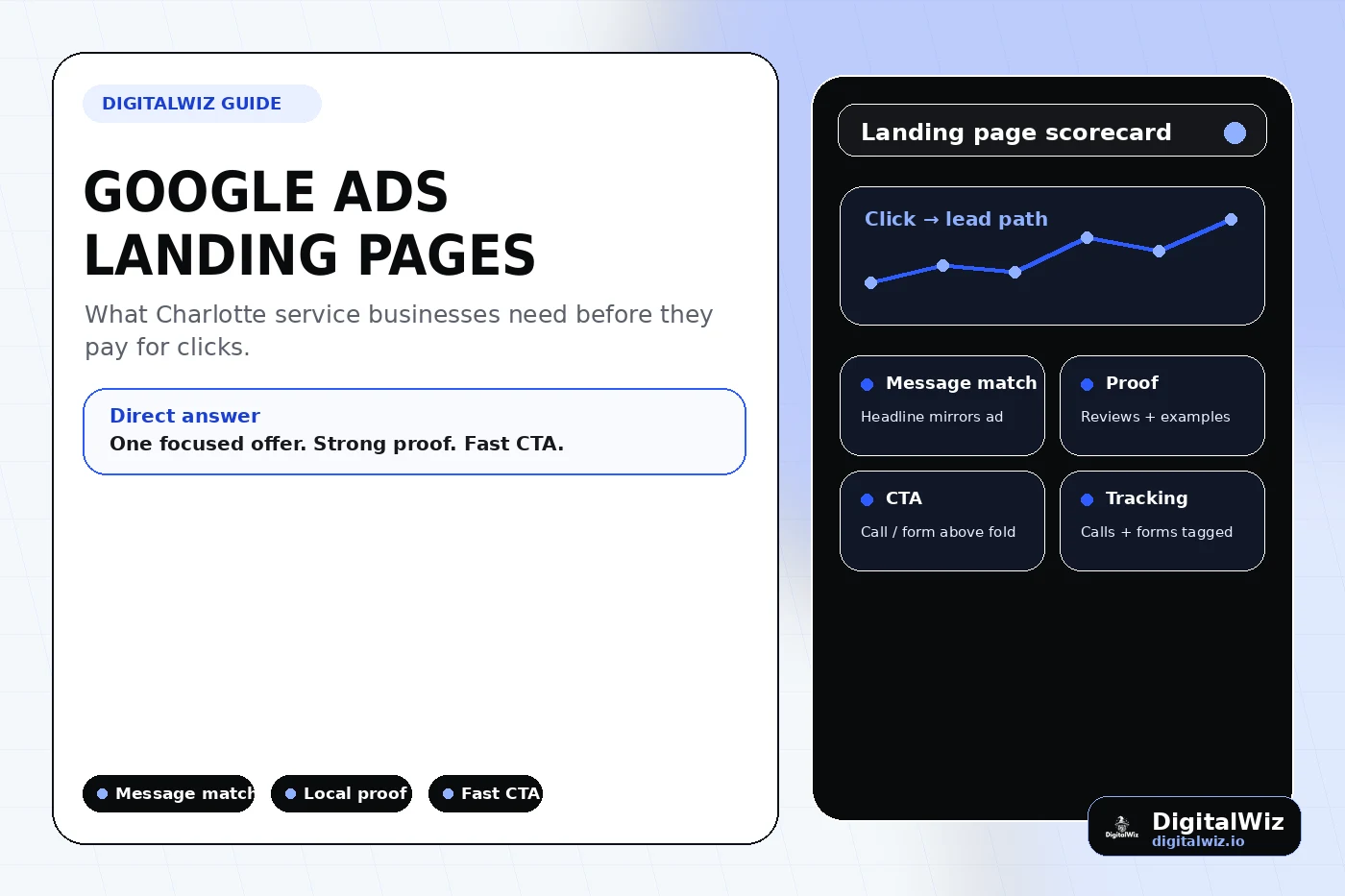
The short answer
Yes — most Google Ads campaigns should use a separate landing page, especially when the click is tied to one service, one location, one offer, or one urgent problem. A homepage is built to introduce the whole business. A landing page is built to convert one searcher into one call, form, booking, or quote request.
For Charlotte service businesses, that difference matters. Someone searching for emergency roof repair, Botox appointments, dental implants, HVAC replacement, or a personal injury lawyer does not want to decode your entire website. They want to know: do you handle this, do you serve my area, can I trust you, and what do I do next?
Use the homepage only when the search is broad or branded. For high-intent paid search, build a focused page that matches the ad and the keyword.
- Use a landing page for one service, one city, one offer, or one audience.
- Use the homepage for branded searches or broad business-introduction traffic.
- Make the page answer the same promise your ad made.
- Track calls, forms, booking clicks, and qualified leads — not just page views.
Why sending ad traffic to the homepage usually wastes money
Your homepage has a lot of jobs. It explains the brand, links to services, builds trust, introduces the team, shows locations, and gives visitors multiple paths. That is useful for organic visitors. It is not always useful for a paid click with a specific intent.
A paid search visitor already told you what they care about. If your ad says “Charlotte Google Ads management” but the click lands on a general marketing homepage, you just added friction. The visitor has to find the right service, confirm it applies to them, and decide whether the next step is worth it.
That friction costs money. Not because the homepage is bad, but because it is not specific enough for the paid search moment.
What Google cares about: relevance and landing page experience
Google Ads documentation includes landing page experience as part of Quality Score. Google describes Quality Score as a diagnostic tool that looks at expected clickthrough rate, ad relevance, and landing page experience. In plain English: the page after the click matters.
That does not mean a landing page is a magic Quality Score hack. It means your ad, keyword, page, and offer should feel connected. If someone searches for a specific service in Charlotte, the page should talk about that service, show local trust, load fast on mobile, and make the next step obvious.
The same principle supports Search Visibility, too. Clear, helpful, specific pages are easier for people, Google, and AI search tools to understand.
- Match the headline to the search intent.
- Keep the offer consistent with the ad copy.
- Make the page fast and easy to use on mobile.
- Show proof close to the call to action.
- Avoid bait-and-switch copy, thin content, and dead-end forms.
When a dedicated landing page is worth it
Build a dedicated page when the campaign has enough intent or budget to justify the focus. A roofer running storm-damage ads, a med spa promoting injectables, a dentist advertising implants, a law firm testing a practice area, or a contractor targeting a new city should not send every click to the homepage.
The more expensive the click, the more specific the page should be. If a single lead is worth hundreds or thousands of dollars, a better landing page can pay for itself quickly by reducing confusion and improving lead quality.
DigitalWiz usually pairs Paid Ads Management with a focused website or landing page, because the ad account and the page have to work together. Buying traffic before the page is ready is how small businesses turn good demand into wasted spend.
- High-value service: build the page.
- High-cost keyword: build the page.
- Different city or audience: build the page.
- Different offer or promotion: build the page.
- Broad branded search for your company name: homepage may be fine.
What a good Google Ads landing page needs
A good landing page is not just a pretty hero section. It is a short path from problem to proof to action. The visitor should understand the offer in five seconds, see that you serve their area, and know whether to call, book, or request a quote.
For local Charlotte and NC businesses, the page should include the service, city or service area, main pain point, clear benefits, trust signals, reviews or proof, FAQs, and one primary CTA. You can still link to the rest of the site, but do not make the visitor choose from ten different actions.
If you are running ads to multiple services, do not cram them onto one generic page. Build one strong page for the highest-value offer first, then expand based on lead data.
- Headline that repeats the service and outcome.
- Short proof: reviews, project examples, credentials, photos, or numbers you can back up.
- Fast mobile layout with tap-to-call and a simple form.
- FAQs that remove buyer hesitation.
- One clear primary CTA, repeated naturally down the page.
- Conversion tracking for calls, forms, bookings, and qualified leads.
Homepage vs landing page: the quick decision tree
Ask three questions before launching the campaign. First, is the searcher looking for one specific service? Second, is the ad promising one specific result or offer? Third, would a visitor have to scroll, click, or think too much on the homepage to take action?
If the answer is yes to any of those, use a landing page. If the campaign is branded, broad, or meant to introduce the whole company, the homepage can work — as long as it is fast, clear, and already conversion-focused.
The real mistake is treating the landing page as an afterthought. The page is where the money is either captured or lost.
- Specific problem + paid click = landing page.
- Specific city + paid click = landing page.
- Specific promotion + paid click = landing page.
- Company-name search + strong homepage = homepage can work.
- Retargeting or brand awareness = test based on message and audience.
What not to do
Do not build a thin landing page with a headline, stock photo, and form and expect it to outperform a real website. Specific does not mean empty. The page still needs enough substance to earn trust.
Do not use one generic “services” page for every ad group. Do not hide the phone number on mobile. Do not make the form ask for twenty fields. Do not promise guaranteed leads, rankings, or results you cannot control.
And do not judge the page only by conversion rate. A page can convert junk leads. Track qualified leads, answered calls, booked appointments, cost per qualified lead, and close rate.
The bottom line
If you are paying for Google Ads, a dedicated landing page is usually the safer bet. It keeps the message tight, lowers friction, improves tracking, and gives each campaign a fair chance to work.
Start with one campaign, one offer, one page, and clean conversion tracking. Then improve based on real lead quality instead of guessing from clicks.
Want to know if your ad traffic should go to a homepage or a dedicated landing page? Run a free BizScore audit or contact DigitalWiz. We will show you where your website, paid ads, and lead tracking are leaking opportunities.