What Should a Small Business About Page Include?
Explain who the business is, what it actually does, who stands behind the work, where it operates, and how a customer can verify the claims and take the next step.
The direct answer
A small business About page should quickly explain who the business is, what it does, who it serves, where it operates, who is accountable for the work, and what a customer should do next. Support that summary with accurate history, real people or ownership information when approved, relevant credentials, verifiable proof, and a clear route to services or contact.
The page is not a place for vague mission statements or an invented founder story. It should help a prospective customer answer practical trust questions: Is this a real business? Does it handle my kind of need? Is it connected to my area? Are its claims current? Can I reach someone if I have a question?
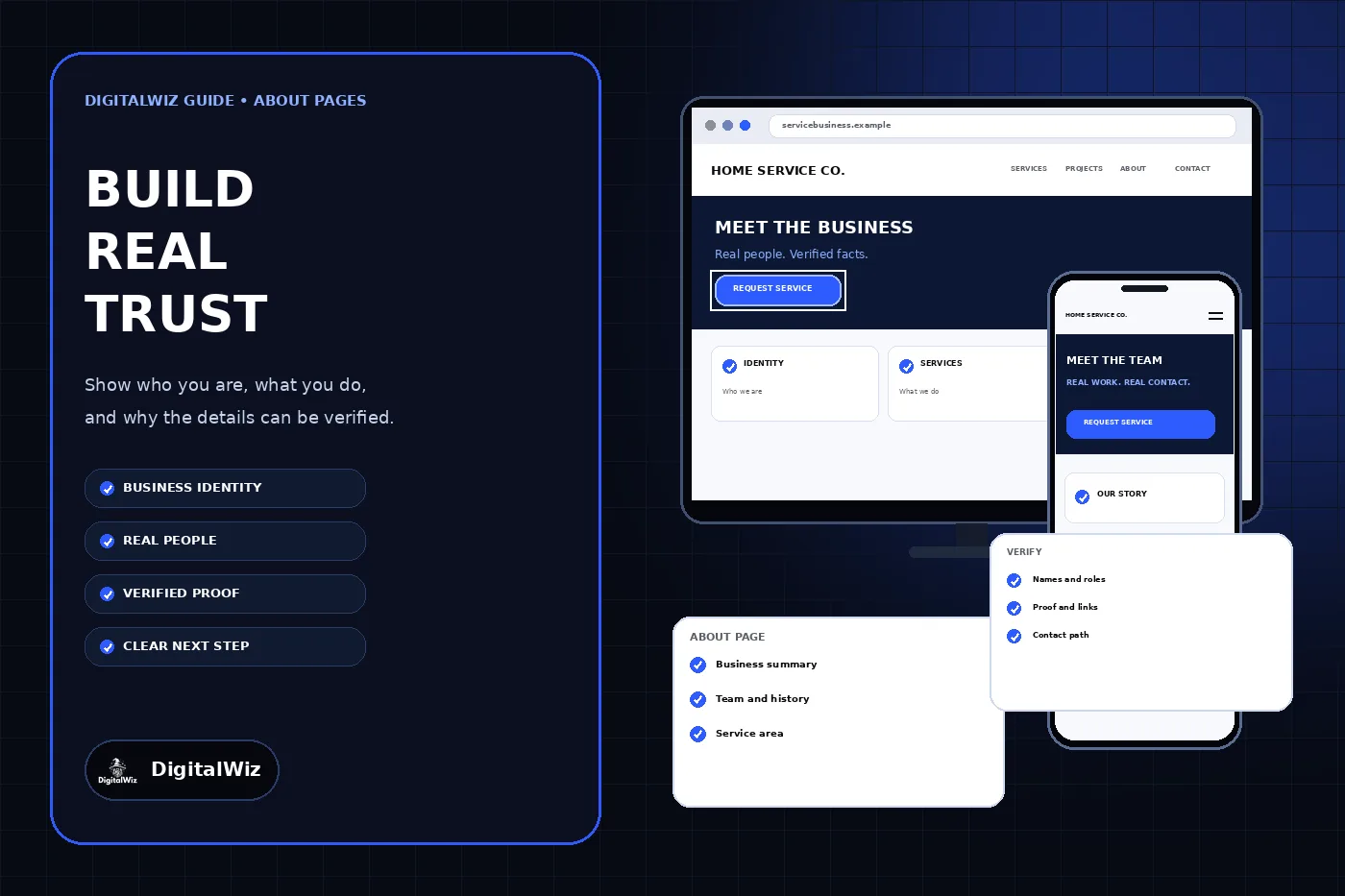
The About-page interfaces shown above are illustrative. They are not a client website, employee roster, customer review, credential, project record, or performance claim.
- State the business name, offer, audience, and service area in plain language.
- Identify the real people or team behind the work without inventing biographies.
- Use only current credentials, memberships, awards, photos, and proof you can verify.
- Link to the services, projects, policies, and contact paths a reader may need next.
- Review the page whenever ownership, staff, territory, services, or credentials change.
Open with a clear business summary
Lead with one or two short paragraphs that name the business, describe its main work, identify the customers it serves, and state the geographic area when location affects eligibility. A reader should not need to decode a slogan before understanding the company.
Nielsen Norman Group’s research on About Us information found that people expect company content to be clear, authentic, and transparent, and often compare it with outside sources. That makes a specific summary more useful than broad claims about passion, excellence, innovation, or being the best.
Keep the summary aligned with the homepage, service pages, contact details, public profiles, and current operations. If the business has several divisions or serves different customer groups, explain the structure rather than presenting unrelated offers as one vague specialty.
Show who is accountable for the business
Name the owner, leadership, or customer-facing team only when the information is current and approved for publication. Use the person’s real role and a concise biography grounded in facts the business can support. Do not turn a marketing byline into a trade credential, invent years of experience, or imply that every employee performs every service.
A small owner-operated company may need only a short owner introduction and an explanation of how work is handled. A larger company may need leadership, department, or service-team information. If privacy or safety makes individual profiles inappropriate, describe the real team structure and accountability path without publishing personal details.
Use actual, authorized photos when available. Label representative or generated imagery honestly and never present it as the owner, staff, office, customer, or completed project. A polished fictional team is worse than a straightforward text explanation.
- Real name and current role
- Relevant, supportable background
- What the person or team is responsible for
- Approved photograph and caption, when available
- A monitored way to reach the business rather than a private personal channel
Tell the history without manufacturing a legend
Include the company’s origin when it helps explain the business today: when and why it started, an important change in focus, how ownership developed, or what problem the company was created to solve. Keep dates, locations, names, and milestones consistent with business records and public profiles.
A useful history is selective. Readers rarely need every year in a timeline, but they may need to know whether the company is newly formed, family operated, part of a larger organization, or trading under a different brand. Explain those relationships directly when they affect contracts, billing, warranties, or customer expectations.
Do not borrow a dramatic founder narrative from another company or fill a gap with a plausible local anecdote. If the documented history is short, say what the business does now and how it intends to serve customers.
Use proof that a reader can verify
Choose proof that belongs to the claims on the page. This can include current licenses or certifications where relevant, manufacturer or professional memberships, authorized project examples, press coverage, community work, or links to independent review profiles. Record the source, owner, date, scope, and permission for every item before publication.
Testimonials and reviews should preserve the customer’s real words and context. The Federal Trade Commission’s Endorsement Guides guidance explains that endorsements must be honest and not misleading, and that material connections can require clear disclosure. Do not invent a quote, hide an incentive, rewrite an ordinary review into a results claim, or use a review for work the business did not perform.
Avoid decorative proof: unsupported counters, generic award seals, copied association logos, stock badges, unnamed testimonials, or claims such as ‘trusted by thousands’ without a reliable record. Link to the underlying source when practical so the reader can inspect it.
Connect identity to services, area, and next steps
An About page should not become a second homepage, but it should route readers to the information that verifies fit. Link to the primary service pages, a truthful service-area page, approved project or portfolio material, relevant policies, and the contact method that matches the next step.
State a street address only when it is a real business location the company is prepared to publish and customers may use as described. A service-area business can explain its territory without presenting a private residence, mailbox, or virtual address as a staffed storefront. Keep the name, phone, address or service area, hours, and URL consistent across owned pages and profiles.
Use one clear primary action near the end. A reader may need to view services, check availability, request an estimate, or ask a question. Match the button wording to what actually happens after the click; do not promise an appointment, quote, or response time the business has not confirmed.
Make the page easy to scan and use
Use a descriptive H1 and section headings for business summary, team, history, proof, service area, and contact information. W3C’s headings and labels guidance explains that descriptive headings help people find information and understand how sections relate.
Keep important facts in text rather than only inside a video, image, timeline, map, or logo wall. Give meaningful images accurate alternative text, use captions when context matters, preserve readable contrast, and check the page with keyboard navigation and at narrow mobile widths.
Test every service, credential, review, map, policy, social, and contact link on the live domain. The About page should remain useful if an image fails, a third-party embed is blocked, or a visitor arrives directly from search without seeing the homepage first.
Maintain the page as business information changes
Assign an owner for each changing fact: leadership, staff, services, territory, hours, credentials, memberships, awards, reviews, community work, photos, and contact details. Add review dates to the internal content record rather than displaying a freshness date that does not reflect a real review.
Recheck the page after an ownership change, rebrand, move, new service, territory change, staff departure, expired credential, merger, or change in how customers contact the business. Remove outdated claims only after confirming whether another page, structured-data block, social profile, or marketing campaign still depends on them.
A practical final review is simple: ask a person unfamiliar with the company to identify what it does, who stands behind it, where it works, which claims they can verify, and what they should do next. If the page cannot answer those questions, tighten the facts before adding more storytelling. DigitalWiz can help align the About page with the rest of the customer path through Website Development or a strategy call.
- Business identity and offer match current operations.
- People, roles, history, and credentials are verified and approved for publication.
- Reviews, projects, logos, and photos have a source and permission.
- Service-area and contact information agree across the website.
- Every link works and the next step is accurate on desktop and mobile.