What Is a Good Website Conversion Rate for a Local Service Business?
A good website conversion rate is the one that turns the right visitors into qualified calls, forms, bookings, or estimates. For local businesses, lead quality and tracking matter more than chasing a generic benchmark.
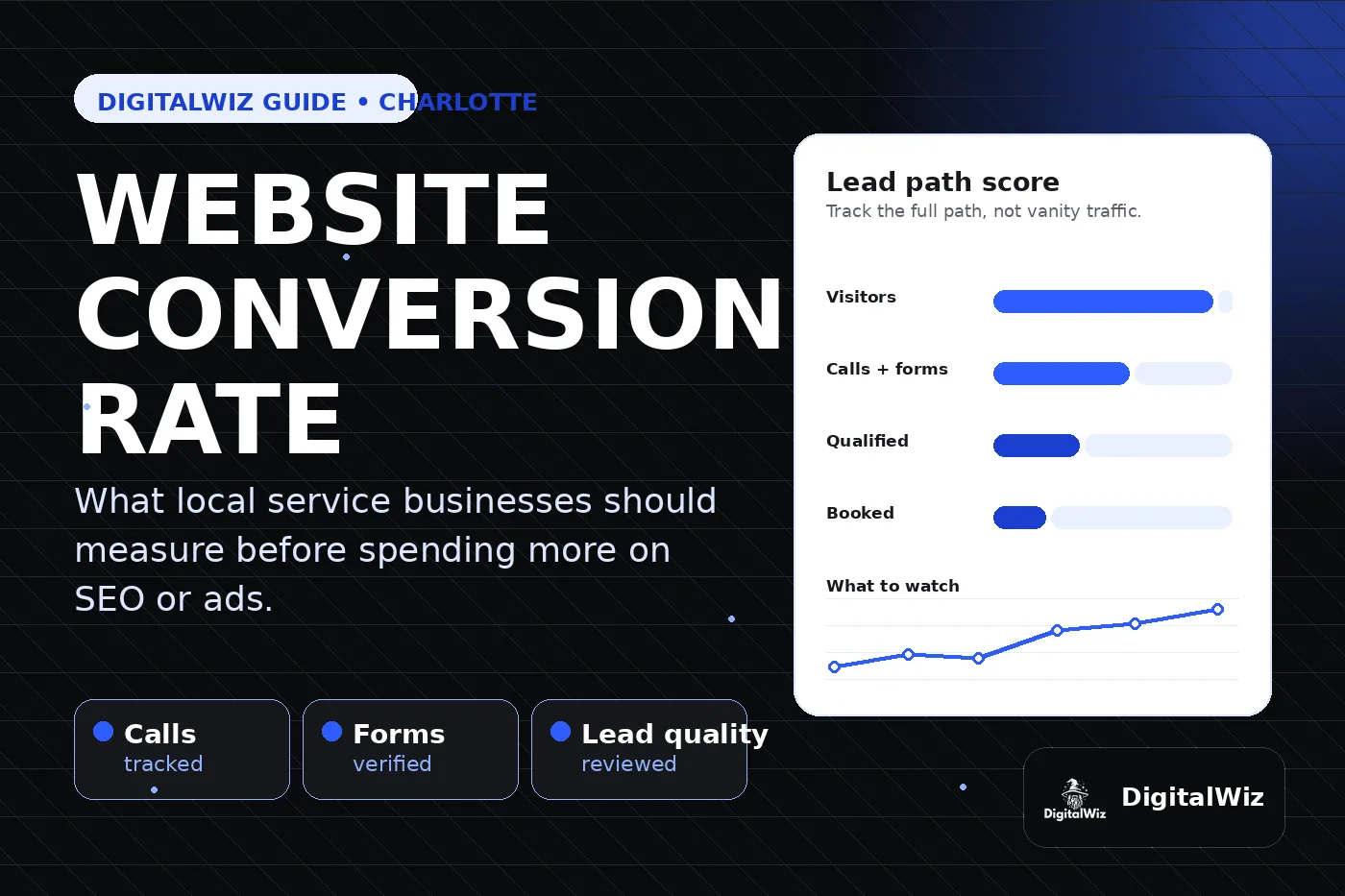
The direct answer
A good website conversion rate for a local service business is not a universal percentage. It is the rate at which the right visitors become qualified calls, form fills, bookings, estimate requests, or consultations. A lower volume of strong leads is usually worth more than a bigger pile of weak inquiries.
For a Charlotte contractor, dentist, med spa, law firm, restaurant, or home service company, the real question is: are the people landing on the site taking the next step, and are those leads worth following up? If you cannot answer that, the conversion rate number is probably misleading.
Use conversion rate as a diagnostic tool, not a bragging metric. Track the source, landing page, service, device, call/form event, and lead quality before deciding whether the website, SEO, paid ads, or offer is the problem.
- Count the actions that matter: calls, forms, bookings, estimate requests, quote starts, and consultation requests.
- Separate qualified leads from spam, job seekers, wrong-service requests, and price-only shoppers.
- Judge conversion rate by page intent. A paid landing page should convert differently than a broad blog post.
- Fix tracking before you spend more on SEO or ads.
Why generic conversion benchmarks can mislead you
Benchmarks sound useful, but local businesses are messy in a good way. A plumbing emergency page, a med spa treatment page, a restaurant catering page, and a law firm consultation page should not be judged by the same number. Intent, price, trust, urgency, location, and device all change the expected behavior.
Google Analytics 4 treats conversions as key events you define, and Google Ads conversion tracking is built around actions that matter to the business. That is the point: the business decides which actions are meaningful. A page can look weak by one metric and still produce profitable calls if the traffic is high-intent.
The better question is not "what conversion rate should I have?" It is "which pages and channels create leads we actually want?" That is where Website Development, Search Visibility, and Paid Ads Management start working together.
- High-intent service pages usually deserve stricter conversion expectations than educational blog posts.
- Mobile visitors may call instead of filling out long forms.
- Higher-ticket services may convert less often but create more valuable opportunities.
- A broad traffic spike can lower conversion rate while still helping brand awareness.
What should count as a conversion
For most local service businesses, a conversion should be an action that starts a real sales conversation. That usually means a phone call, contact form, booking, quote request, chat lead, financing application, or audit request. Newsletter signups and page views can be useful, but they should not be mixed with sales leads when you judge performance.
Track micro-conversions separately. Clicks on a phone number, pricing page views, directions clicks, service-area views, and FAQ engagement can show intent, but they are not the same as a qualified lead. Keep the reporting clean so you do not accidentally celebrate activity that never turns into revenue.
If your website gets traffic but no leads, start by reading Why Is My Website Getting Traffic But No Leads?. Conversion rate is usually a symptom of message match, trust, page speed, mobile layout, offer clarity, or tracking gaps.
- Primary conversions: calls, forms, bookings, quote requests, consultation requests, and BizScore/audit starts.
- Secondary signals: CTA clicks, phone clicks, map clicks, service page visits, and pricing-page visits.
- Quality filters: service fit, location fit, budget fit, urgency, and whether the lead became a real opportunity.
- Bad data to exclude: spam forms, duplicate submissions, job applicants, vendor pitches, and wrong-market leads.
How to diagnose a weak conversion rate
Do not rebuild the whole site just because one dashboard number looks low. Start with the path. Which channel brought the visitor in? Which page did they land on? What did the page promise? What action was available? Did the phone number, form, or booking button actually work on mobile?
Then inspect intent. A page ranking for beginner research questions will not convert like a page built for "emergency HVAC repair Charlotte" or "book med spa consultation near me." If the traffic is wrong, copy tweaks will not solve the real issue. If the traffic is right but nobody acts, the page needs stronger proof, clearer CTAs, less friction, or a better offer.
For paid traffic, message match matters even more. We covered that in What Should Be on a Google Ads Landing Page for a Local Business?. A generic homepage can waste expensive clicks because it asks visitors to figure out the next step themselves.
- Check whether calls and forms are being tracked correctly before judging the page.
- Split results by traffic source, landing page, device, city, service, and campaign.
- Review the page above the fold: service, location, proof, CTA, and offer should be obvious.
- Listen to call quality or review form submissions so you know whether the leads are usable.
What improves conversion rate for local businesses
Local conversion work is usually practical, not flashy. Say what you do. Say where you do it. Show proof. Make the next step easy. Remove anything that makes a buyer hesitate. Then measure whether the change produced better calls and forms, not just a prettier page.
Strong local pages usually include a plain-language headline, local service context, reviews or proof, photos or examples when appropriate, a short process, FAQs that answer real objections, click-to-call on mobile, and a form that does not ask for too much too soon.
This is why DigitalWiz treats conversion as part of the full lead system. The website has to convert, search visibility has to attract the right demand, and paid ads have to send clicks to pages that match the searcher's intent.
- Use one primary CTA per page and repeat it naturally.
- Put phone, form, or booking access near the top on mobile.
- Add local proof: reviews, service areas, project examples, credentials, photos, or process details.
- Keep forms short for first contact, then collect details after the conversation starts.
- Improve speed and remove popups or scripts that block the main action.
The bottom line
A good website conversion rate is useful only when it is tied to real business outcomes. For local service businesses, the goal is not to win a benchmark chart. The goal is to turn the right visitors into qualified conversations and booked opportunities.
If your website traffic is growing but leads are flat, do not guess. Check tracking, page intent, mobile UX, trust signals, offer clarity, and lead quality. Then fix the bottleneck before buying more traffic.
Want a fast read on where your site is leaking leads? Run a free BizScore audit or contact DigitalWiz. We will review your website, search visibility, paid traffic path, and tracking so you know what to fix first.