How Much Should a Small Business Spend on Marketing in Charlotte?
There is no magic number. Start with the revenue goal, choose the channels that match buyer intent, and fund the pages, tracking, SEO, and ads that can actually create leads.
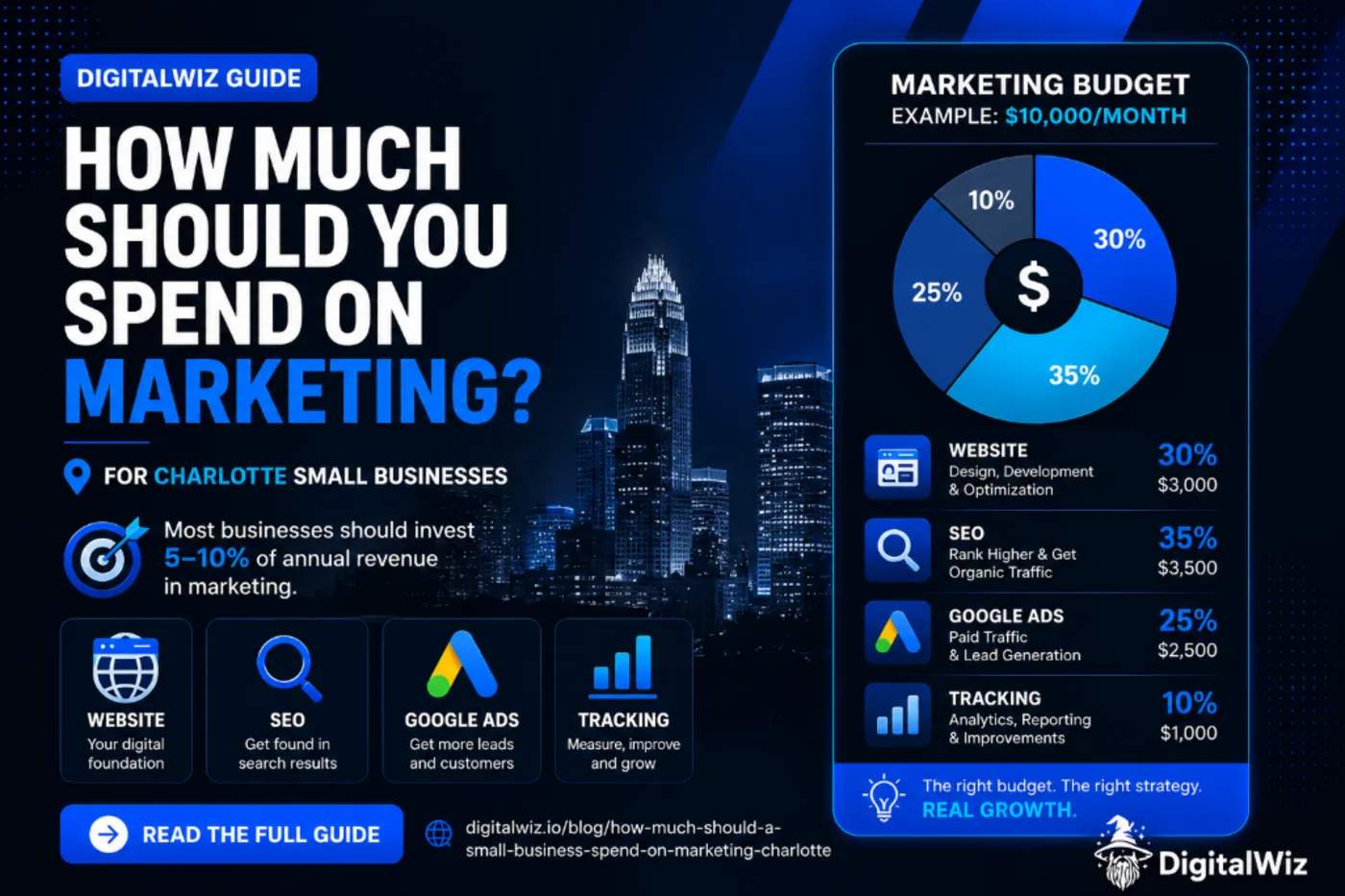
The direct answer
A Charlotte small business should spend enough on marketing to hit a clear revenue goal, not an arbitrary percentage copied from the internet. If the website is weak, the first dollars should fix the offer, service pages, tracking, and conversion path. If the foundation is already solid, budget can move into SEO, Google Business Profile work, paid ads, and follow-up.
For most local service businesses, the question is not “How much can I spend?” It is “Which channel can turn local demand into qualified calls, forms, bookings, and estimates without wasting money?” A contractor, med spa, dentist, law firm, restaurant, or home service company may need a different mix depending on search demand, sales cycle, competition, and capacity.
Start with one target: how many new qualified opportunities do you need each month? Then decide what has to be funded to get there.
- Fix the website and tracking before scaling spend.
- Fund high-intent channels first: search, local SEO, Google Business Profile, and focused landing pages.
- Use paid ads when you need demand now and can respond quickly.
- Use SEO, content, and AI-search readiness to compound visibility over time.
- Measure cost per qualified lead, not just clicks, impressions, or traffic.
1. Start with the revenue goal, not a random budget
A useful marketing budget starts with math the owner actually cares about. How many jobs, appointments, consultations, or booked estimates do you need? What is a qualified lead worth? How many leads normally turn into customers? Those answers shape the budget better than a generic rule of thumb.
If one new customer is highly valuable, you can afford a different acquisition cost than a business selling low-ticket offers. If your team cannot answer calls quickly or follow up well, spending more will expose that leak faster. The budget should match both the opportunity and the operation behind it.
This is why DigitalWiz ties websites, Search Visibility, and Paid Ads Management together. The channel matters, but the whole lead path matters more.
- Monthly revenue target.
- Average customer or job value.
- Lead-to-sale close rate.
- Current website conversion rate or best available estimate.
- Sales capacity: how many new inquiries can you handle well?
2. Fix the foundation before buying more attention
If your website does not explain the service, prove trust, load well on mobile, and make contact easy, more marketing spend can turn into more expensive disappointment. Paid traffic will not save a confusing offer. SEO traffic will not help much if the page does not convert.
Before increasing spend, check the basics: clear service pages, local proof, calls and forms that work, fast mobile pages, tap-to-call buttons, simple quote forms, and conversion tracking. If you are already getting traffic but not leads, read our guide on why website traffic does not always turn into leads.
A small foundation budget often beats a bigger ad budget pointed at a weak page.
- One strong page for each high-value service.
- A clear contact path on mobile.
- Reviews, photos, case proof, credentials, or process details near CTAs.
- Call, form, booking, and UTM tracking.
- A weekly report that separates real opportunities from spam.
3. Spend by stage: urgent leads, local trust, or long-term visibility
Different channels solve different problems. Google Ads can reach people who are searching right now. Local SEO and Google Business Profile optimization help you show up where nearby buyers compare options. Helpful blog and FAQ content supports search, answer engines, and sales conversations over time.
Do not force every dollar into one bucket. A newer business may need more paid search and landing-page work to create immediate conversations. A business with steady demand may put more into local SEO, content, reviews, and conversion optimization. A company expanding across Charlotte, Matthews, Concord, Huntersville, Waxhaw, or Indian Trail may need service-area pages and GBP consistency before more ads.
The right mix depends on what is broken: demand, trust, conversion, tracking, or follow-up.
- Need leads now: paid search, landing pages, call tracking, and fast follow-up.
- Need local trust: Google Business Profile, reviews, photos, citations, and service-area clarity.
- Need durable visibility: SEO content, internal links, service pages, and AI-search-ready answers.
- Need better ROI: conversion tracking, page rebuilds, offer testing, and lead quality review.
4. Do not spend evenly just to feel balanced
A balanced-looking budget can still be wrong. If Google search demand is strong for your service, paid search and local SEO may deserve the first serious investment. If customers need heavy education before buying, content, email, retargeting, and proof pages may matter more. If you are already busy but losing leads after hours, missed-call text-back and follow-up may be the highest-return fix.
Budget should follow bottlenecks. If nobody can find you, invest in visibility. If people find you but do not contact you, invest in the page and offer. If people contact you but disappear, invest in follow-up and sales process. If you do not know which problem you have, invest in tracking first.
That is usually where a free BizScore audit helps: it shows whether the leak is website, search, ads, tracking, or follow-up.
- Visibility problem: rankings, GBP, local pages, ads, and content.
- Conversion problem: website copy, proof, CTAs, forms, and mobile UX.
- Measurement problem: analytics, call tracking, form events, UTMs, and CRM notes.
- Follow-up problem: response speed, missed-call workflows, reminders, and lead nurturing.
5. Use paid ads carefully if the funnel is not ready
Paid ads are powerful because they create fast feedback. They are also unforgiving. If the ad sends traffic to a generic homepage, the offer is vague, or nobody answers the phone, the campaign may look bad even when the market is there.
For Charlotte service businesses, paid search usually works best when the ad, keyword, landing page, location, offer, and CTA all line up. If you are running Google Ads, a separate landing page is often the smarter move. We break that down in Do I Need a Separate Landing Page for Google Ads?.
Set the budget high enough to learn, but not so high that a broken funnel burns cash for weeks.
- Match one campaign to one service or offer.
- Send clicks to a focused landing page when intent is specific.
- Track calls, forms, and booked consultations as conversions.
- Review search terms and lead quality, not just clicks.
- Pause waste quickly and move budget toward what creates real opportunities.
6. Review the budget monthly, but judge strategy in the right time window
Marketing budgets need active management. Paid ads can show useful signals quickly, but SEO and local visibility take longer because pages, trust, reviews, and authority compound. If you judge every channel on the same timeline, you may cut the work that would have built durable demand.
Look at the right metrics for each stage. Early on, check whether pages are indexed, ads are reaching the right searches, GBP activity is consistent, and tracking is working. As data builds, shift attention to qualified leads, booked calls, cost per opportunity, close rate, and revenue created.
The goal is not to spend more forever. The goal is to spend on the parts of the system that produce better conversations with better-fit customers.
- Weekly: make sure leads, calls, forms, and campaigns are being tracked.
- Monthly: review channel performance and lead quality.
- Quarterly: decide what to scale, fix, pause, or rebuild.
- Always: compare spend against qualified opportunities, not vanity metrics.
The bottom line
A good Charlotte small business marketing budget is not a guess. It is a plan tied to revenue goals, local demand, conversion quality, and follow-up capacity.
If the foundation is weak, spend first on the website, service pages, tracking, and proof. If the foundation is strong, put budget into the channels that match your buyer intent: local SEO, Google Business Profile, paid search, content, and retargeting. Then review what creates qualified opportunities and move money toward what works.
Want a practical budget recommendation for your business? Run a free BizScore audit or contact DigitalWiz. We will show you what to fix first across your website, search visibility, paid ads, and lead tracking.