How Should Contractors Use Reviews on Their Website?
Contractors should use real customer reviews near the decisions that matter: homepage CTAs, service pages, project proof, landing pages, and contact paths. Reviews work best when they are specific, current, permission-safe, and connected to lead tracking.
The direct answer
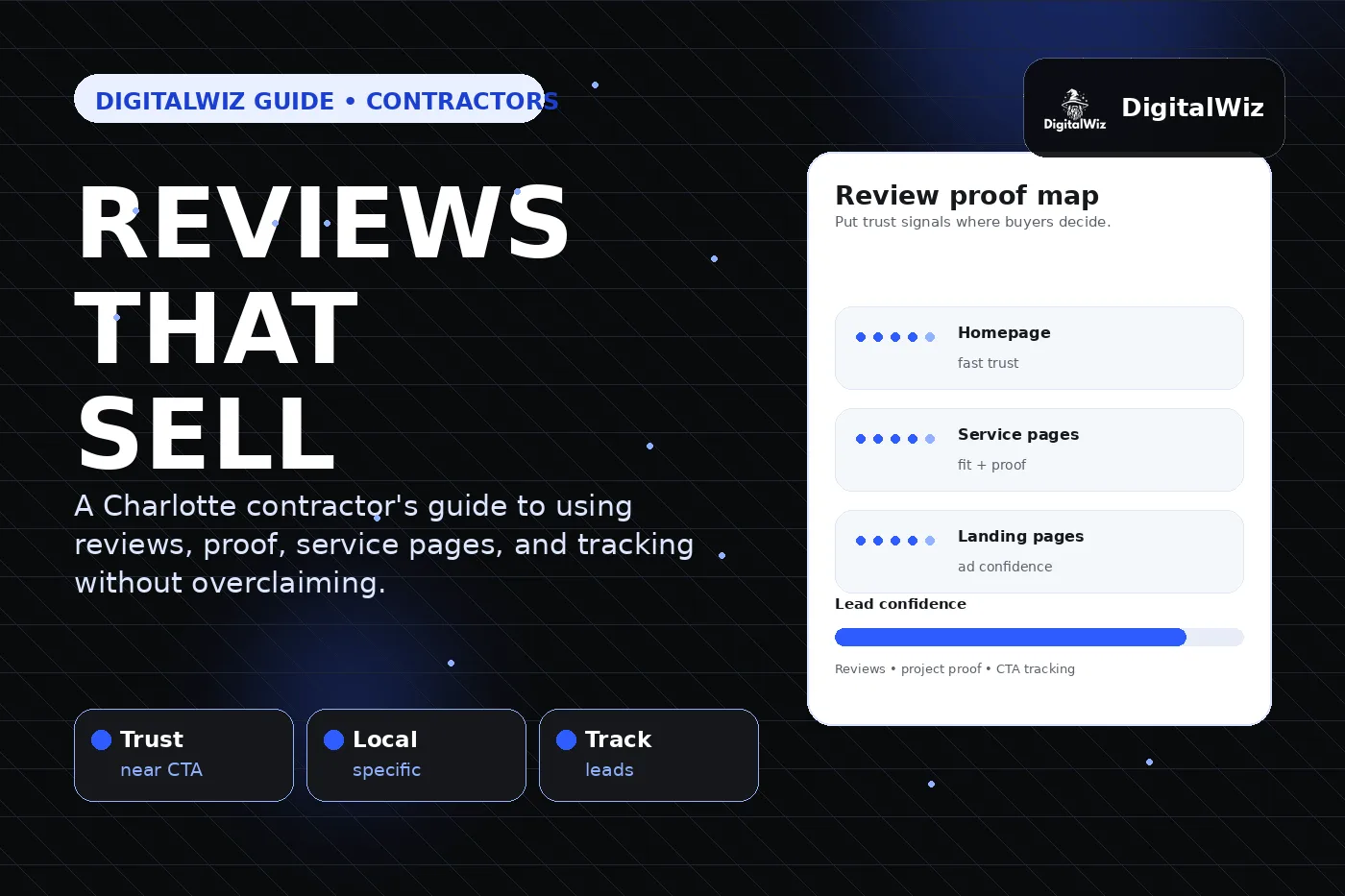
Contractors should use reviews on their website where reviews help a buyer feel safe enough to call, request an estimate, book an inspection, or start a project conversation. That usually means the homepage, service pages, project proof sections, paid-ad landing pages, and contact path — not one lonely reviews page hidden in the menu.
For a Charlotte or NC contractor, reviews answer the trust question fast: have real homeowners or property managers hired this company, did the team handle the work professionally, and does the proof match the service I need? Roofing, remodeling, HVAC, plumbing, electrical, landscaping, painting, concrete, restoration, and similar trades all need review proof close to the decision.
The DigitalWiz rule: reviews should support website conversion, Search Visibility, and clean lead tracking. Use real reviews, keep them current, place them beside relevant CTAs, and measure whether the pages with stronger proof create better calls and form leads.
- Put strong review snippets near the first CTA on important pages.
- Match reviews to the service page when possible: roof repair reviews on roof repair pages, remodel reviews on remodeling pages, and so on.
- Use only real, permission-safe review text and avoid editing reviews in a misleading way.
- Track calls, forms, landing pages, and lead quality so review placement is tied to business results.
Why reviews matter so much for contractors
Contractor leads are risk-heavy. The buyer may be inviting a crew into a home, approving a large repair, comparing estimates, or trusting a company with a time-sensitive problem. A generic promise about quality is weaker than a real customer explaining what went well.
Reviews also make the site feel less anonymous. A contractor website with service copy, photos, project examples, and customer language feels more believable than a site that only says the company is professional. The goal is not to decorate the page with stars. The goal is to reduce doubt at the exact moment the visitor is deciding whether to act.
Google also says local ranking is shaped by relevance, distance, and prominence, and review count and score can factor into prominence. That does not mean reviews guarantee rankings. It means reviews are part of a bigger trust system: Google Business Profile, website proof, service pages, local mentions, citations, photos, and real customer experience.
- Reviews reduce perceived risk before the first call.
- They show real customer language, not just company claims.
- They support local trust when they mention actual services, areas, crews, process, or outcomes.
- They work best alongside photos, project proof, FAQs, and a clear next step.
Where contractor reviews should go on the site
Start with the pages closest to revenue. The homepage should show a small amount of review proof near the first strong CTA. Service pages should include reviews that match the service being explained. A review about emergency roof repair is more useful on a roof repair page than buried on a general testimonials page.
Project galleries and recent-work sections should also connect to reviews when possible. A project photo shows the work. A review explains the experience. Together, they answer more objections than either one alone.
A dedicated reviews page can still be useful, especially for people who want to browse proof, but it should not be the only place reviews live. Reviews should appear where the buyer needs confidence.
- Homepage: one to three strong snippets near the top and another proof section lower on the page.
- Service pages: reviews tied to that service, problem, or project type.
- Project galleries: reviews next to relevant before-and-after or recent-work examples.
- Contact page: a final trust cue before someone submits a form or calls.
- Paid landing pages: short, specific proof without sending visitors into a maze.
What makes a review useful on a contractor website
The strongest reviews are specific. They mention the service, the problem, the process, the team, the communication, the cleanup, the timeline, or the final result. A short review that says the crew fixed a leak quickly and explained the next step can be more persuasive than a vague paragraph saying the company was great.
Use review snippets honestly. If you shorten a review for layout, do not change the meaning. If a review includes sensitive customer details, remove or avoid that detail. If the review came from a third-party platform, keep attribution clear enough that the proof feels real without copying platform branding into the design.
Avoid fake certainty. Reviews can show trust, but they should not be used to claim guaranteed outcomes, guaranteed rankings, or guaranteed lead volume. Let customers speak to their experience and let the page explain the next step.
- Specific service or project context beats generic praise.
- Short snippets usually work better than giant testimonial walls.
- Attribution should be clear, but the design should not copy third-party logos or marks.
- Review text should support the CTA, not distract from it.
How reviews support SEO and AI visibility
Reviews can support SEO when they add real-world context around services, areas, and customer experience. Search systems are trying to understand what the business does, where it works, and whether the page is useful. Review language can reinforce that context when it is visible, accurate, and surrounded by helpful page copy.
For answer-engine and AI-search visibility, reviews are part of the broader credibility picture. A contractor site that explains services clearly, shows project proof, answers buyer questions, and includes current customer feedback is easier to understand than a thin site with claims only.
Do not stuff reviews with city names or rewrite them to chase keywords. Keep customer language natural. Add your own page copy around the review to explain the service, location, proof, and next step.
- Use reviews to support relevance, trust, and buyer confidence — not as keyword filler.
- Pair review snippets with descriptive headings, service details, project proof, and FAQs.
- Keep Google Business Profile, website, citations, and service-area messaging consistent.
- Link review-supported pages to the right service, gallery, BizScore, or contact path.
Review mistakes that make a site weaker
The most common mistake is treating reviews as a separate archive instead of conversion proof. If every review is hidden on one page, visitors on service pages may never see the trust signal before they leave.
Another mistake is using vague or outdated proof. A review from years ago may still be real, but if it is the only proof on the site, the business can look inactive. Contractors should refresh review sections over time, especially after strong projects, seasonal work, or service-area growth.
Also avoid fake reviews, copied testimonials, platform-logo clutter, screenshots that are hard to read on mobile, and review widgets that slow the page or break the design. The review section should make the page clearer, faster to trust, and easier to act on.
- Do not rely on one hidden testimonials page.
- Do not publish fake, copied, or misleading reviews.
- Do not use tiny screenshots that are unreadable on mobile.
- Do not let widgets slow down or visually clutter important landing pages.
- Do not claim reviews guarantee rankings, calls, or sales.
A simple review system for contractors
Use a simple rhythm: ask, organize, place, and measure. Ask happy customers for honest reviews when the job is complete and the timing is appropriate. Organize review snippets by service, city, project type, and objection. Place the best proof near the pages and CTAs it supports. Then measure whether the page creates better calls and estimate requests.
This system also helps paid ads. A Google Ads landing page with relevant proof usually feels safer than a page with only a headline and a form. Review proof can support follow-up emails, estimate pages, service pages, and sales conversations too.
Want a fast read on whether your reviews, website pages, Google Business Profile, and lead tracking are working together? Run a free BizScore audit or contact DigitalWiz. We will show you what to fix first across your website, search visibility, paid ads, and local lead path.
- Ask: build a steady, policy-safe review request habit.
- Organize: tag reviews by service, city, job type, and objection answered.
- Place: add the best snippets near relevant CTAs and proof sections.
- Measure: review calls, forms, source, landing page, and lead quality.