What Pages Should a Window Cleaning Company Website Have?
A window cleaning website should separate residential, commercial, storefront, screen and track, recurring service, service-area, safety, project, pricing, FAQ, and quote paths.
The direct answer
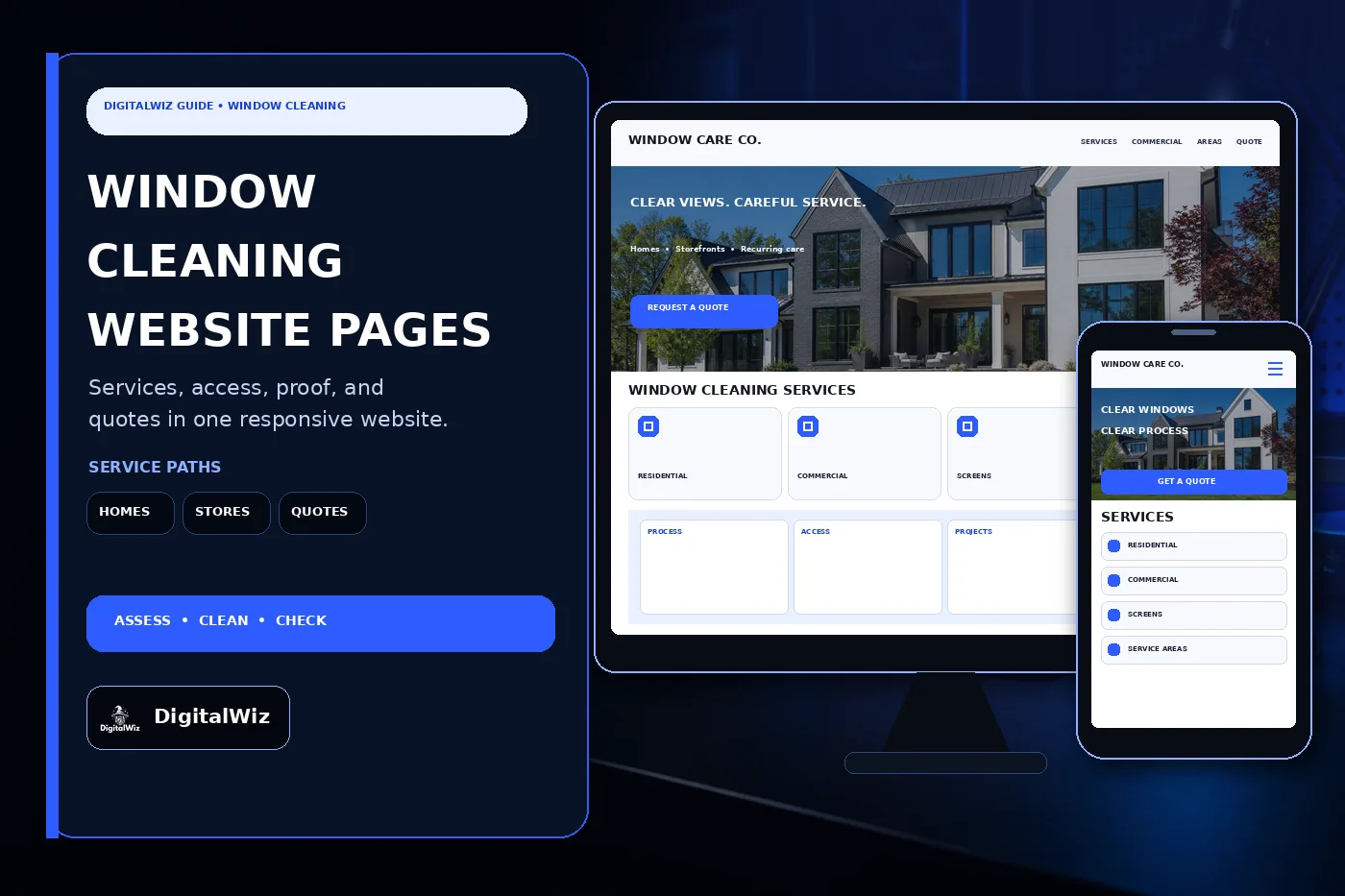
A window cleaning company website should have focused pages for residential window cleaning, commercial and storefront work, recurring service, interior and exterior scope, screens and tracks, hard-water or specialty glass care when genuinely offered, service areas, the work process, access and safety expectations, project proof, pricing context, FAQs, and quote requests. One page called ‘Services’ leaves customers guessing about pane count, height, screens, interior access, recurring schedules, and what the quoted price actually covers.
Start with the jobs the company is trained, insured, equipped, and staffed to perform. A Charlotte-area owner-operator cleaning one- and two-story homes needs a different path than a crew serving retail storefronts, restaurants, offices, multifamily properties, construction projects, or taller buildings. Water-fed-pole work, lifts, rope descent, post-construction cleaning, stain removal, solar panels, gutters, pressure washing, and holiday lighting should appear only when the company truly supports that scope.
Each page should help someone judge fit before calling. Explain the property type, glass or opening, normal scope, access needs, preparation, estimate method, exclusions, scheduling, and final quality check. That gives the website, Search Visibility, and Paid Ads Management useful landing pages instead of sending every local search and ad click to the homepage.
- Create separate pages for residential, commercial, storefront, recurring, screen and track, and every specialty service genuinely offered.
- Explain what is cleaned, how access works, what customers prepare, what changes the quote, and how the final check is handled.
- Publish accurate service limits, credentials, insurance context, safety boundaries, property requirements, and scheduling policies.
- Track calls and forms through qualification, estimate, scheduled work, completed service, property type, territory, value, and lead quality.
Separate residential, commercial, storefront, and specialty services
The residential page should answer ordinary homeowner questions quickly. Does the company clean interior glass, exterior glass, both sides, screens, tracks, sills, frames, storm windows, skylights, French panes, divided-light windows, glass doors, sunrooms, or accessible mirrors? Which items are standard, optional, condition-dependent, or outside scope? If pricing uses panes, windows, openings, or labor time, define the unit in plain English.
Commercial buyers need a dedicated page and quote path. Storefront routes, restaurants, offices, medical settings, schools, apartment communities, builders, property managers, and larger facilities can involve different access hours, certificates of insurance, vendor onboarding, purchase orders, security rules, recurring frequencies, site contacts, traffic control, and invoicing. A facilities manager should not have to submit a form designed for twelve residential windows and two screens.
Storefront cleaning deserves its own section when it is a real recurring offer. Explain the route area, available frequencies, interior versus exterior scope, door glass, lower panels, signs or decals, merchandising near the glass, weather handling, access before opening, missed-visit communication, and how route changes are approved. Keep the copy practical. ‘Weekly’ means little if the page never says which side of the glass gets cleaned.
Specialty pages belong only when the equipment and process back them up. Hard-water deposits, mineral staining, paint or construction debris, adhesive, oxidation, scratch concerns, restoration, solar panels, high interior glass, chandeliers, gutters, pressure washing, and post-construction work are not automatic add-ons. State what the team evaluates, what it will not attempt, what may require a test area, and when damaged or specialty glass needs another qualified provider.
- Residential: glass sides, screens, tracks, frames, sills, storm units, skylights, doors, access, preparation, and final review.
- Commercial: property types, hours, recurring schedules, insurance documents, site contacts, access, invoicing, and quality control.
- Storefronts: route territory, frequency, interior and exterior scope, opening-hour coordination, weather, and missed-service handling.
- Specialty work: deposits, construction debris, solar panels, high glass, restoration, gutters, or pressure washing only when genuinely supported.
Show the estimate, preparation, cleaning, and quality-check process
A useful process page starts before anyone touches the glass. Show the inquiry, service-area check, property and window details, optional photos, preliminary quote or site visit, scope confirmation, appointment reminder, weather review, arrival, walkthrough, access setup, cleaning, screen or track work when included, detail check, customer or site-contact review, payment, and recurring-service follow-up. Label any step that changes by property type.
Quote language should be specific enough to prevent a surprise at the door. Ask whether the count means individual panes, complete window units, removable storms, French panes, doors, skylights, screens, or another measure. Identify interior and exterior sides, accessible areas, screen and track scope, stain or debris concerns, ladder or lift access, minimum charges, travel, parking, and anything priced after inspection. If photos create only an estimate, say that clearly.
Preparation should be short and mobile-friendly. Tell residential customers whether to move fragile items, open blinds, raise shades, clear furniture, secure pets, unlock gates, and provide safe interior access. Tell commercial contacts how to handle displays, desks, customer traffic, alarms, access cards, loading areas, security escorts, and restricted spaces. Do not quietly transfer professional safety duties to the customer through a vague checklist.
Then show how the company checks its own work. That may include viewing glass from different angles, checking edges and corners, reinstalling screens, wiping identified sills, confirming locked windows, reviewing inaccessible or damaged areas, taking permission-safe completion photos, and getting the site contact’s signoff. A clear callback process is stronger than promising every pane will remain spotless regardless of rain, construction dust, sprinklers, landscaping, or new damage.
- Map the complete path from first property details through scope confirmation, preparation, cleaning, review, payment, and follow-up.
- Define the counting method and every included, optional, condition-dependent, or excluded item.
- Give homeowners and commercial contacts separate preparation and access instructions.
- Use a real final-review and callback process instead of a universal streak-free or weather-proof promise.
Publish access, safety, insurance, and property boundaries clearly
Safety copy should build trust without turning the site into a do-it-yourself manual. Explain the types of properties and access methods the company is qualified to use, the conditions that can postpone work, the areas crews will not enter, and the information needed before arrival. Height, roof edges, fragile surfaces, steep grades, overhead hazards, interior openings, locked areas, weather, electrical lines, pedestrian traffic, and damaged glass can all change the plan.
For commercial or higher-access work, keep claims tied to the real program. OSHA’s walking-working surfaces rule addresses employer duties for fall protection and includes requirements for scaffolds and rope descent systems. A marketing page does not need to reproduce the regulation. It should accurately identify the company’s supported access methods, training and supervision context, equipment inspection practices, rescue or site planning when applicable, and the jobs it refers elsewhere.
Insurance and credential pages need more than a badge wall. Publish the legal business name, real service territory, insurance information available for review, relevant training or certifications, commercial-document process, and the organization or person that holds each credential. Requirements vary by location, property, access method, and scope. Do not call a general business registration a trade license or imply every employee holds the same qualification.
Property boundaries matter too. State how the crew handles fragile or failing screens, loose glazing, cracked panes, failed seals, damaged frames, unstable windows, alarms, tint or film, decals, blinds, landscaping, furniture, electronics, valuables, pets, tenant spaces, and restricted areas. Document pre-existing damage before work. A clean window does not repair fogged insulated glass, failed seals, scratches, frame rot, leaks, or broken hardware.
- Describe supported property types and access methods without publishing unsafe procedural instructions.
- Identify weather, height, surface, glass-condition, electrical, traffic, and access conditions that require a new plan or referral.
- Make the legal identity, insurance-document path, qualifications, and commercial compliance process verifiable.
- Separate cleaning results from damaged glass, failed seals, scratches, leaks, frames, screens, film, and hardware repairs.
Use project proof and pricing context without fake shine
Window cleaning is visual, but one sparkling stock photo proves very little. Useful project examples show the broad property type, window configuration, original concern, included scope, access challenge, preparation, method category, screen or track work, commercial coordination, and completed review. Exterior views can show the building and access context. Detail photos should make it clear whether the image shows glass, a screen, a track, a frame, or a condition outside the cleaning scope.
Use only authorized work. Protect addresses, family photographs, children, pets, security systems, access codes, tenant information, office screens, medical details, customer records, license plates, and valuables. Never invent testimonials, star ratings, customer counts, pane counts, safety records, certifications, before-and-after results, recurring contracts, or commercial clients to make a page look established.
Pricing changes with more than window count. Property type, pane style, height, interior and exterior access, screens, tracks, storm units, skylights, doors, hard-water deposits, construction debris, film or decals, fragile components, lifts, parking, travel, route frequency, site rules, weather, minimum charges, and scheduling can all move the quote. A tiny per-window price can mislead when it excludes the windows a customer actually has.
The site can still make cost easier to understand. Publish exact fees or ranges only when the definitions and assumptions stay current. Explain minimums, counting method, included sides, screen and track charges, recurring discounts when real, commercial site visits, deposit or cancellation policies, quote expiration, payment terms, and changed-scope approval. The goal is not to price every building from a headline. It is to make the written quote easier to compare.
- Show permission-safe projects with property, window, access, scope, preparation, and review context.
- Never invent proof, ratings, clients, safety claims, credentials, counts, contracts, or outcomes.
- Explain the biggest glass, pane, height, access, screen, track, stain, site, travel, frequency, and scheduling cost drivers.
- Define every published fee or range, including assumptions, inclusions, exclusions, minimums, expiration, and change approval.
Build local quote paths and track the work that actually fits
Service-area pages should reflect the routes the company truly runs. Residential appointments, weekly storefront routes, larger commercial work, post-construction cleaning, and specialty access may have different territories or scheduling windows. Charlotte, Matthews, Mint Hill, Indian Trail, Monroe, Huntersville, Concord, and nearby communities can bring different travel, parking, building access, route density, and weather logistics. Do not clone one thin paragraph across every city.
The quote form should collect enough context without asking the customer to become an estimator. Ask for name, phone, email, service address or ZIP code, residential or commercial property, requested service, approximate window or pane count if known, number of stories, interior and exterior scope, screens or tracks, recurring interest, access notes, preferred timing, and optional safe photos. Mark unknown details as optional. Never ask someone to climb, lean outside, move heavy furniture, or photograph a hazardous area for a marketing form.
Route inquiries where the workflow changes. A one-story home, tall interior window, weekly storefront, occupied office, multifamily property, construction cleanup, hard-water concern, damaged glass, lift-required building, emergency breakage, out-of-area request, and warranty callback should not all enter one queue. The confirmation message should explain the review step without promising price, access method, service date, stain removal, or final result before the details are checked.
Then track what becomes real work. Record source, campaign, landing page, property type, requested scope, territory, route fit, qualification, quote, scheduled appointment, completed service, recurring plan, final value, cancellation reason, and lead quality when the operation supports it. That shows whether residential pages bring profitable appointments or broad ads keep producing unsupported high-rise work. Want a practical review of your pages, local visibility, quote flow, and lead tracking? Run a free BizScore audit.
- Separate residential territory, storefront routes, commercial coverage, specialty-access work, and out-of-area requests when they differ.
- Ask for property, scope, approximate count, stories, access, screens, tracks, frequency, timing, and safe optional photo context.
- Route routine, recurring, commercial, construction, specialty, damaged-glass, callback, and unsupported-access inquiries appropriately.
- Track source and landing page through qualification, quote, schedule, completion, recurring service, value, and lead quality.