What Pages Should a Water Well Drilling Company Website Have?
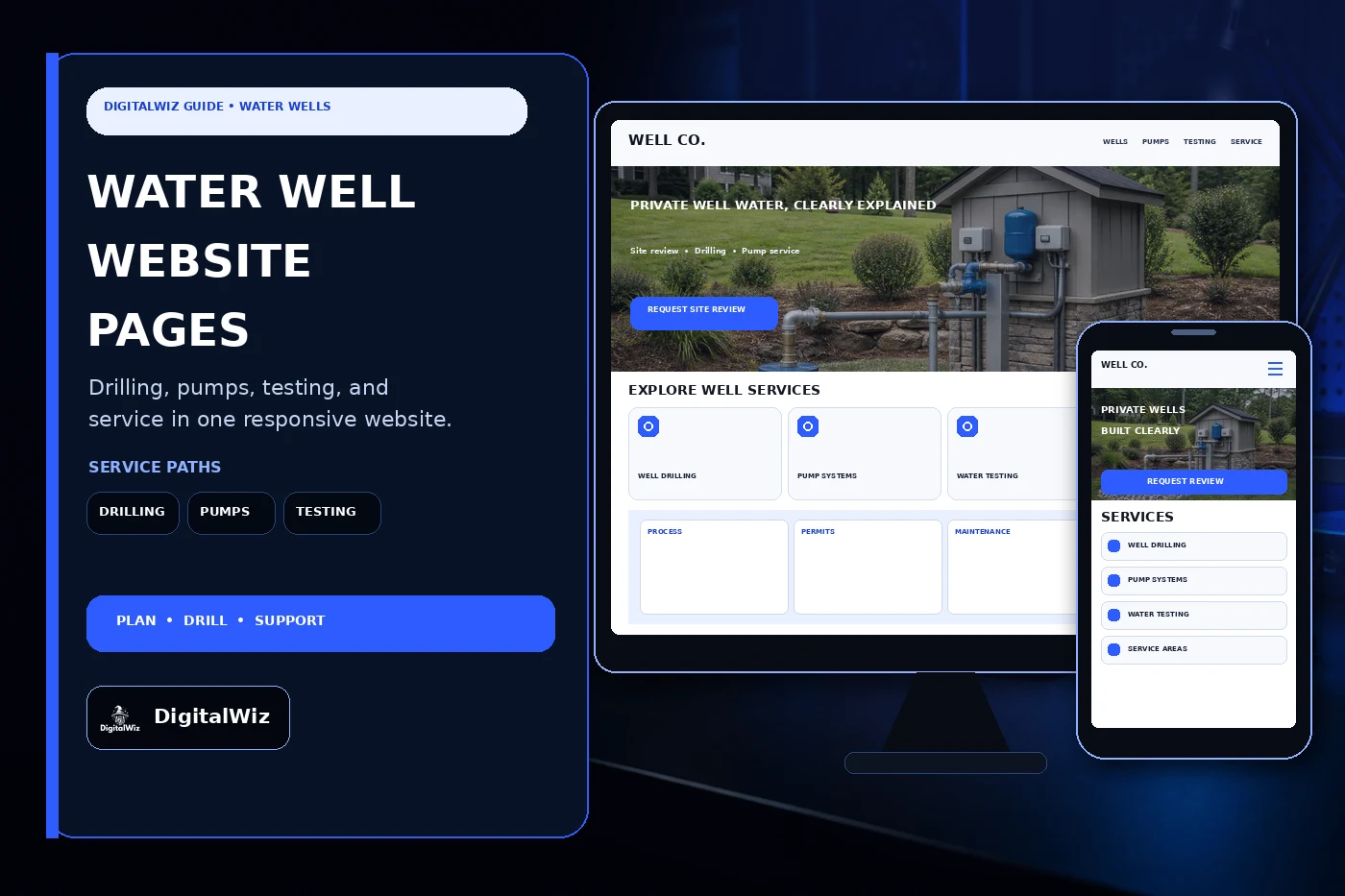
A water well drilling company website should separate new wells, pump systems, repairs, testing, maintenance, service areas, credentials, process, and estimate paths.
The direct answer
A water well drilling company website should have focused pages for new well drilling, pump installation and replacement, pump or pressure-system repair, well inspections, water testing coordination, maintenance, well rehabilitation, abandonment or sealing when offered, service areas, credentials, the work process, FAQs, and estimate requests. If the company also handles geothermal bores, irrigation wells, agricultural systems, commercial projects, storage, treatment, or constant-pressure systems, those need their own honest paths too.
Why split them up? Because a homeowner planning a new well has a different problem than someone who woke up with no water. A buyer with low pressure, cloudy water, a failed lab result, an older pump, or a property-transfer deadline should not have to decode one page called ‘Our Services’ to learn whether the company can help.
Start with the work the crew can actually perform, coordinate, permit, document, and support. Then connect each service to the right website, Search Visibility, and Paid Ads Management landing path. That keeps a search for emergency pump repair from landing on a page written only for new construction—and keeps a new-well prospect from expecting an instant repair visit.
- Build separate pages for new wells, pumps, repairs, inspections, testing, maintenance, and every specialty service the company truly offers.
- Explain the process, responsible parties, permits, site access, documentation, and limits without promising a specific depth, yield, schedule, or water quality.
- Publish real credentials, equipment policies, service boundaries, warranty roles, and emergency availability.
- Track leads through site review, qualification, estimate, scheduled work, completion, project value, territory, and lead quality.
Separate new-well, pump, repair, and specialty service pages
The new-well page should explain who the service is for, the property information needed before a visit, access requirements, the early site review, permit responsibility, drilling, casing and construction, well development, yield or flow evaluation, pump sizing, pressure-system setup, disinfection, sampling, documentation, and final handoff. Keep the language plain. Most property owners do not know which decisions happen before drilling and which depend on conditions found underground.
Pump work needs its own section. Separate new pump installation, pump replacement, pressure tanks, controls, constant-pressure equipment, drop pipe, wiring responsibility, storage, and related plumbing work according to the company's real scope. If an electrician, plumber, laboratory, treatment specialist, excavator, county office, or another contractor handles part of the job, say that before the estimate—not after the work starts.
Repair pages should be organized around symptoms without pretending a webpage can diagnose the cause. ‘No water,’ ‘low pressure,’ ‘short cycling,’ ‘air in the lines,’ ‘discolored water,’ and ‘unusual pump noise’ are useful entry points. Each page can explain safe first steps, what information to gather, what not to touch, how service is prioritized, and what the technician may inspect. Avoid copy that declares every low-pressure call a failed pump.
Specialty pages belong only where the service is real. Geothermal drilling, agricultural wells, irrigation, commercial systems, well deepening, rehabilitation, camera inspections, hydrofracturing, well cleaning, storage, treatment, and abandonment all involve different equipment, qualifications, site conditions, and customer expectations. One logo wall is not a substitute for a clear scope.
- New wells: property use, site review, access, permits, drilling, construction, development, pump setup, sampling, records, and handoff.
- Pumps and pressure systems: supported equipment, sizing process, controls, tanks, electrical or plumbing boundaries, commissioning, and warranty service.
- Repairs: symptoms, triage, inspection steps, emergency availability, diagnostic limits, parts policy, and next-step communication.
- Specialty work: geothermal, irrigation, agricultural, commercial, rehabilitation, storage, treatment, or abandonment only when actually offered.
Show the site review, permit, drilling, and handoff process
A strong process page starts before the rig arrives. Show the inquiry, service-area check, property and project review, available well records, site visit, utility and access discussion, applicable permit steps, proposal, scheduling, mobilization, drilling, construction, development, testing, pump and pressure-system work, disinfection, sampling, cleanup, records, and owner orientation. Label the stages that change by jurisdiction or property.
Be careful with timelines and underground conditions. A website can explain the factors that affect depth, production, access, placement, materials, equipment, weather, permit timing, restoration, and final cost. It should not turn a preliminary conversation into a guarantee. Geology does not read marketing copy. Neither does a permit office.
The page should also define site readiness. Explain width, height, weight, slope, turning, overhead, underground-utility, septic-system, landscaping, gate, surface-protection, water-management, spoil, and restoration considerations that may matter to the company's equipment and process. Ask customers to identify known private utilities and property constraints, but do not shift professional locating, permitting, or safety duties with vague fine print.
End the process with the handoff customers will receive: available construction records, equipment information, controls, maintenance guidance, water-sampling information, warranty documents, responsible contacts, and any follow-up work. A finished well is more than a hole and an invoice.
- Map the full path from the first property review through permits, mobilization, drilling, pump work, sampling, documentation, and support.
- Identify which company or agency owns each step and which decisions stay conditional until the site or subsurface is evaluated.
- Explain access and restoration requirements before scheduling heavy equipment.
- Separate estimates and target dates from approved permits, confirmed schedules, actual conditions, completed testing, and final records.
Explain water testing, maintenance, credentials, and proof carefully
Water-safety content needs a higher standard than ordinary service copy. The U.S. Environmental Protection Agency's private drinking water well guidance says private well owners are responsible for delivering safe drinking water to their households and provides resources on wells, groundwater, contaminants, and protecting a home’s water. A contractor website can point owners toward current public-health and laboratory guidance without presenting a visual inspection as a clean-water result.
Spell out the testing workflow. Who collects the sample? Which certified or qualified laboratory performs the analysis? Which panels are available? How are results delivered? Who can explain treatment options, and who cannot? Testing, inspection, disinfection, treatment, and a guarantee of safe water are not interchangeable claims. Date health-related guidance and link back to current official sources rather than copying a checklist forever.
Maintenance pages should explain what the company inspects and services: the visible well area, cap or seal, drainage around the well, pump performance, pressure equipment, controls, storage, accessible connections, records, and warning signs. Keep do-it-yourself advice conservative. A homeowner should not be encouraged to open electrical controls, enter confined spaces, pull pumps, or pour chemicals into a system based on a blog paragraph.
Credentials and proof deserve full pages, not tiny badges. Show the legal business name, applicable certifications or licenses, insurance context, service territory, years in business when verified, equipment types, subcontractor roles, and how customers can confirm credentials. Project examples should use permission-safe photos and describe the problem, property type, access, scope, equipment, coordination, and outcome without exposing addresses, test reports, account details, permit numbers, or private records. Never invent well depths, yields, reviews, ratings, customer totals, or performance claims.
- Keep testing, inspection, disinfection, treatment, and water-safety claims in separate lanes.
- Use current official guidance and identify the laboratory, sampling, reporting, and interpretation roles accurately.
- Publish verifiable credentials, insurance context, subcontractor responsibilities, service areas, and warranty contacts.
- Use real, permission-safe project proof with no fabricated depth, yield, purity, ratings, rankings, or customer results.
Give pricing context without pretending every property is the same
Water well work can vary with location, subsurface conditions, target use, depth, diameter, construction method, casing and materials, access, mobilization, permits, development, testing, pump capacity, controls, pressure equipment, electrical or plumbing scope, storage, treatment, cleanup, and restoration. A useful pricing page explains those moving parts. It does not publish one teaser number and hide everything else behind a form.
If the company shares ranges or examples, state the date, assumptions, included scope, excluded work, service area, access conditions, equipment, and change-order triggers. Explain how drilling charges, materials, mobilization, pump work, testing, permits, standby time, difficult access, additional trips, and restoration are handled in the proposal. Customers should know what can change before they compare bids.
The estimate page should tell people what helps: property address, intended water use, new construction or replacement, current symptoms, existing well records, known depth or equipment, recent lab reports, safe ground-level photos, access notes, preferred timing, and the best contact method. Sensitive documents should use a secure upload or another defined process—not an open email request with no explanation.
- Explain the site, drilling, material, equipment, permit, testing, access, cleanup, and restoration factors that affect cost.
- Date every range or example and publish its assumptions, inclusions, exclusions, and change conditions.
- Show customers what property, system, symptom, record, access, and timing details improve an estimate.
- Never market a preliminary range as a guaranteed final depth, yield, completion date, water result, or project price.
Build the service-area and estimate path for real jobs
A water well company should not rely on a footer list of towns. Build service-area pages around the places the crew genuinely reaches and the services available there. A repair radius may be smaller than the area for planned drilling. Some jurisdictions, terrain, equipment moves, or project types may need separate scheduling. Say so.
The form should route the job before it lands in a general inbox. New well, replacement well, no-water call, low pressure, pump replacement, inspection, testing, maintenance, treatment question, geothermal, commercial, agricultural, warranty, and out-of-area requests should not all receive the same automated reply. The confirmation message needs to explain the next review step and emergency limitations without promising dispatch, depth, parts, permits, test results, or completion dates.
Then track what happens after the form. Record source, campaign, landing page, location, project type, property use, urgency, access flag, existing system details, qualification, site visit, estimate, scheduled work, completed work, final value, lead quality, and the reason a job did not move forward. That is how a company learns whether a service page attracts viable drilling work or just broad traffic from outside its territory.
Finally, test the entire route on a phone. Tap-to-call should reach the right line. Forms should not demand technical answers a homeowner cannot know. Photo and record uploads need a safe fallback, and every request should have a visible handoff. Want to see where your water well website loses qualified calls? Run a free BizScore audit.
- Separate planned drilling territory, repair coverage, emergency availability, and specialty-project travel when they differ.
- Route new wells, pump work, no-water calls, testing, maintenance, specialty drilling, warranty, and out-of-area leads appropriately.
- Track source and landing page through qualification, site review, estimate, scheduled work, final value, and lead quality.
- Use the findings to improve service pages, paid campaigns, intake, scheduling, sales follow-up, and customer handoffs.