What Pages Should a Water Treatment Company Website Have?
A water treatment company website should separate testing, filtration, softeners, drinking-water systems, maintenance, service areas, process, proof, pricing context, and estimate paths.
The direct answer
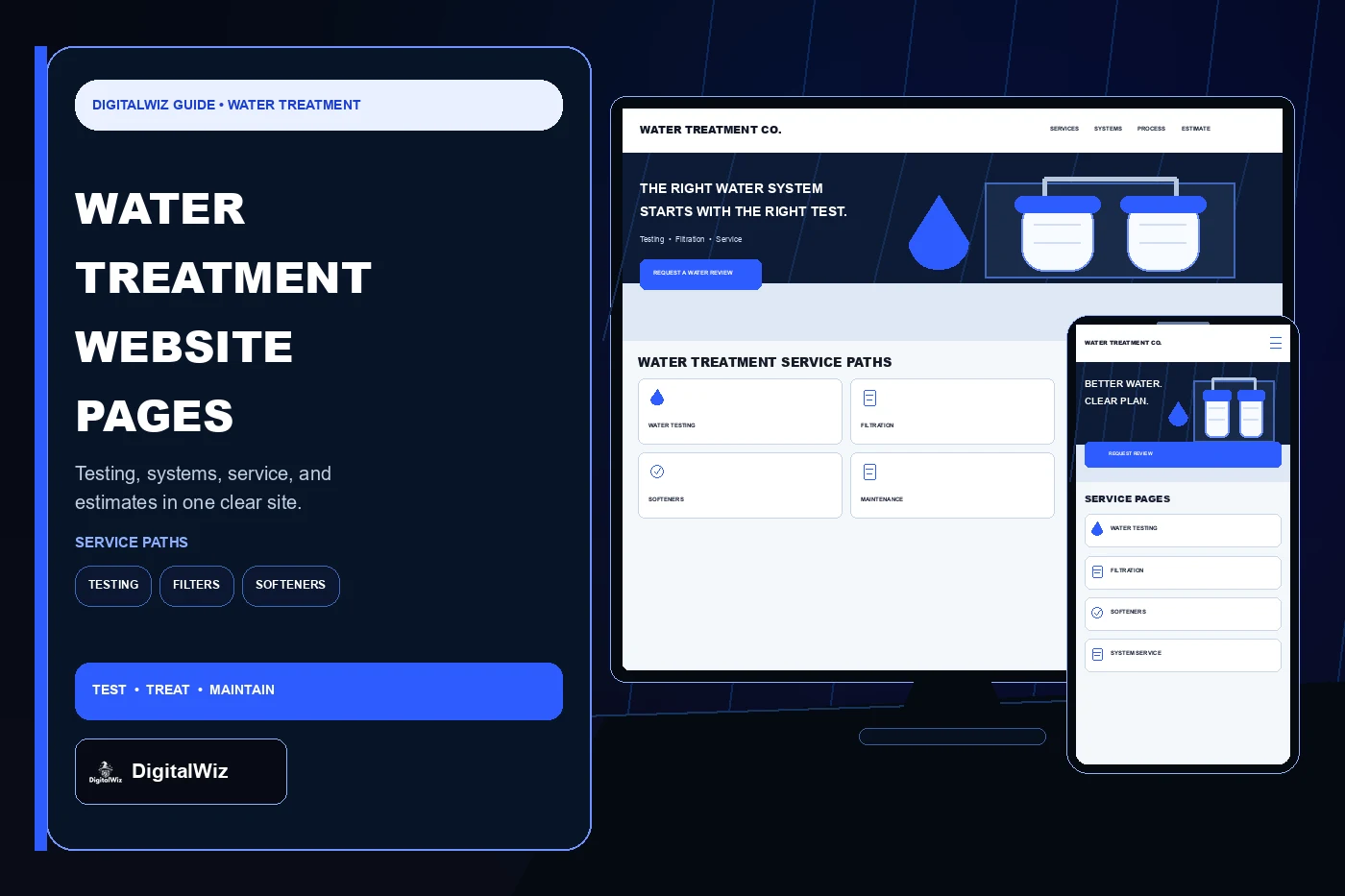
A water treatment company website should have focused pages for water testing, whole-home filtration, drinking-water systems, water softeners and conditioning, contaminant-specific treatment within the company’s real scope, system maintenance, filter replacement, service areas, the evaluation and installation process, product or certification information, project proof, pricing context, FAQs, and estimate requests. If the company serves private wells, public-water customers, commercial properties, builders, property managers, or existing-system owners through different workflows, give those visitors separate paths too.
Do not funnel every concern into one page that promises ‘pure water.’ Hardness, staining, taste, odor, sediment, scale, corrosion, an aging filter, a private-well concern, and a public-water question are not interchangeable. The website should help a customer explain the property and concern, then show what testing or review happens before equipment is recommended.
That structure also gives the website, Search Visibility, and Paid Ads Management useful destinations. A search about water softeners should reach a softener page. An ad about private-well filtration should not drop people onto a generic product carousel with no testing, service-area, or maintenance information.
Keep the promise honest. A website can explain common concerns, available treatment categories, the company’s evaluation process, and factors that shape the recommendation. It cannot identify an unknown contaminant, confirm health safety, select final equipment, guarantee a result, or give a binding installation price from a symptom and ZIP code alone.
- Separate testing, whole-home filtration, drinking-water systems, softeners, maintenance, process, service areas, proof, pricing, FAQs, and estimates.
- Create distinct well-water, public-water, residential, commercial, builder, and existing-customer paths only when the operation supports them.
- Explain what the website can help screen and what still requires a sample, laboratory result, plumbing review, site visit, or written scope.
- Track each lead from source and landing page through testing, appointment, recommendation, proposal, approval, installation, service, and lead quality.
Start with water source, testing, and the customer’s concern
Water testing deserves a real page, not a sentence under a contact form. Explain whether the company offers an in-home screening, collects samples, uses a certified laboratory, reviews customer-provided reports, or coordinates another qualified provider. Name the property and water sources it serves. Public-water customers and private-well owners may begin with different records, tests, responsibilities, and next steps.
Organize common concerns without diagnosing them online: hardness and scale, iron or manganese staining, sediment, chlorine taste or odor, sulfur-like odor, cloudiness, acidity or corrosion concerns, existing equipment that is not performing, and questions raised by a laboratory report. Similar symptoms can have different causes. The page should say that plainly instead of assigning a product to a color, smell, or social-media photo.
The EPA’s home drinking-water filtration fact sheet tells consumers to identify what is in their water and choose a filter that addresses the specific concern. That is a useful model for the website: start with the source and evidence, explain treatment choices in context, and avoid presenting one device as a universal answer.
Give urgent concerns a sensible route. A suspected sewage event, chemical spill, fuel odor, sudden change after flooding, official boil-water notice, illness concern, or damaged well should not sit in an ordinary estimate queue. Direct customers to the appropriate utility, health department, emergency authority, licensed well professional, laboratory, plumber, or medical guidance while keeping the company’s own role accurate.
- State who samples, what is screened on site, when a laboratory is used, how reports are delivered, and what the customer receives.
- Separate private-well and public-water starting points instead of treating every property as the same system.
- Use symptoms to route questions, not to diagnose contaminants or prescribe equipment online.
- Publish clear boundaries for emergencies, health questions, utility notices, plumbing failures, well problems, and work outside the company’s scope.
Build service pages around real systems and maintenance
Whole-home filtration needs its own page when it is a core service. Explain the broad categories the company installs—such as sediment filtration, activated-carbon treatment, backwashing filters, or other supported systems—along with the concerns each category may be evaluated for. Show where equipment typically sits, the space and plumbing access it needs, whether electricity or drainage may be involved, and what ongoing media or filter service looks like.
Water softeners and conditioners should have a separate route. Cover hardness testing, household demand, regeneration approach, salt or other consumables, bypass valves, drainage, electrical needs, installation space, maintenance, and what softened water does and does not address. Do not blur hardness treatment into a promise to remove every possible contaminant.
Give drinking-water systems their own page too. Under-sink filtration, reverse-osmosis systems, dedicated faucets, refrigerator connections, storage tanks, membrane or cartridge schedules, wastewater considerations, pressure, cabinet space, and plumbing modifications can all affect the fit. Explain the company’s supported configurations without turning the page into a risky do-it-yourself installation guide.
Maintenance is not an afterthought. Build clear pages for filter changes, sanitizing within the supported process, salt delivery when offered, annual or scheduled service, performance checks, repairs, replacement parts, warranty concerns, and existing systems installed by another company. Customers should know whether the team services only its own equipment, selected brands, or a wider range of systems before they book.
- Whole-home pages: treatment category, target concern, plumbing space, flow, pressure, drainage, power, maintenance, and scope boundaries.
- Softener pages: hardness review, sizing inputs, regeneration, consumables, bypass, drain, service, and limits.
- Drinking-water pages: system type, faucet, tank, pressure, cabinet space, connections, cartridge or membrane schedule, and service.
- Maintenance pages: supported systems, filter changes, consumables, checks, repairs, parts, warranties, and existing-customer booking.
Explain products, certifications, and the installation process
Product pages should help customers compare without drowning them in model numbers. Group systems by the job they are designed to do, then provide current manufacturer documents for the models the company actually sells. Useful details include rated capacity or flow under stated conditions, replacement intervals, operating requirements, dimensions, connection size, drain and electrical needs, certifications, warranty documents, and compatible consumables.
Certification language must be specific. A component, filter, complete system, or performance claim may be evaluated under a particular standard for particular substances or functions. Link to the current certification listing when available. Do not turn ‘uses certified components’ into ‘certified to remove everything,’ and do not reuse a badge from one model across an entire product family.
The process page should follow the real job: initial call, service-area check, water-source and concern review, existing test results, appointment, sampling or on-site screening, accessible plumbing and equipment review, recommendation, options, written proposal, scheduling, installation preparation, shutoff coordination, installation, startup, flushing or conditioning, customer walkthrough, follow-up testing when appropriate, documentation, and maintenance reminders.
Spell out trade boundaries. Existing plumbing condition, pressure, well pumps and tanks, water heaters, electrical outlets, drains, septic considerations, cabinetry, wall repair, permits, backflow requirements, commercial code, and laboratory work can change the scope. State what the water treatment crew handles, what needs another qualified trade, and what is confirmed only after the site review.
- Tie every capacity, flow, reduction, efficiency, certification, replacement, and warranty statement to the exact supported model and current documentation.
- Separate component certification, material safety, structural standards, and contaminant-reduction claims instead of using one broad badge.
- Map the full customer path from source and testing through options, proposal, installation, startup, documentation, follow-up, and service.
- Define plumbing, well, pump, pressure, drain, electrical, septic, cabinet, permit, laboratory, and other-trade responsibilities.
Use project proof, pricing, and warranties responsibly
Project pages work best as short case studies. Give the broad property and water-source context, the customer’s original concern, the tests or records reviewed, accessible conditions, selected system category, major equipment, installation constraints, work by other trades, startup steps, follow-up within scope, and ongoing maintenance plan. Show the actual plumbing and equipment neatly, not just a close-up of a glass of water.
Protect the customer while showing the work. Remove addresses, laboratory account details, well records, serial numbers, family photos, security information, paperwork, and anything else that identifies the property. Never invent test results, contaminant reductions, health outcomes, customer quotes, ratings, savings, flow rates, certifications, warranty terms, or before-and-after stories to make a template look complete.
Pricing pages can still be useful. Explain the factors that move the proposal: water source, test findings, treatment goal, household or building demand, flow and pressure, equipment size, plumbing material and location, bypass, drain, power, installation space, access, existing equipment removal, well or pump coordination, permits, startup, follow-up testing, consumables, travel, and maintenance. Publish package prices only when the included assumptions are clear and someone keeps them current.
Warranty pages should separate manufacturer equipment coverage from installation workmanship and any service-plan terms. State registration requirements, covered parts, labor, consumables, maintenance, water-condition limits, freeze or flood damage, plumbing outside the installed system, unauthorized changes, transfer rules, response process, and records the owner should keep. A warranty is not a blanket guarantee about every future water condition or household fixture.
- Caption real projects with source, concern, evidence reviewed, selected scope, equipment, constraints, startup, follow-up, and maintenance context.
- Never fabricate test results, removal claims, customers, reviews, ratings, savings, certifications, flow, health outcomes, warranties, or project totals.
- Explain testing, demand, plumbing, drainage, power, access, equipment, consumables, service, travel, and adjacent-trade cost drivers.
- Separate equipment, component, workmanship, labor, consumable, maintenance, transfer, exclusion, and service terms accurately.
Create local estimate paths and track qualified work
Service-area pages should reflect where the company can test, install, maintain equipment, source parts, and honor its warranty. Charlotte, Matthews, Mint Hill, Indian Trail, Monroe, Waxhaw, Concord, Huntersville, and nearby communities can involve different public-water providers, private wells, plumbing layouts, crawl spaces, basements, utility rooms, septic systems, travel, scheduling, and permit questions. Do not create fake local offices or clone one thin paragraph across every city.
The estimate form should collect enough context to route the request: name, phone, email, property address or ZIP code, residential or commercial use, public water or private well when known, the customer’s concern, existing test results, current equipment, number of occupants or broad demand context, installation location, desired timing, and safe optional photos of accessible equipment. Keep it short enough to finish on a phone.
Use different paths when the workflow changes. A new-system consultation, water test, filter replacement, softener service, drinking-water cartridge change, existing-system repair, warranty concern, builder request, commercial property, and urgent water-quality question should not all land in one undifferentiated inbox. Confirmation copy should say whether the request was received, is under review, or has a confirmed appointment.
Then measure what turns into the right work. Track source, campaign, landing page, location, water source, stated concern, requested service, appointment, test or review stage, recommendation, proposal, approval, installation, recurring service, value, loss reason, and lead quality when the operation supports it. DigitalWiz builds contractor websites, search visibility, and paid-ad systems around the way the business actually tests, installs, and services. Want a practical list of the page, local-search, estimate, and tracking gaps worth fixing first? Run a free BizScore audit.
- Build local pages around the real testing, installation, parts, service, travel, scheduling, and warranty territory.
- Ask for location, water source, concern, existing reports and equipment, demand context, timing, and safe photos without diagnosing online.
- Test tap-to-call, uploads, confirmations, CRM delivery, appointment routing, service requests, and mobile layout end to end.
- Track source and landing page through appointment, testing, recommendation, proposal, approval, installation, service, value, and lead quality.