What Pages Should a Solar Installation Company Website Have?
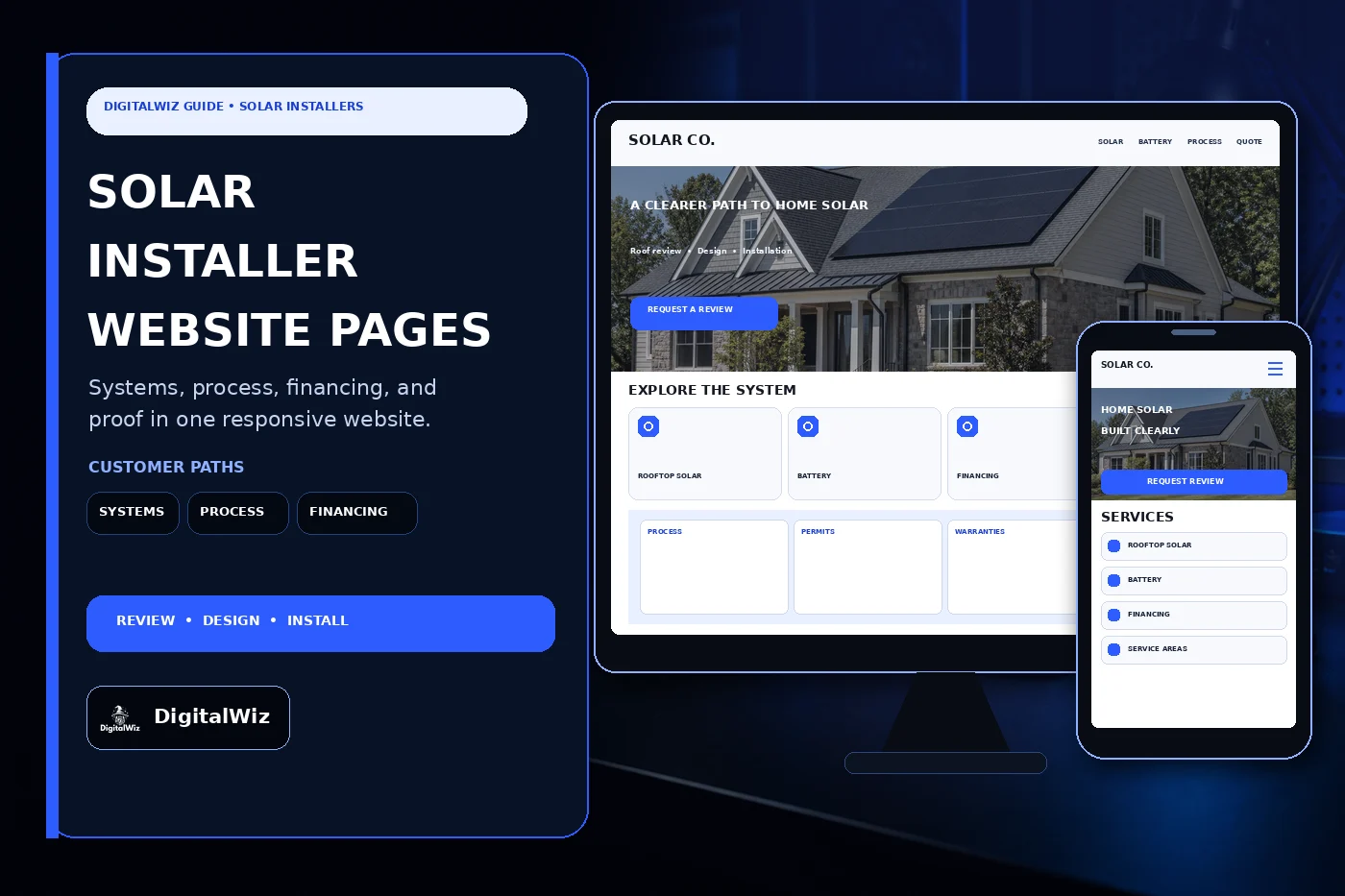
A solar installer website should separate rooftop solar, battery storage, financing, incentives, process, service areas, credentials, warranties, FAQs, and consultation paths.
The direct answer
A solar installation company website should have focused pages for rooftop solar, battery storage, commercial or specialty systems when offered, financing and ownership options, current incentives, the evaluation and installation process, service areas, credentials, equipment, warranties, maintenance, FAQs, and consultation requests. One broad solar page leaves homeowners guessing about roof fit, utility bills, system ownership, backup power, permits, timelines, and who handles the work.
Start with what the company can legally and reliably design, sell, install, commission, and support. A Charlotte-area residential installer needs a different website path than a firm handling commercial arrays, ground mounts, new construction, detached structures, batteries, generators, EV charging, roofing coordination, or long-term monitoring. Separate those paths whenever engineering, electrical scope, equipment, financing, permitting, interconnection, scheduling, warranties, or service responsibility changes.
Every page should help a buyer understand fit before asking for personal information. Explain the property and system type, the first review, which records help, what requires an on-site visit, how proposals are built, and what happens after a customer says yes. That gives the website, Search Visibility, and Paid Ads Management useful landing pages instead of sending every search or ad click to one vague homepage.
- Create a focused page for every residential, commercial, battery, service, and related electrical scope the company actually offers.
- Explain evaluation, design, proposal, permitting, interconnection, installation, inspection, commissioning, monitoring, and support.
- Publish current credentials, equipment policies, financing relationships, service areas, warranty roles, and project limits.
- Track calls and forms through qualified consultation, proposal, sold project, installation, system type, territory, value, and lead quality.
Separate rooftop solar, batteries, and specialty system paths
The rooftop solar page should do more than show panels on a sunny house. Explain the homes and roof types the company evaluates, the utility-bill information it needs, how shade and roof condition affect the review, where equipment may be located, and when structural, roofing, electrical, or utility questions require another professional. Make it clear that an online estimate is a starting point—not final system engineering.
Battery storage deserves its own page. Buyers may care about outage support, self-consumption, time-based rates, solar pairing, generator coordination, critical-load selection, or future expansion. Explain which use cases and equipment the company supports, how load review and placement work, what a battery can and cannot power, and which decisions depend on the home, utility, code, manufacturer, and final design. Avoid language that makes whole-home backup sound automatic.
Commercial, ground-mount, new-construction, EV-charging, service-upgrade, and roofing-coordination pages belong on the site only when those scopes are real. Spell out who performs each piece. A company that refers roof replacement, trenching, engineering, tree work, or electrical upgrades should say so. Customers should not discover after signing that an important part of the project belongs to a separate contract.
- Rooftop solar: property types, roof review, shade, electrical context, system design, equipment, monitoring, and support.
- Battery storage: supported use cases, load review, placement, capacity limits, controls, commissioning, and service.
- Commercial and ground mount: site information, engineering, access, utility coordination, procurement, schedule, and closeout.
- Related work: roofing, structural review, service upgrades, generators, EV charging, trenching, tree work, and responsible parties.
Show the evaluation, proposal, permit, and installation process
Solar buyers need a process page they can actually follow. Start with the inquiry and bill review, then show the remote screening, site assessment, roof and electrical review, preliminary design, equipment selection, proposal, contract, financing approval when applicable, permit work, utility interconnection steps, material scheduling, installation, inspection, permission to operate, activation, monitoring setup, and customer handoff. Label each stage accurately and explain which dates are estimates.
The U.S. Department of Energy's Homeowner’s Guide to Solar gives consumers a practical overview of solar options, bids, financing, and installation considerations. Its step-by-step consumer guide also walks through energy-efficiency checks, solar potential, bids, financing, installer selection, and agreements. A local installer can use that same plain-language structure while keeping its own process tied to the utilities, jurisdictions, equipment, and teams it actually works with.
Do not compress permits, inspections, and utility approval into a promise such as ‘installed next week.’ Project timing can change with design revisions, roof or electrical findings, financing documents, homeowner-association review, permit offices, inspections, equipment availability, weather, and the utility. The website should identify the company's role, the customer's responsibilities, and the point when a requested installation date becomes confirmed.
- Map every stage from bill review and site assessment through activation, monitoring, documentation, and support.
- Identify who owns design, engineering, permits, inspections, interconnection, financing, installation, and closeout.
- Separate preliminary layouts and estimates from approved designs, signed agreements, scheduled work, and permission to operate.
- Explain common dependencies without guaranteeing permit, utility, equipment, inspection, savings, or activation dates.
Explain equipment, credentials, warranties, and proof without shortcuts
Equipment pages should help buyers compare the system, not bury them in model numbers. Explain the categories the company installs—modules, inverters, optimizers, racking, batteries, monitoring, disconnects, and related electrical equipment—along with selection factors, compatibility, availability, and service responsibility. If a proposal may substitute an equivalent component, say how approval works. Keep product claims tied to current manufacturer documentation.
North Carolina companies should make electrical credentials easy to verify. The North Carolina State Board of Examiners of Electrical Contractors publishes licensing information and public resources. Show the legal business name, applicable license information, qualifier relationship, insurance context, and subcontractor roles accurately. A badge is not enough. Buyers should be able to tell which company holds the contract, which company performs the electrical work, and whom they call after installation.
Warranty pages need clear lanes. Separate equipment manufacturer warranties, workmanship coverage, roof-penetration terms, battery coverage, production or performance guarantees when truly offered, monitoring, labor for replacement work, shipping, transfer rules, exclusions, and the process for making a claim. Then use real project proof with permission. Show the general property context, system type, design constraints, installed equipment, approvals, and final handoff without exposing addresses, account numbers, bills, meter IDs, contracts, financing details, or monitoring credentials. Never invent reviews, savings, output, payback, customer totals, rankings, or project results.
- Describe supported equipment categories, compatibility, substitutions, monitoring, replacement responsibility, and service boundaries.
- Publish the legal business identity, license verification, insurance context, installer roles, and subcontractor relationships accurately.
- Separate manufacturer, workmanship, roof, battery, performance, monitoring, transfer, labor, and claim terms.
- Use permission-safe project proof with no invented production, savings, reviews, ratings, rankings, or customer results.
Give financing, incentives, and savings context without selling a fantasy
Solar cost depends on system size, roof layout and condition, shade, structural findings, electrical work, equipment, battery capacity, trenching, access, permits, utility requirements, financing, taxes, related repairs, and the work included in the contract. The website can explain those cost drivers without attaching one price to every home. Publish example pricing only when the assumptions, date, equipment, and exclusions are clear.
Ownership and financing pages should separate cash purchases, loans, leases, power-purchase agreements, and any other option the company actually offers. Identify the provider, ownership structure, payment terms, escalation terms when applicable, liens or security interests, transfer or sale-of-home process, maintenance responsibility, tax treatment, cancellation rules, and where the customer receives the controlling disclosures. Avoid calling every payment option ‘no-cost solar.’ Someone pays for the equipment and service, even when no upfront payment is required.
Incentives and utility programs change. Date every incentive page, link to current official sources, explain eligibility as something to verify, and avoid presenting a credit or rebate as guaranteed money in the customer's pocket. Savings estimates need the same discipline. State the utility-rate, usage, production, degradation, financing, ownership, export-credit, and escalation assumptions behind them. A proposal is easier to trust when a buyer can see what changes the result.
- Explain roof, electrical, equipment, battery, access, permit, utility, financing, and related-work cost drivers.
- Separate cash, loan, lease, power-purchase, and other options with ownership, payment, transfer, service, and disclosure details.
- Date incentive content, link to official sources, and make eligibility, tax treatment, and program availability subject to verification.
- Show the assumptions behind production, bill, savings, payback, and financing illustrations; never guarantee the outcome.
Make the consultation path useful on a phone, then track project quality
A solar consultation form should collect enough information to route the lead without demanding a full financial file. Ask for name, phone, email, service address, property type, homeowner or decision-maker status, utility provider, average bill range or safe optional bill upload, roof age and material if known, interest in solar, battery, EV charging, or related work, preferred timing, and a safe way to share ground-level photos. Mark unknown details as optional.
Route leads where the workflow changes. A standard residential roof, battery-only request, roof replacement, major shade concern, electrical upgrade, new build, detached structure, commercial property, ground mount, financing question, warranty call, existing-system service request, and out-of-area address should not all enter one inbox. Confirmation copy should explain the next review step without promising system size, savings, financing approval, equipment, installation timing, or eligibility.
Track the customer journey beyond the first form. Record source, campaign, landing page, property type, utility, requested system, battery interest, roof or electrical flag, territory, qualified status, consultation, proposal, financing path, sold project, installation, final value, cancellation, and lead quality when the sales process supports it. That shows whether service pages bring viable projects or paid traffic keeps producing unsupported properties and territories.
And test the whole thing on a real phone. Tap-to-call should reach the right team. Bill and photo uploads need a fallback. Consent language must match the actual follow-up, and every request needs a visible handoff. Want a practical review of your solar pages, search visibility, consultation flow, and lead tracking? Run a free BizScore audit.
- Ask for property, utility, bill context, roof details if known, requested system, location, timing, and safe optional files.
- Route residential, battery, roofing, electrical, commercial, ground-mount, service, warranty, and out-of-area inquiries appropriately.
- Track source and landing page through qualification, consultation, proposal, financing path, sold project, value, and lead quality.
- Use the findings to improve pages, ads, service areas, intake, design handoffs, sales follow-up, and support.