What Pages Should a Junk Removal Company Website Have?
A junk removal website should separate residential, commercial, cleanout, accepted-item, pricing, service-area, process, disposal, FAQ, and quote paths.
The direct answer
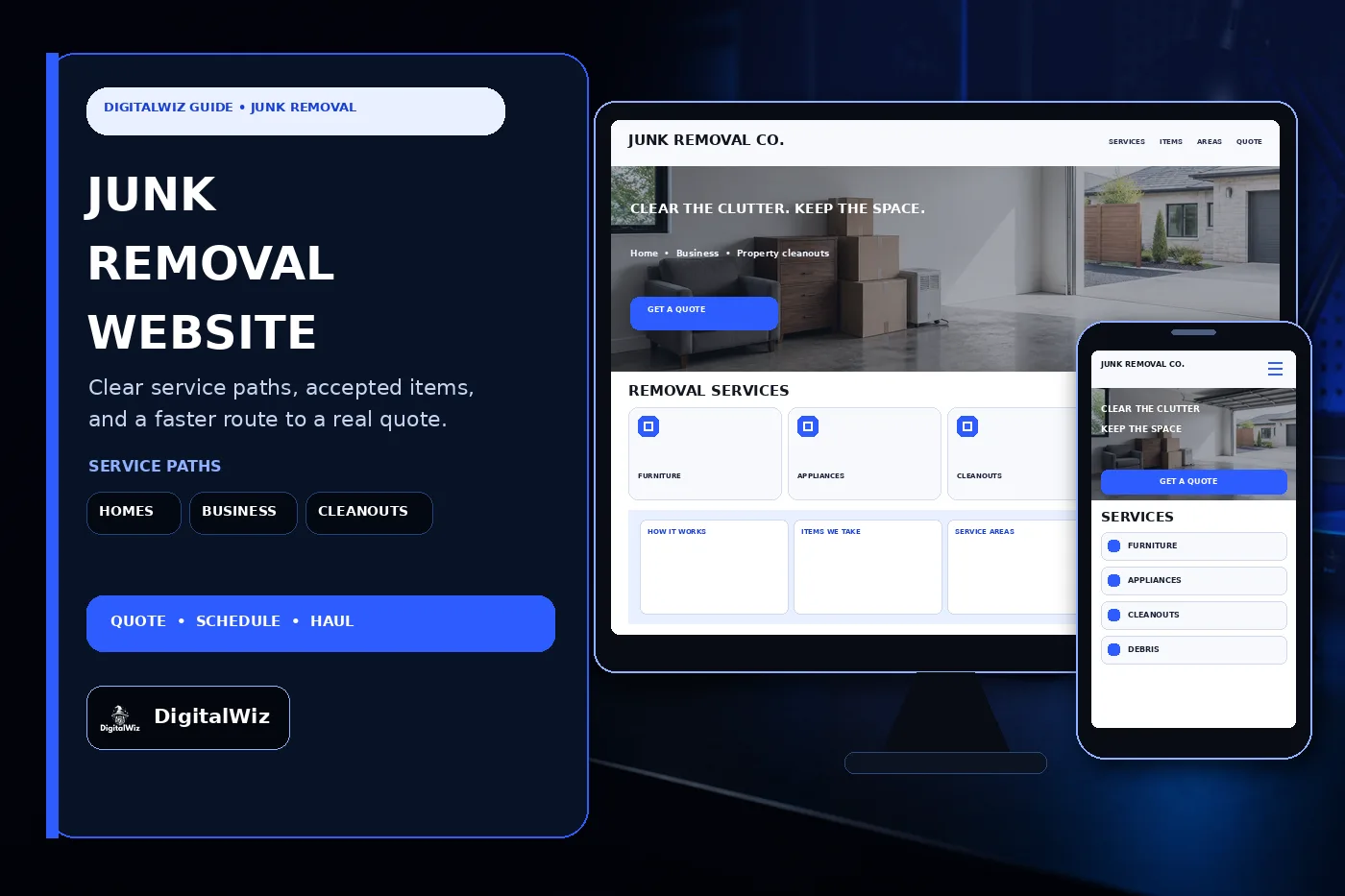
A junk removal company website should have focused pages for residential junk removal, commercial hauling, property and estate cleanouts, furniture and appliance removal, construction debris when accepted, service areas, items the crew takes and does not take, the quote process, pricing context, disposal practices, FAQs, and booking. One catch-all page forces every visitor to ask the same basic questions: Will you take this, can you reach me, what will it cost, and how soon can it happen?
Start with the jobs the company is insured, equipped, permitted, and willing to handle. A Charlotte-area crew collecting household furniture needs a different page than a business clearing office contents, a property manager turning over a unit, or a contractor hauling renovation debris. Separate those paths whenever truck capacity, labor, access, disposal location, scheduling, documentation, or prohibited materials change.
Each page should help a customer confirm fit before requesting a quote. Show the job type, common accepted items, preparation and access requirements, how estimates work, what can change the price, how scheduling is confirmed, and what happens to the material afterward. That gives the website, Search Visibility, and Paid Ads Management clear landing pages instead of sending every click to a vague homepage.
- Create a focused page for every meaningful removal, cleanout, hauling, and customer type the company actually serves.
- Publish a maintained accepted-items list, a prohibited-items list, and a clear route for uncertain materials.
- Explain estimating, access, labor, volume, scheduling, payment, disposal, and confirmation without making blanket promises.
- Track calls and forms through quoted job, scheduled pickup, completed work, service type, territory, value, and lead quality.
Separate residential, commercial, cleanout, and debris services
Residential removal deserves more than a photo of a truck and a phone number. Build pages around the work customers recognize: furniture, mattresses where accepted, appliances, electronics, garage clutter, yard debris, hot tubs or sheds only when the crew handles disassembly, and whole-home cleanouts. Say whether items must be disconnected, emptied, bagged, moved to the curb, or left in place for the crew.
Commercial and property-management work has different stakes. Offices, retail spaces, warehouses, apartment turns, storage units, foreclosures, and recurring pickups may involve loading docks, elevators, certificates of insurance, building hours, access contacts, invoicing, multiple decision-makers, or documented completion. Give that work its own page and inquiry path rather than asking a manager to use a homeowner form.
Estate, eviction, hoarding, and sensitive cleanouts need careful language. Explain what the company can do, what must be sorted or approved first, how photographs or item holds are handled, and when specialized remediation or hazardous-material providers are required. Construction debris should also be separate. List accepted materials, weight or volume limits, loading rules, container options if offered, and exclusions such as asbestos-containing materials, chemicals, fuel, pressurized cylinders, medical waste, or anything the crew is not authorized to transport.
- Residential pages: furniture, appliances, electronics, outdoor items, garage clutter, and household cleanouts.
- Commercial pages: offices, retail, property turns, storage spaces, recurring work, access, insurance, and invoicing.
- Cleanout pages: estate, move-out, foreclosure, storage, and sensitive-job approval or privacy steps.
- Debris pages: accepted materials, loading method, capacity, weight, prohibited waste, site access, and cleanup scope.
Make accepted items, exclusions, and disposal rules easy to find
The accepted-items page is often the most useful page on the site. Group items in plain language: furniture, appliances, electronics, household goods, exercise equipment, outdoor items, renovation debris, yard material, office contents, and specialty items. Then list the common exclusions beside them. Do not bury paint, chemicals, batteries, fuel, refrigerants, tires, medical waste, asbestos concerns, propane cylinders, or other restricted material inside a generic terms page.
Disposal options change by material and location, so keep claims specific. The U.S. Environmental Protection Agency advises consumers to consider donation or recycling for electronics and notes that requirements vary by location. A company website should say what it donates, recycles, transfers, or disposes of only when the workflow is real and documented. Avoid broad promises that every usable item will be donated or that a fixed share avoids the landfill unless the company measures and can support that claim.
North Carolina operators can point customers toward current state and local guidance when a material falls outside normal pickup. The North Carolina Department of Environmental Quality Solid Waste Section provides solid-waste program and facility information. The company should still verify the destination, facility rules, transport requirements, and local restrictions for each waste stream instead of turning a marketing page into legal advice.
- Group accepted items by household, commercial, outdoor, renovation, and specialty categories.
- Name common prohibited or conditional materials and give customers a safe next step for each category.
- Describe donation, recycling, transfer, and disposal practices accurately, without unsupported diversion claims.
- Review accepted-item and facility information whenever vendors, local rules, equipment, or service scope changes.
Explain pricing and estimates without bait-and-switch language
Junk removal pricing can depend on volume, weight, item type, labor, stairs, elevator or loading-dock access, disassembly, distance from the truck, parking, travel, disposal fees, minimum charges, same-day requests, and local facility rules. A single price attached to a staged pile rarely explains enough. Customers need to know whether the company prices by truck space, item, load, labor time, weight, or a combination.
The site can still make cost easier to understand. Publish exact item prices or honest ranges only when the assumptions stay stable. Otherwise, explain what photos and job details are needed for a preliminary estimate, when an on-site quote becomes final, what could change it, whether taxes or disposal fees are included, and whether the customer can decline before loading begins. If there is a minimum charge, say so before the appointment request.
Show a quote process that matches operations. A photo estimate may work for a visible group of household items but not for a packed attic, a multi-room estate, dense construction debris, or material hidden behind other contents. Confirmation copy should distinguish an estimate request, a scheduled assessment, and a booked removal window. Clear wording prevents the form from promising a final price or guaranteed pickup before a real person reviews the job.
- Explain whether price is based on item, volume, weight, labor, disposal cost, travel, or a combination.
- State minimum charges, included labor, common surcharges, payment timing, and cancellation terms.
- Tell customers when photos are enough and when an on-site review is required.
- Separate preliminary estimates from final quotes and requested times from confirmed appointments.
Build local trust with a real process and verifiable proof
A useful service-area page says more than a list of city names. Explain where the company regularly works, how travel affects scheduling or pricing, which jobs need extra lead time, and whether apartment, gated-community, uptown, rural, or commercial access changes the process. Charlotte, Matthews, Mint Hill, Indian Trail, Monroe, and nearby communities can have very different parking, drive-time, disposal, and building-access realities. Do not publish dozens of thin city pages that all make the same promise.
Then show the actual workflow: customer sends job details and photos, the office reviews fit and exclusions, the crew confirms a window, the customer approves the quote, material is loaded, the area receives the promised basic sweep-up when included, payment is collected, and disposal or donation documentation is provided when the service offers it. State who must be present, how access works, and what happens when the load contains unlisted or prohibited material.
Use permission-safe proof from real work. A project example can identify the job type, general property context, access challenge, material categories, crew scope, and completion process without exposing a customer's address, belongings, family circumstances, gate code, documents, license plates, or private photographs. Never invent reviews, ratings, load counts, savings, response times, landfill-diversion percentages, donation values, or before-and-after results. A neutral mock website is an illustration, not a client case study.
- Describe real coverage, travel, access, parking, building, and scheduling constraints for each service area.
- Show the request-to-review-to-quote-to-haul workflow exactly as the company performs it.
- Use authorized project photos and examples with personal property and location details protected.
- Avoid invented ratings, job counts, savings, response times, diversion percentages, and guarantees.
Make mobile quoting fast, then track which leads become jobs
A junk removal form should collect enough information to route the request without feeling like an inventory spreadsheet. Ask for name, phone, email, service address, customer or property type, item categories, approximate volume, stairs or elevator, parking or loading access, disassembly needs, preferred timing, and photos. Add a plain warning not to upload private documents, people, account information, or unsafe-material details that belong in a direct conversation.
Route leads where the work changes. A single couch, an appliance that needs disconnection, a full garage, a third-floor apartment, an estate, an office clearout, recurring property work, and heavy construction debris should not all enter the same undifferentiated queue. The confirmation should explain review time, follow-up questions, estimate status, appointment confirmation, and what the crew cannot collect.
Track more than the first call. Record source, campaign, landing page, job type, material category, territory, access, estimated load, quoted value, scheduled status, completed revenue, disposal cost, cancellation, and lead quality when the operation can support it. That shows whether local pages bring workable jobs, paid search attracts prohibited-material requests, or a high-volume campaign keeps sending loads the crew cannot carry profitably.
Test the whole path on a real phone. Tap-to-call must work, photo uploads need a fallback, the form should survive a weak connection, and every inquiry must reach the right dispatcher. Want a practical look at your service pages, local visibility, quote flow, and tracking gaps? Run a free BizScore audit.
- Ask for item, volume, access, location, timing, disassembly, and photo details without demanding perfect measurements.
- Route residential, commercial, cleanout, recurring, heavy, conditional, and out-of-area work appropriately.
- Track source and landing page through quote, schedule, completion, service mix, cost, value, and lead quality.
- Use the findings to improve pages, ads, exclusions, forms, service areas, estimating, and follow-up.