What Pages Should a Commercial Cleaning Company Website Have?
A commercial cleaning company website should separate recurring janitorial work, office cleaning, floor care, specialty services, industries served, service areas, proof, and quote requests.
The direct answer
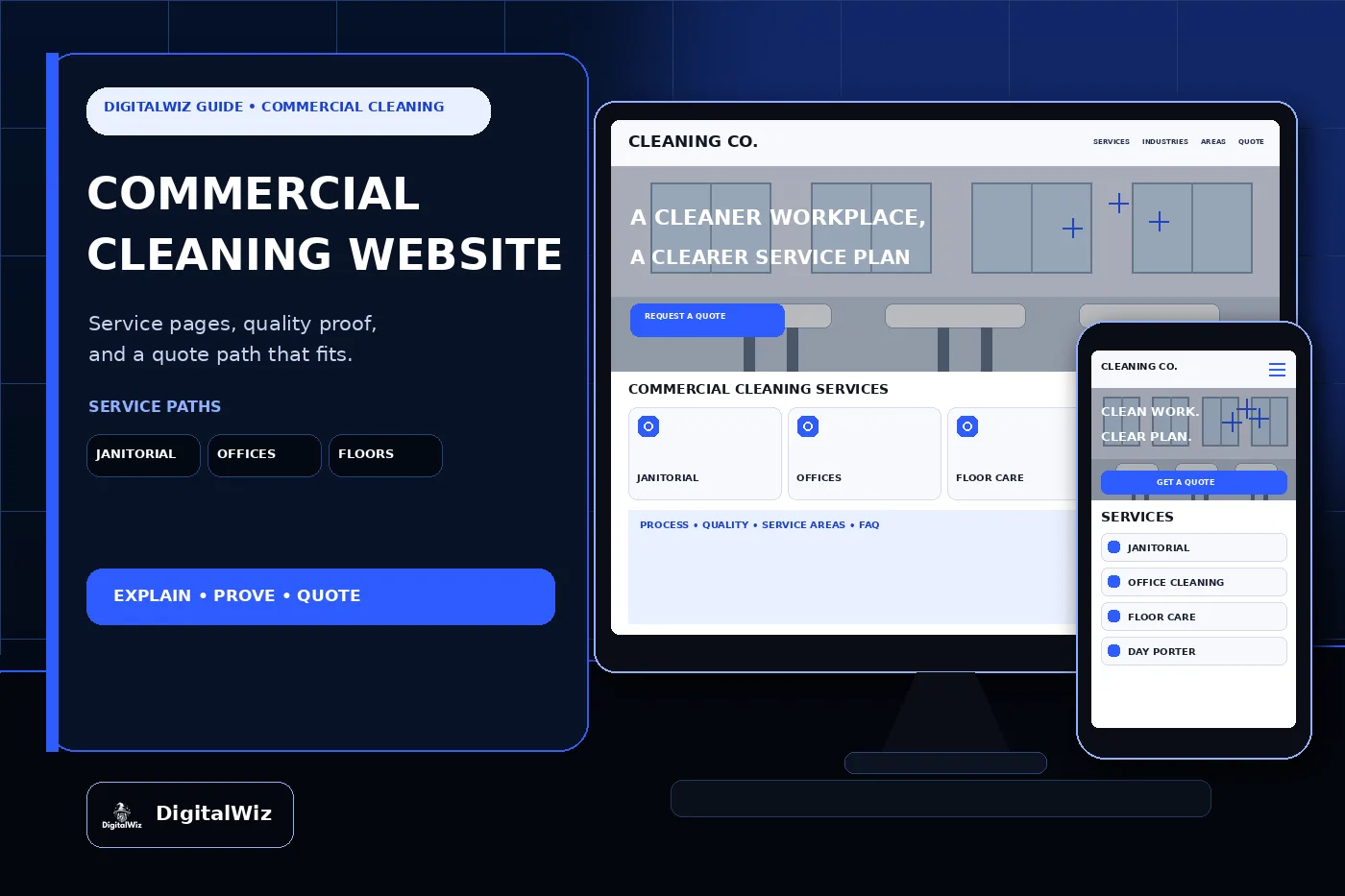
A commercial cleaning company website should have focused pages for recurring janitorial service, office cleaning, floor care, day porter work, deep cleaning, specialty services actually offered, industries served, service areas, the cleaning process, quality control, project proof, FAQs, and quote requests. One crowded services page makes a facility manager dig for basic answers: Do you work after hours? Can you handle this building type? Who checks the work? What happens when the scope changes?
Start with the work you want more of. A company built around recurring office contracts needs a different website path than one focused on post-construction cleanup, medical facilities, schools, industrial properties, or one-time floor projects. Separate those paths when staffing, training, scheduling, equipment, documentation, or estimating changes.
Then connect each page to a real next step. Your website should help a buyer confirm fit, understand the walkthrough and proposal process, and request a quote without writing a full cleaning specification from scratch. Those focused pages also give Search Visibility and Paid Ads Management useful destinations instead of sending every visitor to the homepage.
- Create a page for each meaningful service line, building type, and territory you can support consistently.
- Explain walkthroughs, scope creation, staffing, supplies, access, communication, quality checks, and issue resolution.
- Publish only accurate certifications, insurance details, green-product claims, client proof, and availability.
- Track calls and forms through walkthrough, qualified opportunity, proposal, contract, service type, and lead quality.
Separate recurring service from one-time and specialty work
Recurring janitorial work deserves its own page. Explain the building sizes and property types you serve, typical scheduling windows, how tasks are scoped, whether the client or cleaner provides consumables, how keys and access are handled, how absences are covered, and how requests reach the right supervisor. Avoid publishing a universal checklist if every contract is customized. Show a representative process and say where the final scope is documented.
One-time services should not hide inside that recurring page. Deep cleaning, turnover cleaning, post-construction cleanup, carpet cleaning, hard-floor care, window cleaning, pressure washing, disinfection, and event cleanup can require different crews, equipment, lead times, minimums, or site preparation. Give each important service a clear page only when the company really offers it and can explain the boundaries.
Be especially careful with technical or regulated language. Do not imply that ordinary cleaning is remediation, hazardous-material work, infection-control certification, or restoration unless the business has the training, authorization, equipment, and process to support that claim. When another qualified trade is needed, say so before a prospect books the wrong service.
- Recurring janitorial: schedule, scope, staffing, supplies, communication, supervision, and quality checks.
- One-time cleaning: preparation, exclusions, minimums, access, equipment, timing, and completion review.
- Floor and specialty work: surface or facility types, limitations, maintenance plan, and quote requirements.
- Urgent requests: actual response coverage and hours, without promising immediate availability everywhere.
Build industry pages around real operating differences
An industry page should explain more than “we clean offices.” A corporate office may care about evening access, conference rooms, kitchens, touchpoints, waste handling, and a consistent appearance before staff arrive. A retail property may need work around opening hours and customer traffic. A property manager may need service across several locations with one reporting process.
Medical, dental, school, childcare, food-service, industrial, laboratory, government, and controlled facilities can bring stricter requirements. Publish a page only when the company can state its actual training, product, documentation, background-check, safety, access, and compliance process accurately. A stock photo and a badge do not prove capability.
Keep the geography honest too. List the Charlotte-area cities, counties, or service zones where crews can reliably cover recurring accounts. If project minimums, travel charges, scheduling days, or specialty-service territories differ, say that. A useful location page describes the buildings and service model in that market; it is not the same paragraph copied under twenty town names.
- Describe the specific rooms, traffic patterns, access rules, reporting needs, and service windows for each market.
- Name the actual training, documentation, product, PPE, background, or supervisor requirements the team follows.
- Separate routine cleaning from regulated, hazardous, restorative, or specialty work outside the normal scope.
- Publish only territories the operation can staff and supervise consistently.
Show the walkthrough, proposal, and quality-control process
A serious buyer wants to know how the relationship starts. Explain the first call, property walkthrough, measurements or room inventory, current pain points, frequency discussion, task list, exclusions, supply plan, access plan, proposal, onboarding, and first service. If pricing cannot be accurate without a walkthrough, say that plainly and explain what information helps the estimator prepare.
Quality control needs its own proof. Describe how supervisors inspect work, how clients submit requests, what happens when an area is missed, how recurring issues are documented, and how scope changes are approved. Use the process the team can follow every week—not a polished dashboard concept that exists only on the website.
Project examples can help when they protect client privacy. A useful case summary can name the general property type, approximate scope, scheduling challenge, agreed service model, communication approach, and result without exposing security details or inventing performance data. Use real, permission-safe photographs. Never fabricate customer logos, testimonials, retention numbers, inspection scores, response times, or savings.
- Walkthrough: building type, square footage, occupied hours, rooms, surfaces, traffic, access, and current concerns.
- Proposal: task scope, frequency, schedule, supplies, exclusions, price assumptions, start plan, and change process.
- Quality control: supervisor checks, client communication, issue escalation, correction, and recurring review.
- Proof: permission-safe examples with useful context and no invented clients, ratings, savings, or outcomes.
Explain pricing factors, credentials, supplies, and insurance clearly
Commercial cleaning prices change with more than square footage. Building use, occupied hours, room count, restroom and breakroom volume, floor types, service frequency, task list, access, security, parking, supply responsibility, equipment, travel, staffing, supervision, seasonal needs, one-time setup, and specialty work can all affect the proposal. A cheap per-square-foot headline can create the wrong expectation when its assumptions are missing.
You can still give buyers useful context. Explain which details shape the quote, whether there is a minimum visit or contract size, what the walkthrough covers, which consumables are included, how extra work is approved, and when a one-time project is priced separately. Publish a starting range only when the conditions behind it are clear and kept current.
Credentials should be specific and verifiable. State the legal business name, insurance coverage available for review, applicable licenses, employee screening practices, safety training, product programs, and certifications accurately. Green-cleaning language needs the same care: identify the actual product standard or operating practice rather than calling every bottle “eco-friendly.” Do not display customer, association, or certification logos without current permission.
- Explain the largest building, schedule, task, access, staffing, supply, equipment, travel, and specialty cost drivers.
- State what is included, excluded, client-supplied, separately approved, or subject to a walkthrough.
- Keep insurance, screening, safety, certification, product, and environmental claims current and supportable.
- Make proposal terms, service changes, cancellations, and issue reporting easy to understand.
Make the quote form useful on a phone, then track lead quality
A quote form should collect enough information to route the opportunity without forcing a facility manager to build the entire scope on a phone. Ask for name, work email, phone, property address, building type, approximate size, requested service, desired frequency, occupied hours, preferred service window, current provider or startup status when useful, main concern, desired start date, and optional documents or photos that are safe to share.
Route the request based on how the sales process actually works. A recurring multi-site account, small office, post-construction cleanup, floor-care project, urgent spill, healthcare property, and out-of-area lead may need different follow-up. Confirmation copy should say when the office will respond and whether a walkthrough is required. It should not promise a start date, price, staffing level, or compliance outcome before review.
Finally, track more than total forms. Record source, campaign, landing page, building type, territory, service, frequency, estimated size, walkthrough booked, qualified opportunity, proposal, contract, project value, and lead quality when the process allows it. That shows whether office-cleaning pages attract recurring accounts, specialty ads bring one-time work, or broad traffic falls outside the team’s service area. Want a quick read on your own pages, proof, quote path, and tracking? Run a free BizScore audit or talk with DigitalWiz.
- Ask for property, service, size, frequency, access, timing, current concern, and safe optional files.
- Route recurring, one-time, specialty, multi-site, urgent, regulated, and out-of-area inquiries appropriately.
- Track source and landing page through walkthrough, qualification, proposal, contract, service type, and lead quality.
- Use those findings to improve pages, ads, forms, targeting, minimums, scheduling, and follow-up.