How Long Does Local SEO Take for a Charlotte Business?
Most Charlotte businesses should expect local SEO to create small cleanup wins first, then build stronger visibility and lead quality over several months as pages, reviews, GBP signals, and proof compound.
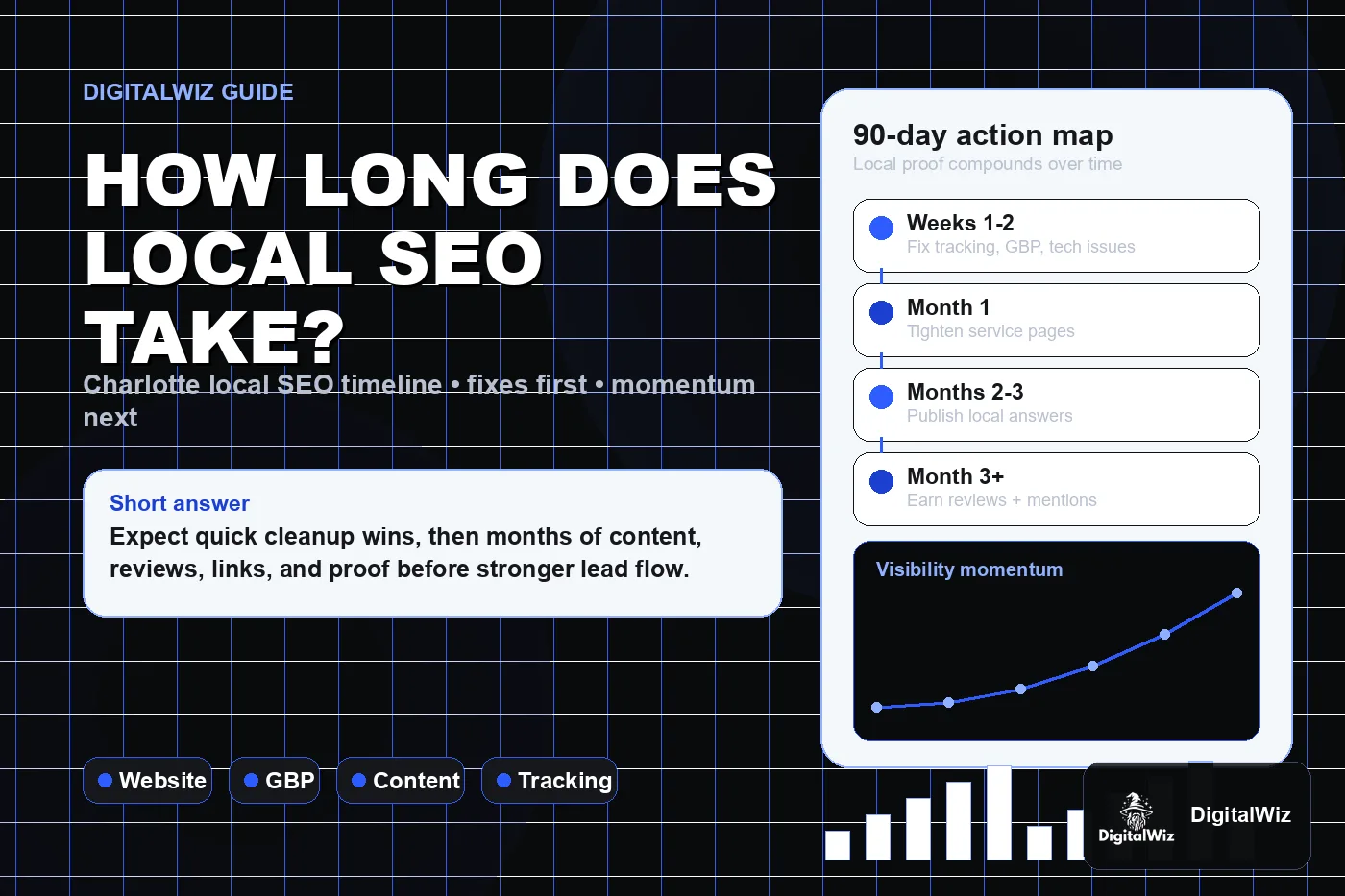
The direct answer
Local SEO usually does not turn on like a paid ad. A Charlotte business can see small wins quickly when obvious issues get fixed, but meaningful visibility and lead quality usually take months of steady work: better pages, cleaner Google Business Profile signals, reviews, local proof, helpful answers, and tracking.
If your site is already strong, the timeline can be shorter because you are improving a foundation that exists. If your website is thin, your service pages are vague, your reviews are inconsistent, or your tracking is missing, the first phase is cleanup before growth.
The practical answer: expect the first few weeks to reveal and fix the biggest blockers, the first 60 to 90 days to build momentum, and the following months to separate businesses that keep improving from businesses that publish once and disappear.
- Fastest wins: tracking fixes, title tags, broken pages, GBP cleanup, internal links, and conversion improvements.
- Slower wins: rankings for competitive services, map pack trust, content depth, reviews, local links, and AI-search visibility.
- Best signal to watch: qualified calls, forms, booked estimates, and consultation requests — not vanity traffic alone.
- Biggest mistake: stopping after one round of edits before Google and buyers have enough proof to trust the business.
Why local SEO takes time
Google has to crawl the site, process changes, compare your pages against competitors, and connect your website with your broader local footprint. That footprint includes your Google Business Profile, reviews, citations, location signals, service-area clarity, and the usefulness of your content.
Google's own local ranking guidance centers on relevance, distance, and prominence. You cannot control distance for every searcher, but you can improve relevance and prominence by making your services, locations, proof, reviews, photos, and business details easier to understand.
For Charlotte and nearby markets like Matthews, Indian Trail, Waxhaw, Huntersville, Concord, Monroe, and Rock Hill, competition also matters. A niche service with weak competitors may move faster than roofing, HVAC, legal, dental, med spa, or other crowded categories.
What should happen in the first 30 days
The first month should be about finding leaks and fixing the foundation. Before publishing a pile of blog posts, make sure your revenue pages are clear. Your homepage, service pages, contact path, tracking, and Google Business Profile should all tell the same story.
This is where many businesses get quick non-ranking wins. A better call button, cleaner service page, fixed form, faster mobile page, improved internal links, or clearer offer can turn existing visitors into more leads while SEO work compounds in the background.
DigitalWiz usually looks at the website foundation, Search Visibility signals, Google Business Profile basics, analytics, call tracking, and lead path before recommending more content.
- Confirm service names, service areas, phone number, forms, and CTAs are accurate.
- Fix obvious technical issues: broken links, indexing problems, duplicate or missing titles, slow mobile pages, and weak internal links.
- Tighten core service pages before chasing low-intent blog traffic.
- Set up tracking so calls, forms, and booked appointments can be tied back to channels.
What should happen in months two and three
Months two and three are where the work starts to look like a system. You are not just changing tags. You are building pages that answer real buyer questions, improving service-area clarity, earning reviews, adding proof, and making the site easier to cite in search results and AI answers.
A Charlotte contractor may need stronger pages for roof repair, remodeling, or concrete work. A med spa may need treatment pages with careful claims and clear booking paths. A dentist or law firm may need service pages that answer high-intent questions without sounding generic.
If you also run paid ads, this phase matters even more. Ads can create faster traffic, but SEO and landing-page improvements often raise the quality of the entire lead system.
- Create or improve service pages around real buyer intent, not broad slogans.
- Build selective city or service-area pages only where you have useful local proof.
- Publish answer-style content that supports sales conversations and internal links back to service pages.
- Ask for reviews consistently and make sure the website reflects the same services customers mention.
How to know if SEO is working before rankings jump
Rankings are useful, but they are not the only early signal. Before a page jumps to the top, you may see better impressions, more branded searches, more calls from Google Business Profile, stronger engagement on service pages, cleaner crawl data, and more qualified form fills.
This is why tracking matters. A business can get more traffic and fewer leads if the wrong pages rank. Another business can get modest traffic but better booked jobs because the page matches buyer intent and the CTA is obvious.
Watch the full path: search visibility, page quality, calls, forms, booked estimates, sales conversations, and close rate. Local SEO is a lead system, not just a ranking report.
What slows local SEO down
The biggest delays are usually self-inflicted: weak service pages, no local proof, inconsistent business details, poor mobile experience, no review process, generic AI content, missing tracking, and changing the strategy every two weeks.
Another common problem is trying to rank everywhere before you are strong anywhere. A Charlotte business serving the whole metro may eventually need content for several nearby markets, but the first priority is proving the core services and highest-value locations clearly.
Local SEO also slows down when the website says one thing, the Google Business Profile says another, and paid ads send traffic to a third version of the offer. The system has to be consistent.
- Thin pages with no examples, FAQs, reviews, photos, or clear next step.
- Duplicate city pages that only swap the location name.
- No process for reviews, photos, case studies, or local mentions.
- Analytics that show traffic but not calls, forms, booked jobs, or real lead quality.
The bottom line
Local SEO for a Charlotte business should be treated like compounding work. Fix the foundation first, build the pages buyers actually need, keep your Google Business Profile and reviews active, publish useful local answers, and measure whether visibility turns into leads.
If you need leads immediately, pair SEO with a focused landing page and paid search. If you want durable visibility, keep improving the website, content, reviews, and local proof after the first 90 days. The businesses that win are usually the ones that stay consistent after the first cleanup round.
Want to know what is slowing your local SEO down? Run a free BizScore audit or contact DigitalWiz. We will show you the first fixes across your website, search visibility, paid ads, and tracking.