Should I Use AI Content on My Business Website?
AI can help Charlotte businesses draft faster, but thin AI copy will not build trust or leads. Here is the safe way to use it on service pages, blogs, and FAQs.
The short answer
Yes, you can use AI content on your business website, but do not publish it raw. Use AI to speed up outlines, FAQs, drafts, and content refreshes. Then add real expertise, local context, accurate service details, proof, and a clear next step before it goes live.
For a Charlotte contractor, med spa, dentist, law firm, restaurant, or home service business, the risk is not that Google automatically hates AI. The risk is publishing generic copy that sounds like every competitor and gives buyers no reason to call you.
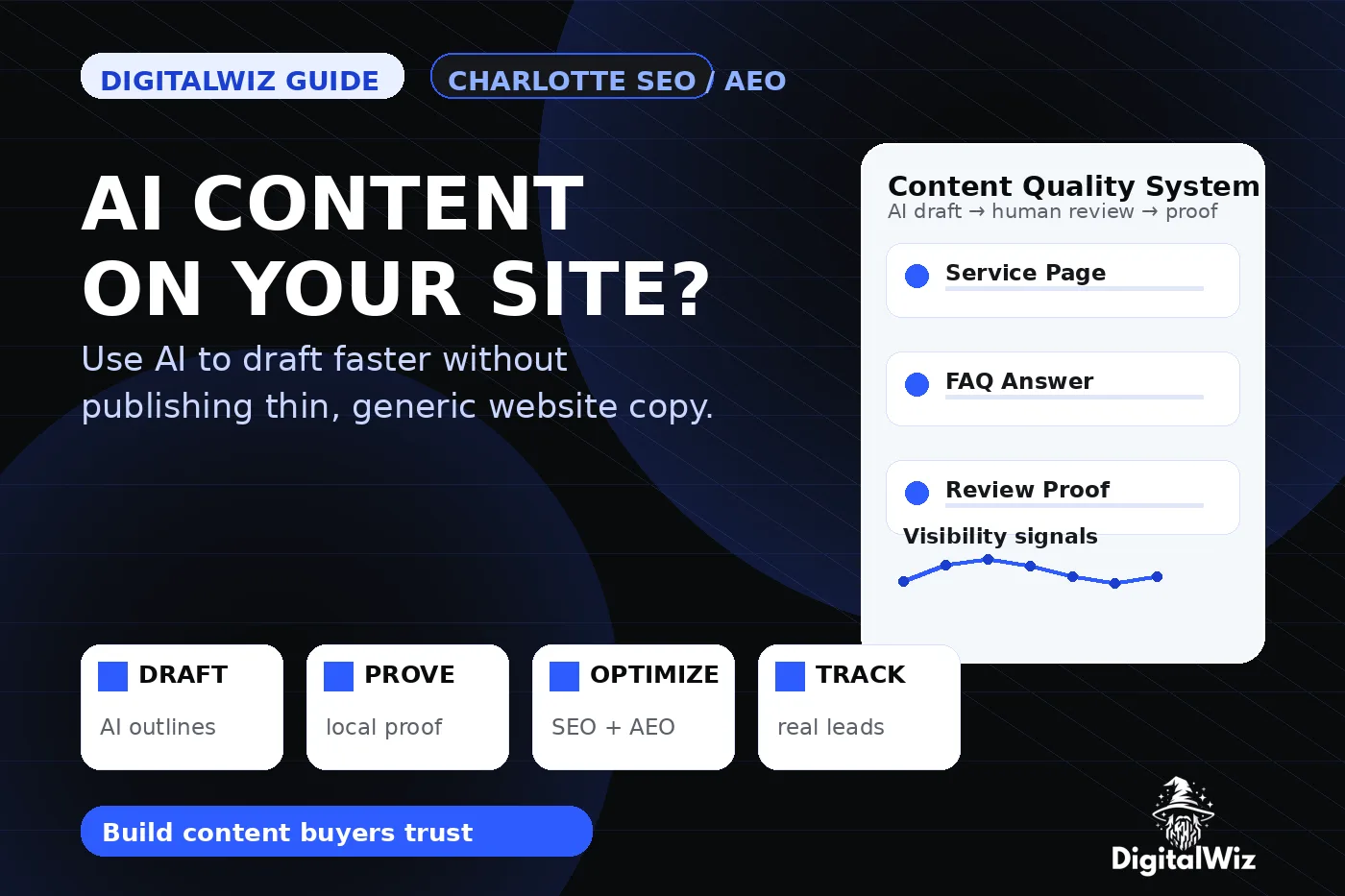
The best use of AI is as a production assistant. The final page still needs to sound like your business, answer real buyer questions, match your service area, and support your website, Search Visibility, and lead tracking goals.
- Use AI for first drafts, outlines, FAQs, repurposing, and research prompts.
- Do not use AI to invent pricing, testimonials, case studies, certifications, or results.
- Add local proof, photos, process details, reviews, and service-area context.
- Review every page for accuracy, usefulness, conversion, and brand voice before publishing.
What Google actually wants from content
Google's Search Central guidance focuses on helpful, reliable, people-first content. It also warns against content made mainly to attract search visits instead of helping people. That is the line to watch with AI.
If AI helps you explain a real service clearly, answer common questions, and make the page easier for customers to use, it can be part of a healthy workflow. If it creates a pile of thin posts, doorway pages, fake expertise, or copied-sounding service pages, it creates SEO and trust problems.
A simple test: would you proudly send this page to a serious prospect before a sales call? If not, it is not ready for search either.
Where AI content works well
AI is useful when the human strategy is already clear. It can turn customer questions into a draft FAQ, summarize call notes into service-page bullets, create blog outlines, rewrite dense paragraphs, or help compare different landing-page angles.
For local businesses, the strongest AI-assisted content usually starts from real inputs: services you actually sell, cities you actually serve, objections your customers actually raise, photos from real projects, reviews from real customers, and tracking data from real leads.
That is how you avoid bland content. The AI can help organize the answer, but your business supplies the truth.
- FAQ sections based on sales calls and form questions.
- First drafts for service pages that a human expert rewrites.
- Blog outlines for PAA-style questions like cost, timing, process, and comparisons.
- Short summaries for Google Business Profile posts, email, and social snippets.
- Content refreshes that improve structure, internal links, and readability.
Where AI content can hurt you
AI becomes a problem when it replaces thinking. Generic pages like “best plumber in Charlotte” with no proof, no service details, no real examples, and no conversion path do not help buyers choose you. They just add noise.
It is also risky to let AI write about regulated, medical, legal, financial, safety, or technical topics without expert review. A wrong claim can create trust problems, compliance problems, or bad customer expectations.
Do not publish anything that invents facts. No fake reviews. No fake project numbers. No made-up pricing. No imaginary awards. No claims that DigitalWiz, Google, ChatGPT, or anyone else can guarantee rankings or leads.
- Thin city pages with only the location swapped.
- Service pages that never mention your real process, proof, or service area.
- Blog posts written only because a keyword tool showed volume.
- Unreviewed medical, legal, financial, or safety advice.
- Content that promises rankings, AI citations, or lead volume you cannot guarantee.
A safe AI content workflow for local businesses
Start with the buyer question, not the tool. Decide what the page should help someone do: choose a service, understand price factors, compare options, request a quote, book an appointment, or trust your company enough to call.
Then gather your source material before asking AI to draft: service details, locations, photos, reviews, common objections, process steps, and tracking notes. The draft should be built around your business, not around generic internet filler.
Before publishing, have someone who knows the service review every claim. Then add internal links, a clear CTA, schema where appropriate, and conversion tracking so you can see whether the page produces calls, forms, or booked appointments.
- Pick one buyer question and one page goal.
- Feed AI real source notes instead of asking for a generic article.
- Edit for accuracy, local detail, brand voice, and plain language.
- Add proof: reviews, examples, photos, credentials, FAQs, and process details.
- Link to the right service page and track the resulting leads.
How this connects to SEO, GEO, and AEO
Search is shifting from ten blue links to answers, maps, snippets, and AI summaries. That makes clarity more important, not less. AI systems need source material they can understand and cross-check.
A strong AI-assisted content program should make your business easier to identify: who you help, what you do, where you work, what proof supports you, and what action a buyer should take next. That helps classic SEO, local SEO, answer-engine optimization, and conversion.
This is why DigitalWiz treats content as part of a system. Your website structure, Google Business Profile, reviews, service pages, paid-ad landing pages, and analytics should all tell the same story.
The bottom line
Use AI content if it makes your website more useful, more accurate, and easier to maintain. Do not use it as a shortcut for expertise, proof, or strategy.
For Charlotte and NC service businesses, the winning formula is simple: AI-assisted production plus human judgment, local proof, strong service pages, clear calls to action, and tracking that shows what turns into real leads.
Want to know whether your site has useful content or just filler? Run a free BizScore audit or contact DigitalWiz. We will show you where your website, search visibility, and lead-generation system need the most attention.