Does My Local Business Website Need Schema Markup?
Schema markup will not magically rank a weak website, but it can help Google and AI systems understand your services, location, FAQs, reviews, and contact details more clearly.
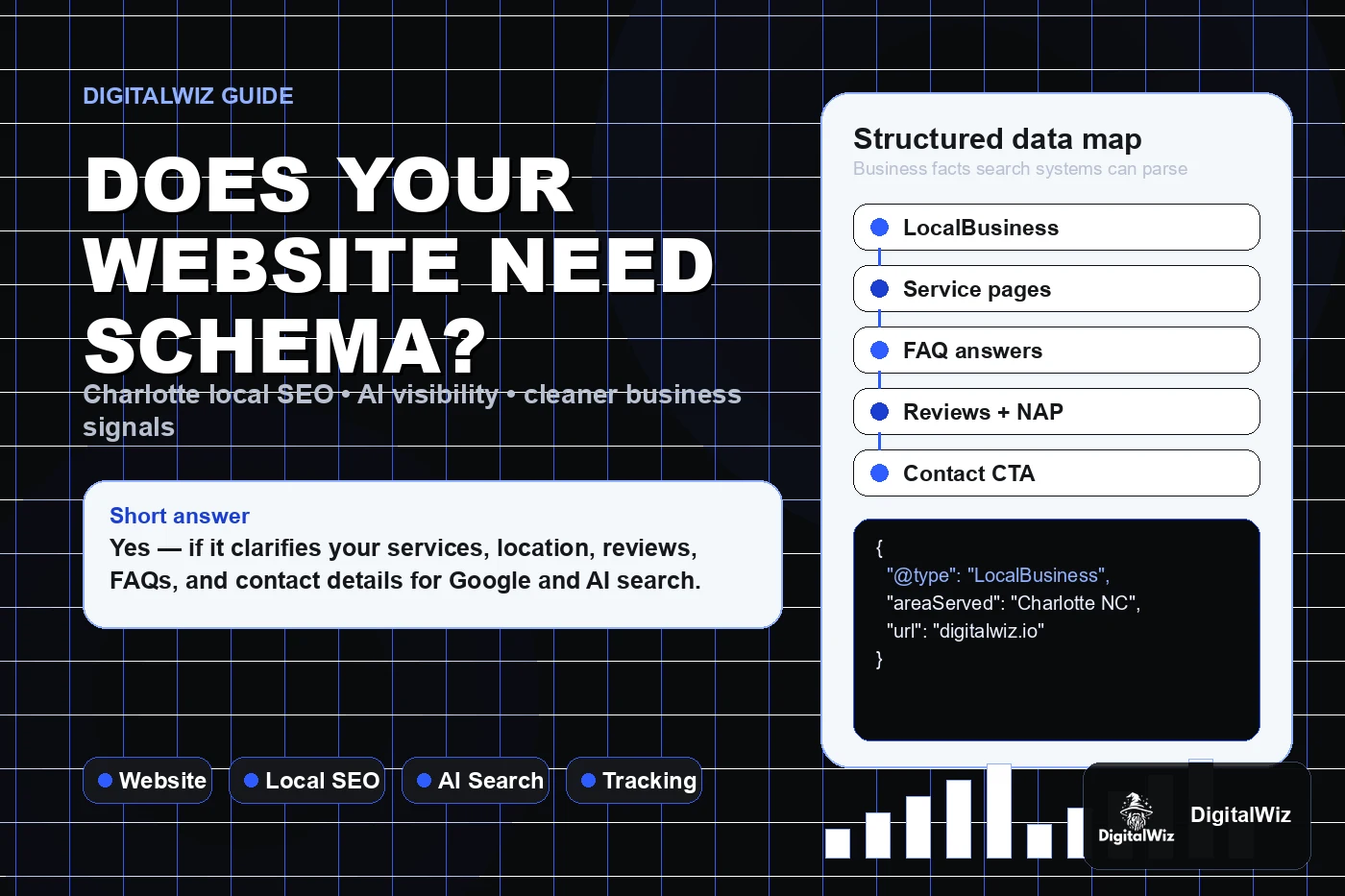
The direct answer
Yes, most local service business websites should use schema markup, but only after the page itself is clear. Schema is structured data that helps search systems understand facts on your site: business name, services, service area, phone number, reviews, FAQs, articles, breadcrumbs, and contact details.
For a Charlotte contractor, med spa, dentist, law firm, restaurant, or home service company, schema is not a magic ranking button. It is a clarity layer. If your website already explains what you do, where you work, why people trust you, and how to contact you, schema can reinforce that information for Google and newer AI search tools.
If the page is vague, thin, or inconsistent, schema will not save it. Fix the website, service pages, local proof, and Search Visibility foundation first, then use structured data to make the facts easier to parse.
- Use schema to clarify real business facts, not invent them.
- Start with Organization or LocalBusiness, Website, Breadcrumb, Article, Service, and FAQ markup where appropriate.
- Keep schema consistent with the visible page, Google Business Profile, citations, and contact page.
- Test markup with Google's Rich Results Test and fix critical errors before publishing.
- Measure leads and visibility, not schema installation alone.
What schema markup actually does
Schema markup is code added to a page, usually as JSON-LD, that labels important information in a machine-readable format. Google Search Central describes structured data as a standardized way to provide information about a page and classify its content.
That means you can tell search systems, in a cleaner format, that this page is an article, a service page, a local business, a breadcrumb trail, an FAQ, or a product/service offer. Search engines still read the visible page, but structured data reduces ambiguity.
Think of it like putting labels on organized files. The labels do not create the documents. They help systems understand what each document is about.
Where schema helps a local business
Local businesses usually need schema in the places where buyers and search systems need the same facts repeated clearly. Your homepage can identify the organization. Your service pages can describe the work. Your blog posts can be marked as articles. Your FAQs can support direct answers. Your breadcrumb markup can clarify site structure.
For Charlotte and NC businesses, schema can reinforce service-area language without creating fake locations. It can also connect your website story to the same facts shown on your Google Business Profile, local citations, social profiles, and contact page.
This matters more as search results blend maps, organic pages, rich results, and AI-generated summaries. The easier your business is to understand and verify, the better your chance of being represented accurately.
- Homepage: Organization, LocalBusiness, Website, logo, contact details, and sameAs profiles.
- Service pages: service name, description, area served, and relevant FAQs.
- Blog posts: Article markup with headline, date, author, image, and canonical URL.
- Navigation: BreadcrumbList markup so page hierarchy is clear.
- FAQs: use FAQ markup only for real questions and answers visible on the page.
What schema will not fix
Schema does not replace good content. If the page has a vague headline, no proof, no service details, and no strong CTA, structured data just wraps a weak page in cleaner code. It also does not guarantee rich results, rankings, AI citations, map pack placement, or lead volume.
Bad schema can create trust problems. Do not mark up reviews that are not visible on the page. Do not add services you do not offer. Do not claim a city you do not actually serve. Do not use FAQ markup for keyword-stuffed answers hidden from users.
The rule is simple: if a customer cannot see or verify the claim on the page, be careful about putting it in structured data.
- Do not use schema to fake reviews, locations, prices, awards, or availability.
- Do not add every possible schema type just because a plugin offers it.
- Do not let schema conflict with your page copy, GBP profile, phone number, or service-area language.
- Do not treat a clean validation report as proof that the page will convert.
A practical schema checklist for Charlotte service businesses
Start with the pages closest to revenue. Your homepage, core service pages, contact page, and top blog answers deserve clean structured data before random low-value posts. Keep the markup boring, accurate, and consistent.
For a contractor, that might mean clear LocalBusiness details, service pages for roofing or remodeling, FAQs about estimates and service area, and article schema for buyer guides. For a med spa or dentist, review regulated claims carefully and avoid unsupported medical promises. For restaurants, make hours, menu links, address, and phone details match everywhere.
If you run paid ads, schema still matters because landing pages and organic pages should tell the same story. It is one more way to keep the whole lead system consistent.
- Confirm business name, phone, URL, logo, and service area are correct.
- Add Article schema to blog posts with the correct publish date and hero image.
- Add BreadcrumbList schema so users and crawlers understand the path.
- Use FAQ markup only for visible, helpful FAQ sections.
- Run Google's Rich Results Test and fix critical issues before deploy.
- Recheck schema after redesigns, URL changes, service changes, or phone number updates.
How schema supports AI search and answer engines
AI search systems look for clear entities, relationships, and evidence. Structured data can help describe those entities in a standard format: the business, the service, the article, the author, the location, the organization, and the page hierarchy.
That does not mean schema alone will make ChatGPT, Gemini, Perplexity, or Google AI features cite your business. It means your site gives search systems cleaner signals to work with. Those signals are stronger when they match visible page copy, reviews, GBP details, citations, and real-world proof.
DigitalWiz treats schema as part of a broader SEO, GEO, and AEO system: better pages, consistent facts, useful answers, local proof, and tracking that shows whether visibility turns into real leads.
The bottom line
Your local business website probably should have schema markup, especially if you rely on Google, Maps, AI search, service pages, and blog answers to bring in leads. Use it to clarify real facts, not to cover up weak content.
Start with the pages that buyers actually visit. Make the copy useful, the offer clear, the proof visible, and the CTA easy. Then add structured data that accurately labels the business, services, articles, breadcrumbs, and FAQs.
Want to know whether your site has schema gaps, content gaps, or conversion leaks? Run a free BizScore audit or contact DigitalWiz. We will show you what to fix first across your website, search visibility, paid ads, and tracking.