How Do I Choose Local SEO Keywords for My Service Business?
Start with the services that make money, match them to the cities you actually serve, then separate buyer-intent searches from research questions. The best local SEO keywords point to pages, offers, tracking, and real leads.
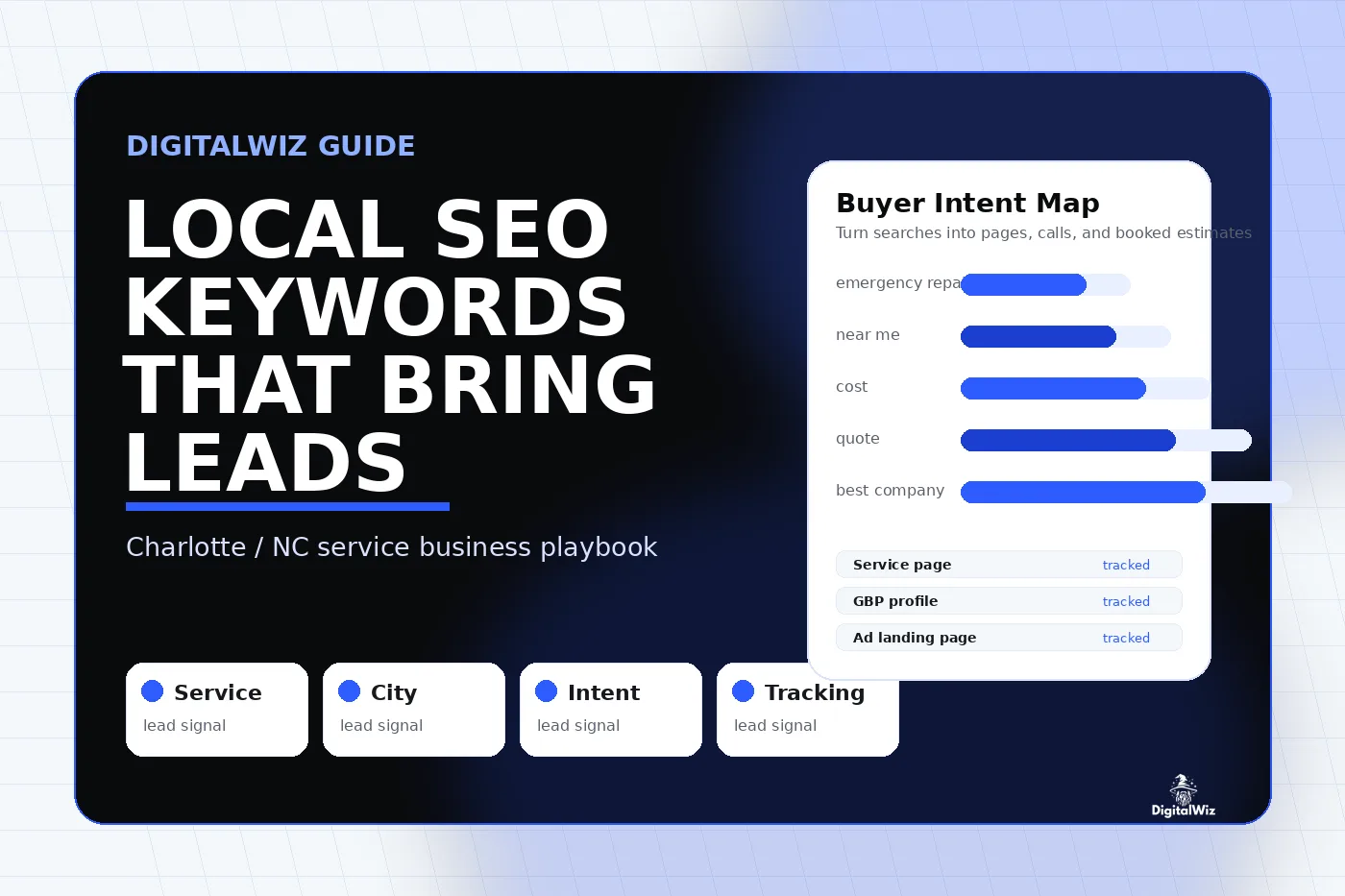
The direct answer
Choose local SEO keywords by starting with the services that create revenue, the cities and neighborhoods you actually serve, and the words buyers use when they are close to calling. Do not start with the biggest search volume. Start with intent.
For a Charlotte or NC service business, the best keywords usually combine a service, a problem, a location, and a next step. Think “roof repair Charlotte,” “emergency plumber Matthews,” “Botox consultation near me,” “family dentist Indian Trail,” or “Google Ads management Charlotte.” Those searches tell you what page needs to exist and what the visitor expects to see.
The goal is not to build a giant keyword spreadsheet. The goal is to turn search demand into clear service pages, useful local content, better Google Business Profile signals, paid-ad landing pages when needed, and tracking that shows which searches produce real leads.
- List your highest-value services first.
- Add real cities, neighborhoods, and service areas — not random place names.
- Group keywords by buyer intent: urgent, comparison, price, proof, and education.
- Map each keyword group to one useful page or section.
- Track calls, forms, and booked estimates so you know what actually worked.
1. Start with services, not search tools
Keyword tools can be useful, but they can also distract small businesses into chasing phrases that do not pay. Before opening a tool, write down the services you most want more of. A contractor might prioritize roof replacement, storm damage repair, gutters, or siding. A med spa might prioritize injectables, laser treatments, memberships, or consultations.
Each priority service deserves its own keyword set and, usually, its own page. If one page tries to rank for every service, it becomes vague. If the page is specific, the visitor can quickly confirm: yes, this business handles my problem, in my area, with a clear next step.
This is why DigitalWiz separates Website Development, Search Visibility, and Paid Ads Management instead of hiding everything under one generic “digital solutions” page. Specific pages are easier for people, Google, and AI search systems to understand.
- Revenue service: the work you want more of.
- Support service: useful, but not the main growth target.
- Emergency service: high urgency and often better for ads plus SEO.
- Education topic: helpful content that supports a buyer before they call.
2. Add locations only where they are real
Local SEO keywords need local context, but that does not mean copying the same page across twenty cities. If you serve Charlotte, Matthews, Indian Trail, Waxhaw, Huntersville, Concord, or Rock Hill, say so clearly. Then back it up with service details, project examples, directions, photos, reviews, or local FAQs where you have something useful to add.
Thin city pages usually disappoint buyers because they say nothing specific. A strong location page explains the service, the area, the problems common in that market, proof that you serve it, and how to contact you. If you cannot make the page useful, mention the city naturally on a broader service-area page instead.
Your website, Google Business Profile, citations, and ads should tell the same service-area story. Mixed signals create confusion for buyers and messy data for search systems.
- Use city modifiers for real service areas.
- Use neighborhood language when buyers actually search that way.
- Avoid doorway-style pages with swapped city names and duplicate copy.
- Connect location pages to matching service pages when it helps the visitor.
3. Separate buyer intent from research intent
Not every keyword should be judged the same way. “Emergency AC repair near me” is a high-intent search. “How does an HVAC system work?” may bring traffic, but it is much earlier in the decision. Both can have value, but they need different pages, CTAs, and expectations.
For local service businesses, buyer-intent keywords deserve the strongest pages: clear headline, service area, proof, reviews, FAQs, phone number, quote form, and tracking. Research keywords can support SEO and AI visibility with helpful answers, internal links, and softer next steps.
If your traffic is growing but leads are flat, intent is one of the first things to inspect. You may be ranking for questions that educate people but do not match a ready-to-buy moment.
- Urgent: emergency, same-day, repair, near me, open now.
- Commercial: best, company, service, contractor, agency, clinic, consultation.
- Price: cost, quote, estimate, pricing, financing.
- Proof: reviews, before and after, examples, case studies.
- Education: how, what is, should I, checklist, mistakes.
4. Map keywords to pages before writing anything
A keyword list is not a strategy until every important group has a home. One group might belong on a service page. Another might belong on a city page. Another might become an FAQ section, blog post, paid-ad landing page, or Google Business Profile post.
This mapping step prevents keyword cannibalization and bloated content. You do not need five pages competing for the same phrase. You need one strong page that answers the buyer better than a generic competitor page.
When DigitalWiz builds Search Visibility systems, we look at the full path: search query, page, offer, proof, CTA, tracking, and follow-up. The keyword is just the starting signal.
- Service + city keyword: usually a service or location page.
- Problem keyword: service page section or helpful blog post.
- Cost keyword: pricing section, FAQ, or dedicated guide.
- Comparison keyword: blog guide or decision page.
- Ad keyword: focused landing page if the click is expensive or urgent.
5. Use paid search data to sharpen SEO
If you are running Google Ads, the search terms report can show what people actually typed before clicking. That data is useful for SEO, landing pages, FAQs, and negative keywords. It can also expose waste fast: broad searches, wrong locations, DIY intent, job seekers, or low-quality leads.
Do not blindly turn every paid search term into an SEO page. First ask whether the term brought a real opportunity. If a phrase gets clicks but no qualified calls or forms, the issue may be intent, page fit, offer clarity, or follow-up.
This is where Paid Ads Management and SEO should talk to each other. Ads give faster feedback. SEO turns the winning patterns into assets that can compound.
- Keep terms that create qualified calls, forms, appointments, or estimates.
- Add negative keywords for searches that waste spend.
- Build SEO content around repeated buyer questions.
- Improve landing pages when good terms produce weak conversion.
6. Measure keywords by leads, not rankings alone
Ranking reports can be useful, but they are not the scoreboard. The better question is: which pages and queries create qualified calls, forms, bookings, estimates, and sales conversations? A keyword that ranks lower but sends ready buyers can be more valuable than a broad keyword with prettier traffic numbers.
Set up call tracking, form events, UTM tags, and a simple lead-quality review. Then look at what each page actually contributes. If a page brings visitors but no leads, tighten the intent, proof, CTA, mobile layout, or tracking before assuming you need more content.
You can also run a free BizScore audit to see where your website, search visibility, paid ads, and tracking have gaps before building more pages.
- Qualified calls and forms by landing page.
- Booked appointments or estimates by channel.
- Lead quality notes from the sales team.
- Queries that triggered ads or organic visits.
- Pages that assist conversions through internal links.
The bottom line
Good local SEO keywords are not just phrases. They are clues about what your buyer wants, where they are searching, how urgent the problem is, and what page they need next.
Start with profitable services. Add real locations. Sort by intent. Map each group to a useful page or section. Then measure what turns into calls, forms, bookings, and estimates. That is how local SEO becomes a lead system instead of a content chore.
Need help choosing the right keywords and pages for your business? Contact DigitalWiz or run a free BizScore audit. We will show you what to fix first across your website, SEO, ads, and tracking.